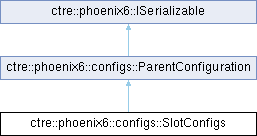
Gains for the specified slot. More...
#include <ctre/phoenix6/configs/SlotConfigs.hpp>
Public Member Functions | |
| constexpr | SlotConfigs ()=default |
| constexpr SlotConfigs & | WithKP (wpi::units::scalar_t newKP) |
| Modifies this configuration's kP parameter and returns itself for method-chaining and easier to use config API. | |
| constexpr SlotConfigs & | WithKI (wpi::units::scalar_t newKI) |
| Modifies this configuration's kI parameter and returns itself for method-chaining and easier to use config API. | |
| constexpr SlotConfigs & | WithKD (wpi::units::scalar_t newKD) |
| Modifies this configuration's kD parameter and returns itself for method-chaining and easier to use config API. | |
| constexpr SlotConfigs & | WithKS (wpi::units::scalar_t newKS) |
| Modifies this configuration's kS parameter and returns itself for method-chaining and easier to use config API. | |
| constexpr SlotConfigs & | WithKV (wpi::units::scalar_t newKV) |
| Modifies this configuration's kV parameter and returns itself for method-chaining and easier to use config API. | |
| constexpr SlotConfigs & | WithKA (wpi::units::scalar_t newKA) |
| Modifies this configuration's kA parameter and returns itself for method-chaining and easier to use config API. | |
| constexpr SlotConfigs & | WithKG (wpi::units::scalar_t newKG) |
| Modifies this configuration's kG parameter and returns itself for method-chaining and easier to use config API. | |
| constexpr SlotConfigs & | WithGravityType (signals::GravityTypeValue newGravityType) |
| Modifies this configuration's GravityType parameter and returns itself for method-chaining and easier to use config API. | |
| constexpr SlotConfigs & | WithStaticFeedforwardSign (signals::StaticFeedforwardSignValue newStaticFeedforwardSign) |
| Modifies this configuration's StaticFeedforwardSign parameter and returns itself for method-chaining and easier to use config API. | |
| constexpr SlotConfigs & | WithGravityArmPositionOffset (wpi::units::turn_t newGravityArmPositionOffset) |
| Modifies this configuration's GravityArmPositionOffset parameter and returns itself for method-chaining and easier to use config API. | |
| constexpr SlotConfigs & | WithGainSchedBehavior (signals::GainSchedBehaviorValue newGainSchedBehavior) |
| Modifies this configuration's GainSchedBehavior parameter and returns itself for method-chaining and easier to use config API. | |
| std::string | ToString () const override |
| std::string | Serialize () const final |
| Serialize this configuration into a string. | |
| ctre::phoenix::StatusCode | Deserialize (std::string const &to_deserialize) final |
| Deserialize this configuration from a string. | |
Static Public Member Functions | |
| static SlotConfigs | From (Slot0Configs const &value) |
| Converts the provided value to an instance of this type. | |
| static SlotConfigs | From (Slot1Configs const &value) |
| Converts the provided value to an instance of this type. | |
| static SlotConfigs | From (Slot2Configs const &value) |
| Converts the provided value to an instance of this type. | |
Public Attributes | |
| wpi::units::scalar_t | kP = 0 |
| Proportional gain. | |
| wpi::units::scalar_t | kI = 0 |
| Integral gain. | |
| wpi::units::scalar_t | kD = 0 |
| Derivative gain. | |
| wpi::units::scalar_t | kS = 0 |
| Static feedforward gain. | |
| wpi::units::scalar_t | kV = 0 |
| Velocity feedforward gain. | |
| wpi::units::scalar_t | kA = 0 |
| Acceleration feedforward gain. | |
| wpi::units::scalar_t | kG = 0 |
| Gravity feedforward/feedback gain. | |
| signals::GravityTypeValue | GravityType = signals::GravityTypeValue::Elevator_Static |
| Gravity feedforward/feedback type. | |
| signals::StaticFeedforwardSignValue | StaticFeedforwardSign = signals::StaticFeedforwardSignValue::UseVelocitySign |
| Static feedforward sign during position closed loop. | |
| wpi::units::turn_t | GravityArmPositionOffset = 0_tr |
| Gravity feedback position offset when using the Arm/Cosine gravity type. | |
| signals::GainSchedBehaviorValue | GainSchedBehavior = signals::GainSchedBehaviorValue::Inactive |
| The behavior of the gain scheduler on this slot. | |
| int | SlotNumber = 0 |
| Chooses which slot these configs are for. | |
Detailed Description
Gains for the specified slot.
If this slot is selected, these gains are used in closed loop control requests.
Constructor & Destructor Documentation
◆ SlotConfigs()
|
constexprdefault |
Member Function Documentation
◆ Deserialize()
|
finalvirtual |
Deserialize this configuration from a string.
- Parameters
-
string The serialized configuration
- Returns
- Status code of the deserialization
Implements ctre::phoenix6::configs::ParentConfiguration.
◆ From() [1/3]
|
static |
Converts the provided value to an instance of this type.
- Parameters
-
value The value to convert
- Returns
- Converted value
◆ From() [2/3]
|
static |
Converts the provided value to an instance of this type.
- Parameters
-
value The value to convert
- Returns
- Converted value
◆ From() [3/3]
|
static |
Converts the provided value to an instance of this type.
- Parameters
-
value The value to convert
- Returns
- Converted value
◆ Serialize()
|
finalvirtual |
Serialize this configuration into a string.
- Returns
- Serialized configuration
Implements ctre::phoenix6::configs::ParentConfiguration.
◆ ToString()
|
overridevirtual |
Implements ctre::phoenix6::configs::ParentConfiguration.
◆ WithGainSchedBehavior()
|
inlineconstexpr |
Modifies this configuration's GainSchedBehavior parameter and returns itself for method-chaining and easier to use config API.
The behavior of the gain scheduler on this slot. This specifies which gains to use while within the configured GainSchedErrorThreshold. The default is to continue using the specified slot.
Gain scheduling will not take effect when running velocity closed-loop controls.
- Default Value: signals::GainSchedBehaviorValue::Inactive
- Parameters
-
newGainSchedBehavior Parameter to modify
- Returns
- Itself
◆ WithGravityArmPositionOffset()
|
inlineconstexpr |
Modifies this configuration's GravityArmPositionOffset parameter and returns itself for method-chaining and easier to use config API.
Gravity feedback position offset when using the Arm/Cosine gravity type.
This is an offset applied to the position of the arm, within (-0.25, 0.25) rot, before calculating the output of kG. This is useful when the center of gravity of the arm is offset from the actual zero point of the arm, such as when the arm and intake form an L shape.
- Minimum Value: -0.25
- Maximum Value: 0.25
- Default Value: 0
- Units: rotations
- Parameters
-
newGravityArmPositionOffset Parameter to modify
- Returns
- Itself
◆ WithGravityType()
|
inlineconstexpr |
Modifies this configuration's GravityType parameter and returns itself for method-chaining and easier to use config API.
Gravity feedforward/feedback type.
This determines the type of the gravity feedforward/feedback.
Choose Elevator_Static for systems where the gravity feedforward is constant, such as an elevator. The gravity feedforward output will always have the same sign.
Choose Arm_Cosine for systems where the gravity feedback is dependent on the angular position of the mechanism, such as an arm. The gravity feedback output will vary depending on the mechanism angular position. Note that the sensor offset and ratios must be configured so that the sensor reports a position of 0 when the mechanism is horizonal (parallel to the ground), and the reported sensor position is 1:1 with the mechanism.
- Default Value: signals::GravityTypeValue::Elevator_Static
- Parameters
-
newGravityType Parameter to modify
- Returns
- Itself
◆ WithKA()
|
inlineconstexpr |
Modifies this configuration's kA parameter and returns itself for method-chaining and easier to use config API.
Acceleration feedforward gain.
The units for this gain is dependent on the control mode. Since this gain is multiplied by the requested acceleration, the units should be defined as units of output per unit of requested input acceleration. For example, when controlling velocity using a duty cycle closed loop, the units for the acceleration feedfoward gain will be duty cycle per requested rot per sec², or 1/(rot per sec²).
- Minimum Value: 0
- Maximum Value: 3.4e+38
- Default Value: 0
- Units:
- Parameters
-
newKA Parameter to modify
- Returns
- Itself
◆ WithKD()
|
inlineconstexpr |
Modifies this configuration's kD parameter and returns itself for method-chaining and easier to use config API.
Derivative gain.
The units for this gain is dependent on the control mode. Since this gain is multiplied by the derivative of error in the input with respect to time (in units of seconds), the units should be defined as units of output per unit of the differentiated input error. For example, when controlling velocity using a duty cycle closed loop, the derivative of velocity with respect to time is rot per sec², which is acceleration. Therefore, the units for the derivative gain will be duty cycle per unit of acceleration error, or 1/(rot per sec²).
- Minimum Value: 0
- Maximum Value: 3.4e+38
- Default Value: 0
- Units:
- Parameters
-
newKD Parameter to modify
- Returns
- Itself
◆ WithKG()
|
inlineconstexpr |
Modifies this configuration's kG parameter and returns itself for method-chaining and easier to use config API.
Gravity feedforward/feedback gain. The type of gravity compensation is selected by GravityType.
This is added to the closed loop output. The sign is determined by the gravity type. The unit for this constant is dependent on the control mode, typically fractional duty cycle, voltage, or torque current.
Note that kG may be negative for some counterbalanced mechanisms.
- Minimum Value: -128
- Maximum Value: 127
- Default Value: 0
- Units:
- Parameters
-
newKG Parameter to modify
- Returns
- Itself
◆ WithKI()
|
inlineconstexpr |
Modifies this configuration's kI parameter and returns itself for method-chaining and easier to use config API.
Integral gain.
The units for this gain is dependent on the control mode. Since this gain is multiplied by error in the input integrated over time (in units of seconds), the units should be defined as units of output per unit of integrated input error. For example, when controlling velocity using a duty cycle closed loop, integrating velocity over time results in rps * s = rotations. Therefore, the units for the integral gain will be duty cycle per rotation of accumulated error, or 1/rot.
- Minimum Value: 0
- Maximum Value: 3.4e+38
- Default Value: 0
- Units:
- Parameters
-
newKI Parameter to modify
- Returns
- Itself
◆ WithKP()
|
inlineconstexpr |
Modifies this configuration's kP parameter and returns itself for method-chaining and easier to use config API.
Proportional gain.
The units for this gain is dependent on the control mode. Since this gain is multiplied by error in the input, the units should be defined as units of output per unit of input error. For example, when controlling velocity using a duty cycle closed loop, the units for the proportional gain will be duty cycle per rps of error, or 1/rps.
- Minimum Value: 0
- Maximum Value: 3.4e+38
- Default Value: 0
- Units:
- Parameters
-
newKP Parameter to modify
- Returns
- Itself
◆ WithKS()
|
inlineconstexpr |
Modifies this configuration's kS parameter and returns itself for method-chaining and easier to use config API.
Static feedforward gain.
This is added to the closed loop output. The unit for this constant is dependent on the control mode, typically fractional duty cycle, voltage, or torque current.
The sign is typically determined by reference velocity when using position, velocity, and Motion Magic® closed loop modes. However, when using position closed loop with zero velocity reference (no motion profiling), the application can instead use the position closed loop error by setting the Static Feedforward Sign configuration parameter. When doing so, we recommend the minimal amount of kS, otherwise the motor output may dither when closed loop error is near zero.
- Minimum Value: -128
- Maximum Value: 127
- Default Value: 0
- Units:
- Parameters
-
newKS Parameter to modify
- Returns
- Itself
◆ WithKV()
|
inlineconstexpr |
Modifies this configuration's kV parameter and returns itself for method-chaining and easier to use config API.
Velocity feedforward gain.
The units for this gain is dependent on the control mode. Since this gain is multiplied by the requested velocity, the units should be defined as units of output per unit of requested input velocity. For example, when controlling velocity using a duty cycle closed loop, the units for the velocity feedfoward gain will be duty cycle per requested rps, or 1/rps.
- Minimum Value: 0
- Maximum Value: 3.4e+38
- Default Value: 0
- Units:
- Parameters
-
newKV Parameter to modify
- Returns
- Itself
◆ WithStaticFeedforwardSign()
|
inlineconstexpr |
Modifies this configuration's StaticFeedforwardSign parameter and returns itself for method-chaining and easier to use config API.
Static feedforward sign during position closed loop.
This determines the sign of the applied kS during position closed-loop modes. The default behavior uses the velocity reference sign. This works well with velocity closed loop, Motion Magic® controls, and position closed loop when velocity reference is specified (motion profiling).
However, when using position closed loop with zero velocity reference (no motion profiling), the application may want to apply static feedforward based on the sign of closed loop error instead. When doing so, we recommend using the minimal amount of kS, otherwise the motor output may dither when closed loop error is near zero.
- Default Value: signals::StaticFeedforwardSignValue::UseVelocitySign
- Parameters
-
newStaticFeedforwardSign Parameter to modify
- Returns
- Itself
Member Data Documentation
◆ GainSchedBehavior
| signals::GainSchedBehaviorValue ctre::phoenix6::configs::SlotConfigs::GainSchedBehavior = signals::GainSchedBehaviorValue::Inactive |
The behavior of the gain scheduler on this slot.
This specifies which gains to use while within the configured GainSchedErrorThreshold. The default is to continue using the specified slot.
Gain scheduling will not take effect when running velocity closed-loop controls.
- Default Value: signals::GainSchedBehaviorValue::Inactive
◆ GravityArmPositionOffset
| wpi::units::turn_t ctre::phoenix6::configs::SlotConfigs::GravityArmPositionOffset = 0_tr |
Gravity feedback position offset when using the Arm/Cosine gravity type.
This is an offset applied to the position of the arm, within (-0.25, 0.25) rot, before calculating the output of kG. This is useful when the center of gravity of the arm is offset from the actual zero point of the arm, such as when the arm and intake form an L shape.
- Minimum Value: -0.25
- Maximum Value: 0.25
- Default Value: 0
- Units: rotations
◆ GravityType
| signals::GravityTypeValue ctre::phoenix6::configs::SlotConfigs::GravityType = signals::GravityTypeValue::Elevator_Static |
Gravity feedforward/feedback type.
This determines the type of the gravity feedforward/feedback.
Choose Elevator_Static for systems where the gravity feedforward is constant, such as an elevator. The gravity feedforward output will always have the same sign.
Choose Arm_Cosine for systems where the gravity feedback is dependent on the angular position of the mechanism, such as an arm. The gravity feedback output will vary depending on the mechanism angular position. Note that the sensor offset and ratios must be configured so that the sensor reports a position of 0 when the mechanism is horizonal (parallel to the ground), and the reported sensor position is 1:1 with the mechanism.
- Default Value: signals::GravityTypeValue::Elevator_Static
◆ kA
| wpi::units::scalar_t ctre::phoenix6::configs::SlotConfigs::kA = 0 |
Acceleration feedforward gain.
The units for this gain is dependent on the control mode. Since this gain is multiplied by the requested acceleration, the units should be defined as units of output per unit of requested input acceleration. For example, when controlling velocity using a duty cycle closed loop, the units for the acceleration feedfoward gain will be duty cycle per requested rot per sec², or 1/(rot per sec²).
- Minimum Value: 0
- Maximum Value: 3.4e+38
- Default Value: 0
- Units:
◆ kD
| wpi::units::scalar_t ctre::phoenix6::configs::SlotConfigs::kD = 0 |
Derivative gain.
The units for this gain is dependent on the control mode. Since this gain is multiplied by the derivative of error in the input with respect to time (in units of seconds), the units should be defined as units of output per unit of the differentiated input error. For example, when controlling velocity using a duty cycle closed loop, the derivative of velocity with respect to time is rot per sec², which is acceleration. Therefore, the units for the derivative gain will be duty cycle per unit of acceleration error, or 1/(rot per sec²).
- Minimum Value: 0
- Maximum Value: 3.4e+38
- Default Value: 0
- Units:
◆ kG
| wpi::units::scalar_t ctre::phoenix6::configs::SlotConfigs::kG = 0 |
Gravity feedforward/feedback gain.
The type of gravity compensation is selected by GravityType.
This is added to the closed loop output. The sign is determined by the gravity type. The unit for this constant is dependent on the control mode, typically fractional duty cycle, voltage, or torque current.
Note that kG may be negative for some counterbalanced mechanisms.
- Minimum Value: -128
- Maximum Value: 127
- Default Value: 0
- Units:
◆ kI
| wpi::units::scalar_t ctre::phoenix6::configs::SlotConfigs::kI = 0 |
Integral gain.
The units for this gain is dependent on the control mode. Since this gain is multiplied by error in the input integrated over time (in units of seconds), the units should be defined as units of output per unit of integrated input error. For example, when controlling velocity using a duty cycle closed loop, integrating velocity over time results in rps * s = rotations. Therefore, the units for the integral gain will be duty cycle per rotation of accumulated error, or 1/rot.
- Minimum Value: 0
- Maximum Value: 3.4e+38
- Default Value: 0
- Units:
◆ kP
| wpi::units::scalar_t ctre::phoenix6::configs::SlotConfigs::kP = 0 |
Proportional gain.
The units for this gain is dependent on the control mode. Since this gain is multiplied by error in the input, the units should be defined as units of output per unit of input error. For example, when controlling velocity using a duty cycle closed loop, the units for the proportional gain will be duty cycle per rps of error, or 1/rps.
- Minimum Value: 0
- Maximum Value: 3.4e+38
- Default Value: 0
- Units:
◆ kS
| wpi::units::scalar_t ctre::phoenix6::configs::SlotConfigs::kS = 0 |
Static feedforward gain.
This is added to the closed loop output. The unit for this constant is dependent on the control mode, typically fractional duty cycle, voltage, or torque current.
The sign is typically determined by reference velocity when using position, velocity, and Motion Magic® closed loop modes. However, when using position closed loop with zero velocity reference (no motion profiling), the application can instead use the position closed loop error by setting the Static Feedforward Sign configuration parameter. When doing so, we recommend the minimal amount of kS, otherwise the motor output may dither when closed loop error is near zero.
- Minimum Value: -128
- Maximum Value: 127
- Default Value: 0
- Units:
◆ kV
| wpi::units::scalar_t ctre::phoenix6::configs::SlotConfigs::kV = 0 |
Velocity feedforward gain.
The units for this gain is dependent on the control mode. Since this gain is multiplied by the requested velocity, the units should be defined as units of output per unit of requested input velocity. For example, when controlling velocity using a duty cycle closed loop, the units for the velocity feedfoward gain will be duty cycle per requested rps, or 1/rps.
- Minimum Value: 0
- Maximum Value: 3.4e+38
- Default Value: 0
- Units:
◆ SlotNumber
| int ctre::phoenix6::configs::SlotConfigs::SlotNumber = 0 |
Chooses which slot these configs are for.
◆ StaticFeedforwardSign
| signals::StaticFeedforwardSignValue ctre::phoenix6::configs::SlotConfigs::StaticFeedforwardSign = signals::StaticFeedforwardSignValue::UseVelocitySign |
Static feedforward sign during position closed loop.
This determines the sign of the applied kS during position closed-loop modes. The default behavior uses the velocity reference sign. This works well with velocity closed loop, Motion Magic® controls, and position closed loop when velocity reference is specified (motion profiling).
However, when using position closed loop with zero velocity reference (no motion profiling), the application may want to apply static feedforward based on the sign of closed loop error instead. When doing so, we recommend using the minimal amount of kS, otherwise the motor output may dither when closed loop error is near zero.
- Default Value: signals::StaticFeedforwardSignValue::UseVelocitySign
The documentation for this class was generated from the following file:
- ctre/phoenix6/configs/SlotConfigs.hpp