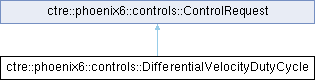
Request PID to target velocity with a differential position setpoint. More...
#include <ctre/phoenix6/controls/DifferentialVelocityDutyCycle.hpp>
Public Member Functions | |
| constexpr | DifferentialVelocityDutyCycle (wpi::units::turns_per_second_t AverageVelocity, wpi::units::turn_t DifferentialPosition) |
| Request PID to target velocity with a differential position setpoint. | |
| constexpr | ~DifferentialVelocityDutyCycle () override |
| constexpr std::string_view | GetName () const override |
| Gets the name of this control request. | |
| constexpr DifferentialVelocityDutyCycle & | WithAverageVelocity (wpi::units::turns_per_second_t newAverageVelocity) |
| Modifies this Control Request's AverageVelocity parameter and returns itself for method-chaining and easier to use request API. | |
| constexpr DifferentialVelocityDutyCycle & | WithDifferentialPosition (wpi::units::turn_t newDifferentialPosition) |
| Modifies this Control Request's DifferentialPosition parameter and returns itself for method-chaining and easier to use request API. | |
| constexpr DifferentialVelocityDutyCycle & | WithEnableFOC (bool newEnableFOC) |
| Modifies this Control Request's EnableFOC parameter and returns itself for method-chaining and easier to use request API. | |
| constexpr DifferentialVelocityDutyCycle & | WithAverageSlot (int newAverageSlot) |
| Modifies this Control Request's AverageSlot parameter and returns itself for method-chaining and easier to use request API. | |
| constexpr DifferentialVelocityDutyCycle & | WithDifferentialSlot (int newDifferentialSlot) |
| Modifies this Control Request's DifferentialSlot parameter and returns itself for method-chaining and easier to use request API. | |
| constexpr DifferentialVelocityDutyCycle & | WithOverrideBrakeDurNeutral (bool newOverrideBrakeDurNeutral) |
| Modifies this Control Request's OverrideBrakeDurNeutral parameter and returns itself for method-chaining and easier to use request API. | |
| constexpr DifferentialVelocityDutyCycle & | WithLimitForwardMotion (bool newLimitForwardMotion) |
| Modifies this Control Request's LimitForwardMotion parameter and returns itself for method-chaining and easier to use request API. | |
| constexpr DifferentialVelocityDutyCycle & | WithLimitReverseMotion (bool newLimitReverseMotion) |
| Modifies this Control Request's LimitReverseMotion parameter and returns itself for method-chaining and easier to use request API. | |
| constexpr DifferentialVelocityDutyCycle & | WithIgnoreHardwareLimits (bool newIgnoreHardwareLimits) |
| Modifies this Control Request's IgnoreHardwareLimits parameter and returns itself for method-chaining and easier to use request API. | |
| constexpr DifferentialVelocityDutyCycle & | WithIgnoreSoftwareLimits (bool newIgnoreSoftwareLimits) |
| Modifies this Control Request's IgnoreSoftwareLimits parameter and returns itself for method-chaining and easier to use request API. | |
| constexpr DifferentialVelocityDutyCycle & | WithUseTimesync (bool newUseTimesync) |
| Modifies this Control Request's UseTimesync parameter and returns itself for method-chaining and easier to use request API. | |
| constexpr DifferentialVelocityDutyCycle & | WithUpdateFreqHz (wpi::units::hertz_t newUpdateFreqHz) |
| Sets the frequency at which this control will update. | |
| std::string | ToString () const override |
| Returns a string representation of the object. | |
| std::map< std::string_view, std::string > | GetControlInfo () const override |
| Gets information about this control request. | |
| Public Member Functions inherited from ctre::phoenix6::controls::ControlRequest | |
| constexpr | ControlRequest ()=default |
| Constructs a new Control Request. | |
| virtual constexpr | ~ControlRequest () |
Public Attributes | |
| wpi::units::turns_per_second_t | AverageVelocity |
| Average velocity to drive toward in rotations per second. | |
| wpi::units::turn_t | DifferentialPosition |
| Differential position to drive toward in rotations. | |
| bool | EnableFOC = true |
| Set to true to use FOC commutation (requires Phoenix Pro), which increases peak power by ~15% on supported devices (see hardware::traits::SupportsFOC). | |
| int | AverageSlot = 0 |
| Select which gains are applied to the average controller by selecting the slot. | |
| int | DifferentialSlot = 1 |
| Select which gains are applied to the differential controller by selecting the slot. | |
| bool | OverrideBrakeDurNeutral = false |
| Set to true to static-brake the rotor when output is zero (or within deadband). | |
| bool | LimitForwardMotion = false |
| Set to true to force forward limiting. | |
| bool | LimitReverseMotion = false |
| Set to true to force reverse limiting. | |
| bool | IgnoreHardwareLimits = false |
| Set to true to ignore hardware limit switches and the LimitForwardMotion and LimitReverseMotion parameters, instead allowing motion. | |
| bool | IgnoreSoftwareLimits = false |
| Set to true to ignore software limits, instead allowing motion. | |
| bool | UseTimesync = false |
| Set to true to delay applying this control request until a timesync boundary (requires Phoenix Pro and CANivore). | |
| wpi::units::hertz_t | UpdateFreqHz {100_Hz} |
| The frequency at which this control will update. | |
Additional Inherited Members | |
| Protected Member Functions inherited from ctre::phoenix6::controls::ControlRequest | |
| constexpr | ControlRequest (ControlRequest const &)=default |
| constexpr | ControlRequest (ControlRequest &&)=default |
| constexpr ControlRequest & | operator= (ControlRequest const &)=default |
| constexpr ControlRequest & | operator= (ControlRequest &&)=default |
Detailed Description
Request PID to target velocity with a differential position setpoint.
This control mode will set the motor's velocity setpoint to the velocity specified by the user. It will also set the motor's differential position setpoint to the specified position.
Constructor & Destructor Documentation
◆ DifferentialVelocityDutyCycle()
|
inlineconstexpr |
Request PID to target velocity with a differential position setpoint.
This control mode will set the motor's velocity setpoint to the velocity specified by the user. It will also set the motor's differential position setpoint to the specified position.
- Parameters
-
AverageVelocity Average velocity to drive toward in rotations per second. DifferentialPosition Differential position to drive toward in rotations.
◆ ~DifferentialVelocityDutyCycle()
|
inlineconstexproverride |
Member Function Documentation
◆ GetControlInfo()
|
overridevirtual |
Gets information about this control request.
- Returns
- Map of control parameter names and corresponding applied values
Implements ctre::phoenix6::controls::ControlRequest.
◆ GetName()
|
inlineconstexproverridevirtual |
Gets the name of this control request.
- Returns
- Name of the control request
Implements ctre::phoenix6::controls::ControlRequest.
◆ ToString()
|
overridevirtual |
Returns a string representation of the object.
- Returns
- a string representation of the object.
Implements ctre::phoenix6::controls::ControlRequest.
◆ WithAverageSlot()
|
inlineconstexpr |
Modifies this Control Request's AverageSlot parameter and returns itself for method-chaining and easier to use request API.
Select which gains are applied to the average controller by selecting the slot. Use the configuration api to set the gain values for the selected slot before enabling this feature. Slot must be within [0,2].
- Parameters
-
newAverageSlot Parameter to modify
- Returns
- Itself
◆ WithAverageVelocity()
|
inlineconstexpr |
Modifies this Control Request's AverageVelocity parameter and returns itself for method-chaining and easier to use request API.
Average velocity to drive toward in rotations per second.
- Units: rotations per second
- Parameters
-
newAverageVelocity Parameter to modify
- Returns
- Itself
◆ WithDifferentialPosition()
|
inlineconstexpr |
Modifies this Control Request's DifferentialPosition parameter and returns itself for method-chaining and easier to use request API.
Differential position to drive toward in rotations.
- Units: rotations
- Parameters
-
newDifferentialPosition Parameter to modify
- Returns
- Itself
◆ WithDifferentialSlot()
|
inlineconstexpr |
Modifies this Control Request's DifferentialSlot parameter and returns itself for method-chaining and easier to use request API.
Select which gains are applied to the differential controller by selecting the slot. Use the configuration api to set the gain values for the selected slot before enabling this feature. Slot must be within [0,2].
- Parameters
-
newDifferentialSlot Parameter to modify
- Returns
- Itself
◆ WithEnableFOC()
|
inlineconstexpr |
Modifies this Control Request's EnableFOC parameter and returns itself for method-chaining and easier to use request API.
Set to true to use FOC commutation (requires Phoenix Pro), which increases peak power by ~15% on supported devices (see hardware::traits::SupportsFOC). Set to false to use trapezoidal commutation.
FOC improves motor performance by leveraging torque (current) control. However, this may be inconvenient for applications that require specifying duty cycle or voltage. CTR-Electronics has developed a hybrid method that combines the performances gains of FOC while still allowing applications to provide duty cycle or voltage demand. This not to be confused with simple sinusoidal control or phase voltage control which lacks the performance gains.
- Parameters
-
newEnableFOC Parameter to modify
- Returns
- Itself
◆ WithIgnoreHardwareLimits()
|
inlineconstexpr |
Modifies this Control Request's IgnoreHardwareLimits parameter and returns itself for method-chaining and easier to use request API.
Set to true to ignore hardware limit switches and the LimitForwardMotion and LimitReverseMotion parameters, instead allowing motion.
This can be useful on mechanisms such as an intake/feeder, where a limit switch stops motion while intaking but should be ignored when feeding to a shooter.
The hardware limit faults and Forward/ReverseLimit signals will still report the values of the limit switches regardless of this parameter.
- Parameters
-
newIgnoreHardwareLimits Parameter to modify
- Returns
- Itself
◆ WithIgnoreSoftwareLimits()
|
inlineconstexpr |
Modifies this Control Request's IgnoreSoftwareLimits parameter and returns itself for method-chaining and easier to use request API.
Set to true to ignore software limits, instead allowing motion.
This can be useful when calibrating the zero point of a mechanism such as an elevator.
The software limit faults will still report the values of the software limits regardless of this parameter.
- Parameters
-
newIgnoreSoftwareLimits Parameter to modify
- Returns
- Itself
◆ WithLimitForwardMotion()
|
inlineconstexpr |
Modifies this Control Request's LimitForwardMotion parameter and returns itself for method-chaining and easier to use request API.
Set to true to force forward limiting. This allows users to use other limit switch sensors connected to robot controller. This also allows use of active sensors that require external power.
- Parameters
-
newLimitForwardMotion Parameter to modify
- Returns
- Itself
◆ WithLimitReverseMotion()
|
inlineconstexpr |
Modifies this Control Request's LimitReverseMotion parameter and returns itself for method-chaining and easier to use request API.
Set to true to force reverse limiting. This allows users to use other limit switch sensors connected to robot controller. This also allows use of active sensors that require external power.
- Parameters
-
newLimitReverseMotion Parameter to modify
- Returns
- Itself
◆ WithOverrideBrakeDurNeutral()
|
inlineconstexpr |
Modifies this Control Request's OverrideBrakeDurNeutral parameter and returns itself for method-chaining and easier to use request API.
Set to true to static-brake the rotor when output is zero (or within deadband). Set to false to use the NeutralMode configuration setting (default). This flag exists to provide the fundamental behavior of this control when output is zero, which is to provide 0V to the motor.
- Parameters
-
newOverrideBrakeDurNeutral Parameter to modify
- Returns
- Itself
◆ WithUpdateFreqHz()
|
inlineconstexpr |
Sets the frequency at which this control will update.
This is designated in Hertz, with a minimum of 20 Hz (every 50 ms) and a maximum of 1000 Hz (every 1 ms). Some update frequencies are not supported and will be promoted up to the next highest supported frequency.
If this field is set to 0 Hz, the control request will be sent immediately as a one-shot frame. This may be useful for advanced applications that require outputs to be synchronized with data acquisition. In this case, we recommend not exceeding 50 ms between control calls.
- Parameters
-
newUpdateFreqHz Parameter to modify
- Returns
- Itself
◆ WithUseTimesync()
|
inlineconstexpr |
Modifies this Control Request's UseTimesync parameter and returns itself for method-chaining and easier to use request API.
Set to true to delay applying this control request until a timesync boundary (requires Phoenix Pro and CANivore). This eliminates the impact of nondeterministic network delays in exchange for a larger but deterministic control latency.
This requires setting the ControlTimesyncFreqHz config in MotorOutputConfigs. Additionally, when this is enabled, the UpdateFreqHz of this request should be set to 0 Hz.
- Parameters
-
newUseTimesync Parameter to modify
- Returns
- Itself
Member Data Documentation
◆ AverageSlot
| int ctre::phoenix6::controls::DifferentialVelocityDutyCycle::AverageSlot = 0 |
Select which gains are applied to the average controller by selecting the slot.
Use the configuration api to set the gain values for the selected slot before enabling this feature. Slot must be within [0,2].
◆ AverageVelocity
| wpi::units::turns_per_second_t ctre::phoenix6::controls::DifferentialVelocityDutyCycle::AverageVelocity |
Average velocity to drive toward in rotations per second.
- Units: rotations per second
◆ DifferentialPosition
| wpi::units::turn_t ctre::phoenix6::controls::DifferentialVelocityDutyCycle::DifferentialPosition |
Differential position to drive toward in rotations.
- Units: rotations
◆ DifferentialSlot
| int ctre::phoenix6::controls::DifferentialVelocityDutyCycle::DifferentialSlot = 1 |
Select which gains are applied to the differential controller by selecting the slot.
Use the configuration api to set the gain values for the selected slot before enabling this feature. Slot must be within [0,2].
◆ EnableFOC
| bool ctre::phoenix6::controls::DifferentialVelocityDutyCycle::EnableFOC = true |
Set to true to use FOC commutation (requires Phoenix Pro), which increases peak power by ~15% on supported devices (see hardware::traits::SupportsFOC).
Set to false to use trapezoidal commutation.
FOC improves motor performance by leveraging torque (current) control. However, this may be inconvenient for applications that require specifying duty cycle or voltage. CTR-Electronics has developed a hybrid method that combines the performances gains of FOC while still allowing applications to provide duty cycle or voltage demand. This not to be confused with simple sinusoidal control or phase voltage control which lacks the performance gains.
◆ IgnoreHardwareLimits
| bool ctre::phoenix6::controls::DifferentialVelocityDutyCycle::IgnoreHardwareLimits = false |
Set to true to ignore hardware limit switches and the LimitForwardMotion and LimitReverseMotion parameters, instead allowing motion.
This can be useful on mechanisms such as an intake/feeder, where a limit switch stops motion while intaking but should be ignored when feeding to a shooter.
The hardware limit faults and Forward/ReverseLimit signals will still report the values of the limit switches regardless of this parameter.
◆ IgnoreSoftwareLimits
| bool ctre::phoenix6::controls::DifferentialVelocityDutyCycle::IgnoreSoftwareLimits = false |
Set to true to ignore software limits, instead allowing motion.
This can be useful when calibrating the zero point of a mechanism such as an elevator.
The software limit faults will still report the values of the software limits regardless of this parameter.
◆ LimitForwardMotion
| bool ctre::phoenix6::controls::DifferentialVelocityDutyCycle::LimitForwardMotion = false |
Set to true to force forward limiting.
This allows users to use other limit switch sensors connected to robot controller. This also allows use of active sensors that require external power.
◆ LimitReverseMotion
| bool ctre::phoenix6::controls::DifferentialVelocityDutyCycle::LimitReverseMotion = false |
Set to true to force reverse limiting.
This allows users to use other limit switch sensors connected to robot controller. This also allows use of active sensors that require external power.
◆ OverrideBrakeDurNeutral
| bool ctre::phoenix6::controls::DifferentialVelocityDutyCycle::OverrideBrakeDurNeutral = false |
Set to true to static-brake the rotor when output is zero (or within deadband).
Set to false to use the NeutralMode configuration setting (default). This flag exists to provide the fundamental behavior of this control when output is zero, which is to provide 0V to the motor.
◆ UpdateFreqHz
| wpi::units::hertz_t ctre::phoenix6::controls::DifferentialVelocityDutyCycle::UpdateFreqHz {100_Hz} |
The frequency at which this control will update.
This is designated in Hertz, with a minimum of 20 Hz (every 50 ms) and a maximum of 1000 Hz (every 1 ms). Some update frequencies are not supported and will be promoted up to the next highest supported frequency.
If this field is set to 0 Hz, the control request will be sent immediately as a one-shot frame. This may be useful for advanced applications that require outputs to be synchronized with data acquisition. In this case, we recommend not exceeding 50 ms between control calls.
◆ UseTimesync
| bool ctre::phoenix6::controls::DifferentialVelocityDutyCycle::UseTimesync = false |
Set to true to delay applying this control request until a timesync boundary (requires Phoenix Pro and CANivore).
This eliminates the impact of nondeterministic network delays in exchange for a larger but deterministic control latency.
This requires setting the ControlTimesyncFreqHz config in MotorOutputConfigs. Additionally, when this is enabled, the UpdateFreqHz of this request should be set to 0 Hz.
The documentation for this class was generated from the following file:
- ctre/phoenix6/controls/DifferentialVelocityDutyCycle.hpp