Class description for the Talon FXS motor controller. More...
#include <ctre/phoenix6/core/CoreTalonFXS.hpp>
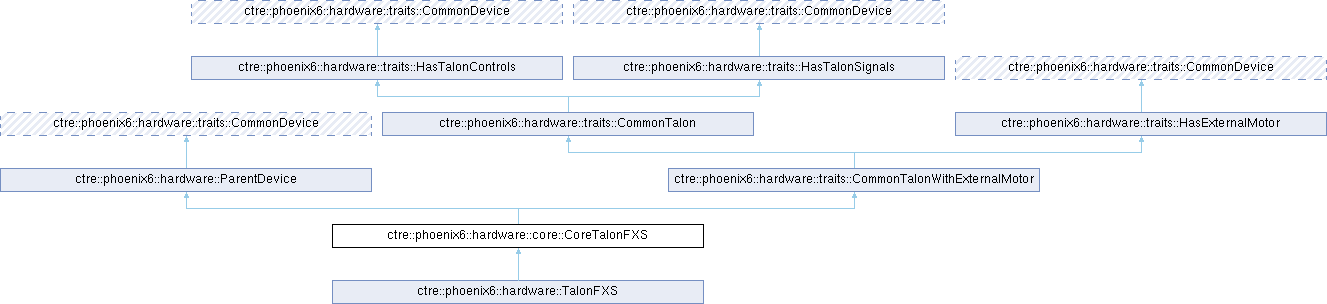
Public Types | |
| using | Configuration = configs::TalonFXSConfiguration |
| The configuration class for this device. | |
Public Member Functions | |
| CoreTalonFXS (int deviceId, CANBus canbus={}) | |
| Constructs a new Talon FXS motor controller object. | |
| CoreTalonFXS (int deviceId, std::string canbus) | |
| Constructs a new Talon FXS motor controller object. | |
| configs::TalonFXSConfigurator & | GetConfigurator () |
| Gets the configurator for this TalonFXS. | |
| configs::TalonFXSConfigurator const & | GetConfigurator () const |
| Gets the configurator for this TalonFXS. | |
| sim::TalonFXSSimState & | GetSimState () |
| Get the simulation state for this device. | |
| StatusSignal< int > & | GetVersionMajor (bool refresh=true) final |
| App Major Version number. | |
| StatusSignal< int > & | GetVersionMinor (bool refresh=true) final |
| App Minor Version number. | |
| StatusSignal< int > & | GetVersionBugfix (bool refresh=true) final |
| App Bugfix Version number. | |
| StatusSignal< int > & | GetVersionBuild (bool refresh=true) final |
| App Build Version number. | |
| StatusSignal< int > & | GetVersion (bool refresh=true) final |
| Full Version of firmware in device. | |
| StatusSignal< int > & | GetFaultField (bool refresh=true) final |
| Integer representing all fault flags reported by the device. | |
| StatusSignal< int > & | GetStickyFaultField (bool refresh=true) final |
| Integer representing all (persistent) sticky fault flags reported by the device. | |
| StatusSignal< units::voltage::volt_t > & | GetMotorVoltage (bool refresh=true) final |
| The applied (output) motor voltage. | |
| StatusSignal< signals::ForwardLimitValue > & | GetForwardLimit (bool refresh=true) final |
| Forward Limit Pin. | |
| StatusSignal< signals::ReverseLimitValue > & | GetReverseLimit (bool refresh=true) final |
| Reverse Limit Pin. | |
| StatusSignal< signals::AppliedRotorPolarityValue > & | GetAppliedRotorPolarity (bool refresh=true) final |
| The applied rotor polarity as seen from the front of the motor. | |
| StatusSignal< units::dimensionless::scalar_t > & | GetDutyCycle (bool refresh=true) final |
| The applied motor duty cycle. | |
| StatusSignal< units::current::ampere_t > & | GetTorqueCurrent (bool refresh=true) final |
| Current corresponding to the torque output by the motor. | |
| StatusSignal< units::current::ampere_t > & | GetStatorCurrent (bool refresh=true) final |
| Current corresponding to the stator windings. | |
| StatusSignal< units::current::ampere_t > & | GetSupplyCurrent (bool refresh=true) final |
| Measured supply side current. | |
| StatusSignal< units::voltage::volt_t > & | GetSupplyVoltage (bool refresh=true) final |
| Measured supply voltage to the device. | |
| StatusSignal< units::temperature::celsius_t > & | GetDeviceTemp (bool refresh=true) final |
| Temperature of device. | |
| StatusSignal< units::temperature::celsius_t > & | GetProcessorTemp (bool refresh=true) final |
| Temperature of the processor. | |
| StatusSignal< units::angular_velocity::turns_per_second_t > & | GetRotorVelocity (bool refresh=true) final |
| Velocity of the motor rotor. | |
| StatusSignal< units::angle::turn_t > & | GetRotorPosition (bool refresh=true) final |
| Position of the motor rotor. | |
| StatusSignal< units::angular_velocity::turns_per_second_t > & | GetVelocity (bool refresh=true) final |
| Velocity of the device in mechanism rotations per second. | |
| StatusSignal< units::angle::turn_t > & | GetPosition (bool refresh=true) final |
| Position of the device in mechanism rotations. | |
| StatusSignal< units::angular_acceleration::turns_per_second_squared_t > & | GetAcceleration (bool refresh=true) final |
| Acceleration of the device in mechanism rotations per second². | |
| StatusSignal< signals::ControlModeValue > & | GetControlMode (bool refresh=true) final |
| The active control mode of the motor controller. | |
| StatusSignal< signals::ExternalMotorTempStatusValue > & | GetExternalMotorTempStatus (bool refresh=true) final |
| Status of the temperature sensor of the external motor. | |
| StatusSignal< units::temperature::celsius_t > & | GetExternalMotorTemp (bool refresh=true) final |
| Temperature of the external motor. | |
| StatusSignal< bool > & | GetMotionMagicAtTarget (bool refresh=true) final |
| Check if the Motion Magic® profile has reached the target. | |
| StatusSignal< bool > & | GetMotionMagicIsRunning (bool refresh=true) final |
| Check if Motion Magic® is running. | |
| StatusSignal< signals::RobotEnableValue > & | GetRobotEnable (bool refresh=true) final |
| Indicates if the robot is enabled. | |
| StatusSignal< signals::DeviceEnableValue > & | GetDeviceEnable (bool refresh=true) final |
| Indicates if device is actuator enabled. | |
| StatusSignal< int > & | GetClosedLoopSlot (bool refresh=true) final |
| The slot that the closed-loop PID is using. | |
| StatusSignal< signals::MotorOutputStatusValue > & | GetMotorOutputStatus (bool refresh=true) final |
| Assess the status of the motor output with respect to load and supply. | |
| StatusSignal< signals::DifferentialControlModeValue > & | GetDifferentialControlMode (bool refresh=true) final |
| The active control mode of the differential controller. | |
| StatusSignal< units::angular_velocity::turns_per_second_t > & | GetDifferentialAverageVelocity (bool refresh=true) final |
| Average component of the differential velocity of device. | |
| StatusSignal< units::angle::turn_t > & | GetDifferentialAveragePosition (bool refresh=true) final |
| Average component of the differential position of device. | |
| StatusSignal< units::angular_velocity::turns_per_second_t > & | GetDifferentialDifferenceVelocity (bool refresh=true) final |
| Difference component of the differential velocity of device. | |
| StatusSignal< units::angle::turn_t > & | GetDifferentialDifferencePosition (bool refresh=true) final |
| Difference component of the differential position of device. | |
| StatusSignal< int > & | GetDifferentialClosedLoopSlot (bool refresh=true) final |
| The slot that the closed-loop differential PID is using. | |
| StatusSignal< ctre::unit::newton_meters_per_ampere_t > & | GetMotorKT (bool refresh=true) final |
| The torque constant (K_T) of the motor. | |
| StatusSignal< ctre::unit::rpm_per_volt_t > & | GetMotorKV (bool refresh=true) final |
| The velocity constant (K_V) of the motor. | |
| StatusSignal< units::current::ampere_t > & | GetMotorStallCurrent (bool refresh=true) final |
| The stall current of the motor at 12 V output. | |
| StatusSignal< signals::BridgeOutputValue > & | GetBridgeOutput (bool refresh=true) final |
| The applied output of the bridge. | |
| StatusSignal< bool > & | GetIsProLicensed (bool refresh=true) final |
| Whether the device is Phoenix Pro licensed. | |
| StatusSignal< units::temperature::celsius_t > & | GetAncillaryDeviceTemp (bool refresh=true) final |
| Temperature of device from second sensor. | |
| StatusSignal< signals::ConnectedMotorValue > & | GetConnectedMotor (bool refresh=true) final |
| The type of motor attached to the Talon. | |
| StatusSignal< units::voltage::volt_t > & | GetFiveVRailVoltage (bool refresh=true) final |
| The measured voltage of the 5V rail available on the JST and dataport connectors. | |
| StatusSignal< units::voltage::volt_t > & | GetAnalogVoltage (bool refresh=true) final |
| The voltage of the analog pin (pin 3) of the Talon FXS data port. | |
| StatusSignal< units::angle::turn_t > & | GetRawQuadraturePosition (bool refresh=true) final |
| The raw position retrieved from the connected quadrature encoder. | |
| StatusSignal< units::angular_velocity::turns_per_second_t > & | GetRawQuadratureVelocity (bool refresh=true) final |
| The raw velocity retrieved from the connected quadrature encoder. | |
| StatusSignal< units::angle::turn_t > & | GetRawPulseWidthPosition (bool refresh=true) final |
| The raw position retrieved from the connected pulse-width encoder. | |
| StatusSignal< units::angular_velocity::turns_per_second_t > & | GetRawPulseWidthVelocity (bool refresh=true) final |
| The raw velocity retrieved from the connected pulse-width encoder. | |
| StatusSignal< bool > & | GetFault_Hardware (bool refresh=true) final |
| Hardware fault occurred. | |
| StatusSignal< bool > & | GetStickyFault_Hardware (bool refresh=true) final |
| Hardware fault occurred. | |
| StatusSignal< bool > & | GetFault_ProcTemp (bool refresh=true) final |
| Processor temperature exceeded limit. | |
| StatusSignal< bool > & | GetStickyFault_ProcTemp (bool refresh=true) final |
| Processor temperature exceeded limit. | |
| StatusSignal< bool > & | GetFault_DeviceTemp (bool refresh=true) final |
| Device temperature exceeded limit. | |
| StatusSignal< bool > & | GetStickyFault_DeviceTemp (bool refresh=true) final |
| Device temperature exceeded limit. | |
| StatusSignal< bool > & | GetFault_Undervoltage (bool refresh=true) final |
| Device supply voltage dropped to near brownout levels. | |
| StatusSignal< bool > & | GetStickyFault_Undervoltage (bool refresh=true) final |
| Device supply voltage dropped to near brownout levels. | |
| StatusSignal< bool > & | GetFault_BootDuringEnable (bool refresh=true) final |
| Device boot while detecting the enable signal. | |
| StatusSignal< bool > & | GetStickyFault_BootDuringEnable (bool refresh=true) final |
| Device boot while detecting the enable signal. | |
| StatusSignal< bool > & | GetFault_UnlicensedFeatureInUse (bool refresh=true) final |
| An unlicensed feature is in use, device may not behave as expected. | |
| StatusSignal< bool > & | GetStickyFault_UnlicensedFeatureInUse (bool refresh=true) final |
| An unlicensed feature is in use, device may not behave as expected. | |
| StatusSignal< bool > & | GetFault_BridgeBrownout (bool refresh=true) final |
| Bridge was disabled most likely due to supply voltage dropping too low. | |
| StatusSignal< bool > & | GetStickyFault_BridgeBrownout (bool refresh=true) final |
| Bridge was disabled most likely due to supply voltage dropping too low. | |
| StatusSignal< bool > & | GetFault_RemoteSensorReset (bool refresh=true) final |
| The remote sensor has reset. | |
| StatusSignal< bool > & | GetStickyFault_RemoteSensorReset (bool refresh=true) final |
| The remote sensor has reset. | |
| StatusSignal< bool > & | GetFault_MissingDifferentialFX (bool refresh=true) final |
| The remote Talon used for differential control is not present on CAN Bus. | |
| StatusSignal< bool > & | GetStickyFault_MissingDifferentialFX (bool refresh=true) final |
| The remote Talon used for differential control is not present on CAN Bus. | |
| StatusSignal< bool > & | GetFault_RemoteSensorPosOverflow (bool refresh=true) final |
| The remote sensor position has overflowed. | |
| StatusSignal< bool > & | GetStickyFault_RemoteSensorPosOverflow (bool refresh=true) final |
| The remote sensor position has overflowed. | |
| StatusSignal< bool > & | GetFault_OverSupplyV (bool refresh=true) final |
| Supply Voltage has exceeded the maximum voltage rating of device. | |
| StatusSignal< bool > & | GetStickyFault_OverSupplyV (bool refresh=true) final |
| Supply Voltage has exceeded the maximum voltage rating of device. | |
| StatusSignal< bool > & | GetFault_UnstableSupplyV (bool refresh=true) final |
| Supply Voltage is unstable. | |
| StatusSignal< bool > & | GetStickyFault_UnstableSupplyV (bool refresh=true) final |
| Supply Voltage is unstable. | |
| StatusSignal< bool > & | GetFault_ReverseHardLimit (bool refresh=true) final |
| Reverse limit switch has been asserted. | |
| StatusSignal< bool > & | GetStickyFault_ReverseHardLimit (bool refresh=true) final |
| Reverse limit switch has been asserted. | |
| StatusSignal< bool > & | GetFault_ForwardHardLimit (bool refresh=true) final |
| Forward limit switch has been asserted. | |
| StatusSignal< bool > & | GetStickyFault_ForwardHardLimit (bool refresh=true) final |
| Forward limit switch has been asserted. | |
| StatusSignal< bool > & | GetFault_ReverseSoftLimit (bool refresh=true) final |
| Reverse soft limit has been asserted. | |
| StatusSignal< bool > & | GetStickyFault_ReverseSoftLimit (bool refresh=true) final |
| Reverse soft limit has been asserted. | |
| StatusSignal< bool > & | GetFault_ForwardSoftLimit (bool refresh=true) final |
| Forward soft limit has been asserted. | |
| StatusSignal< bool > & | GetStickyFault_ForwardSoftLimit (bool refresh=true) final |
| Forward soft limit has been asserted. | |
| StatusSignal< bool > & | GetFault_MissingSoftLimitRemote (bool refresh=true) final |
| The remote soft limit device is not present on CAN Bus. | |
| StatusSignal< bool > & | GetStickyFault_MissingSoftLimitRemote (bool refresh=true) final |
| The remote soft limit device is not present on CAN Bus. | |
| StatusSignal< bool > & | GetFault_MissingHardLimitRemote (bool refresh=true) final |
| The remote limit switch device is not present on CAN Bus. | |
| StatusSignal< bool > & | GetStickyFault_MissingHardLimitRemote (bool refresh=true) final |
| The remote limit switch device is not present on CAN Bus. | |
| StatusSignal< bool > & | GetFault_RemoteSensorDataInvalid (bool refresh=true) final |
| The remote sensor's data is no longer trusted. | |
| StatusSignal< bool > & | GetStickyFault_RemoteSensorDataInvalid (bool refresh=true) final |
| The remote sensor's data is no longer trusted. | |
| StatusSignal< bool > & | GetFault_FusedSensorOutOfSync (bool refresh=true) final |
| The remote sensor used for fusion has fallen out of sync to the local sensor. | |
| StatusSignal< bool > & | GetStickyFault_FusedSensorOutOfSync (bool refresh=true) final |
| The remote sensor used for fusion has fallen out of sync to the local sensor. | |
| StatusSignal< bool > & | GetFault_StatorCurrLimit (bool refresh=true) final |
| Stator current limit occured. | |
| StatusSignal< bool > & | GetStickyFault_StatorCurrLimit (bool refresh=true) final |
| Stator current limit occured. | |
| StatusSignal< bool > & | GetFault_SupplyCurrLimit (bool refresh=true) final |
| Supply current limit occured. | |
| StatusSignal< bool > & | GetStickyFault_SupplyCurrLimit (bool refresh=true) final |
| Supply current limit occured. | |
| StatusSignal< bool > & | GetFault_UsingFusedCANcoderWhileUnlicensed (bool refresh=true) final |
| Using Fused CANcoder feature while unlicensed. | |
| StatusSignal< bool > & | GetStickyFault_UsingFusedCANcoderWhileUnlicensed (bool refresh=true) final |
| Using Fused CANcoder feature while unlicensed. | |
| StatusSignal< bool > & | GetFault_StaticBrakeDisabled (bool refresh=true) final |
| Static brake was momentarily disabled due to excessive braking current while disabled. | |
| StatusSignal< bool > & | GetStickyFault_StaticBrakeDisabled (bool refresh=true) final |
| Static brake was momentarily disabled due to excessive braking current while disabled. | |
| StatusSignal< bool > & | GetFault_BridgeShort (bool refresh=true) final |
| Bridge was disabled most likely due to a short in the motor leads. | |
| StatusSignal< bool > & | GetStickyFault_BridgeShort (bool refresh=true) final |
| Bridge was disabled most likely due to a short in the motor leads. | |
| StatusSignal< bool > & | GetFault_HallSensorMissing (bool refresh=true) final |
| Hall sensor signals are invalid. | |
| StatusSignal< bool > & | GetStickyFault_HallSensorMissing (bool refresh=true) final |
| Hall sensor signals are invalid. | |
| StatusSignal< bool > & | GetFault_DriveDisabledHallSensor (bool refresh=true) final |
| Hall sensor signals are invalid during motor drive, so motor was disabled. | |
| StatusSignal< bool > & | GetStickyFault_DriveDisabledHallSensor (bool refresh=true) final |
| Hall sensor signals are invalid during motor drive, so motor was disabled. | |
| StatusSignal< bool > & | GetFault_MotorTempSensorMissing (bool refresh=true) final |
| Motor temperature signal appears to not be connected. | |
| StatusSignal< bool > & | GetStickyFault_MotorTempSensorMissing (bool refresh=true) final |
| Motor temperature signal appears to not be connected. | |
| StatusSignal< bool > & | GetFault_MotorTempSensorTooHot (bool refresh=true) final |
| Motor temperature signal indicates motor is too hot. | |
| StatusSignal< bool > & | GetStickyFault_MotorTempSensorTooHot (bool refresh=true) final |
| Motor temperature signal indicates motor is too hot. | |
| StatusSignal< bool > & | GetFault_MotorArrangementNotSelected (bool refresh=true) final |
| Motor arrangement has not been set in configuration. | |
| StatusSignal< bool > & | GetStickyFault_MotorArrangementNotSelected (bool refresh=true) final |
| Motor arrangement has not been set in configuration. | |
| StatusSignal< bool > & | GetFault_5V (bool refresh=true) final |
| The CTR Electronics' TalonFX device has detected a 5V fault. | |
| StatusSignal< bool > & | GetStickyFault_5V (bool refresh=true) final |
| The CTR Electronics' TalonFX device has detected a 5V fault. | |
| StatusSignal< double > & | GetClosedLoopProportionalOutput (bool refresh=true) final |
| Closed loop proportional component. | |
| StatusSignal< double > & | GetClosedLoopIntegratedOutput (bool refresh=true) final |
| Closed loop integrated component. | |
| StatusSignal< double > & | GetClosedLoopFeedForward (bool refresh=true) final |
| Feedforward passed by the user. | |
| StatusSignal< double > & | GetClosedLoopDerivativeOutput (bool refresh=true) final |
| Closed loop derivative component. | |
| StatusSignal< double > & | GetClosedLoopOutput (bool refresh=true) final |
| Closed loop total output. | |
| StatusSignal< double > & | GetClosedLoopReference (bool refresh=true) final |
| Value that the closed loop is targeting. | |
| StatusSignal< double > & | GetClosedLoopReferenceSlope (bool refresh=true) final |
| Derivative of the target that the closed loop is targeting. | |
| StatusSignal< double > & | GetClosedLoopError (bool refresh=true) final |
| The difference between target reference and current measurement. | |
| StatusSignal< double > & | GetDifferentialOutput (bool refresh=true) final |
| The calculated motor output for differential followers. | |
| StatusSignal< double > & | GetDifferentialClosedLoopProportionalOutput (bool refresh=true) final |
| Differential closed loop proportional component. | |
| StatusSignal< double > & | GetDifferentialClosedLoopIntegratedOutput (bool refresh=true) final |
| Differential closed loop integrated component. | |
| StatusSignal< double > & | GetDifferentialClosedLoopFeedForward (bool refresh=true) final |
| Differential Feedforward passed by the user. | |
| StatusSignal< double > & | GetDifferentialClosedLoopDerivativeOutput (bool refresh=true) final |
| Differential closed loop derivative component. | |
| StatusSignal< double > & | GetDifferentialClosedLoopOutput (bool refresh=true) final |
| Differential closed loop total output. | |
| StatusSignal< double > & | GetDifferentialClosedLoopReference (bool refresh=true) final |
| Value that the differential closed loop is targeting. | |
| StatusSignal< double > & | GetDifferentialClosedLoopReferenceSlope (bool refresh=true) final |
| Derivative of the target that the differential closed loop is targeting. | |
| StatusSignal< double > & | GetDifferentialClosedLoopError (bool refresh=true) final |
| The difference between target differential reference and current measurement. | |
| ctre::phoenix::StatusCode | SetControl (const controls::DutyCycleOut &request) final |
| Request a specified motor duty cycle. | |
| ctre::phoenix::StatusCode | SetControl (const controls::VoltageOut &request) final |
| Request a specified voltage. | |
| ctre::phoenix::StatusCode | SetControl (const controls::PositionDutyCycle &request) final |
| Request PID to target position with duty cycle feedforward. | |
| ctre::phoenix::StatusCode | SetControl (const controls::PositionVoltage &request) final |
| Request PID to target position with voltage feedforward. | |
| ctre::phoenix::StatusCode | SetControl (const controls::VelocityDutyCycle &request) final |
| Request PID to target velocity with duty cycle feedforward. | |
| ctre::phoenix::StatusCode | SetControl (const controls::VelocityVoltage &request) final |
| Request PID to target velocity with voltage feedforward. | |
| ctre::phoenix::StatusCode | SetControl (const controls::MotionMagicDutyCycle &request) final |
| Requests Motion Magic® to target a final position using a motion profile. | |
| ctre::phoenix::StatusCode | SetControl (const controls::MotionMagicVoltage &request) final |
| Requests Motion Magic® to target a final position using a motion profile. | |
| ctre::phoenix::StatusCode | SetControl (const controls::DifferentialDutyCycle &request) final |
| Request a specified motor duty cycle with a differential position closed-loop. | |
| ctre::phoenix::StatusCode | SetControl (const controls::DifferentialVoltage &request) final |
| Request a specified voltage with a differential position closed-loop. | |
| ctre::phoenix::StatusCode | SetControl (const controls::DifferentialPositionDutyCycle &request) final |
| Request PID to target position with a differential position setpoint. | |
| ctre::phoenix::StatusCode | SetControl (const controls::DifferentialPositionVoltage &request) final |
| Request PID to target position with a differential position setpoint. | |
| ctre::phoenix::StatusCode | SetControl (const controls::DifferentialVelocityDutyCycle &request) final |
| Request PID to target velocity with a differential position setpoint. | |
| ctre::phoenix::StatusCode | SetControl (const controls::DifferentialVelocityVoltage &request) final |
| Request PID to target velocity with a differential position setpoint. | |
| ctre::phoenix::StatusCode | SetControl (const controls::DifferentialMotionMagicDutyCycle &request) final |
| Requests Motion Magic® to target a final position using a motion profile, and PID to a differential position setpoint. | |
| ctre::phoenix::StatusCode | SetControl (const controls::DifferentialMotionMagicVoltage &request) final |
| Requests Motion Magic® to target a final position using a motion profile, and PID to a differential position setpoint. | |
| ctre::phoenix::StatusCode | SetControl (const controls::DifferentialMotionMagicExpoDutyCycle &request) final |
| Requests Motion Magic® to target a final position using an exponential motion profile, and PID to a differential position setpoint. | |
| ctre::phoenix::StatusCode | SetControl (const controls::DifferentialMotionMagicExpoVoltage &request) final |
| Requests Motion Magic® to target a final position using an exponential motion profile, and PID to a differential position setpoint. | |
| ctre::phoenix::StatusCode | SetControl (const controls::DifferentialMotionMagicVelocityDutyCycle &request) final |
| Requests Motion Magic® to target a final velocity using a motion profile, and PID to a differential position setpoint. | |
| ctre::phoenix::StatusCode | SetControl (const controls::DifferentialMotionMagicVelocityVoltage &request) final |
| Requests Motion Magic® to target a final velocity using a motion profile, and PID to a differential position setpoint. | |
| ctre::phoenix::StatusCode | SetControl (const controls::Follower &request) final |
| Follow the motor output of another Talon. | |
| ctre::phoenix::StatusCode | SetControl (const controls::StrictFollower &request) final |
| Follow the motor output of another Talon while ignoring the leader's invert setting. | |
| ctre::phoenix::StatusCode | SetControl (const controls::DifferentialFollower &request) final |
| Follow the differential motor output of another Talon. | |
| ctre::phoenix::StatusCode | SetControl (const controls::DifferentialStrictFollower &request) final |
| Follow the differential motor output of another Talon while ignoring the leader's invert setting. | |
| ctre::phoenix::StatusCode | SetControl (const controls::NeutralOut &request) final |
| Request neutral output of actuator. | |
| ctre::phoenix::StatusCode | SetControl (const controls::CoastOut &request) final |
| Request coast neutral output of actuator. | |
| ctre::phoenix::StatusCode | SetControl (const controls::StaticBrake &request) final |
| Applies full neutral-brake by shorting motor leads together. | |
| ctre::phoenix::StatusCode | SetControl (const controls::MotionMagicVelocityDutyCycle &request) final |
| Requests Motion Magic® to target a final velocity using a motion profile. | |
| ctre::phoenix::StatusCode | SetControl (const controls::MotionMagicVelocityVoltage &request) final |
| Requests Motion Magic® to target a final velocity using a motion profile. | |
| ctre::phoenix::StatusCode | SetControl (const controls::MotionMagicExpoDutyCycle &request) final |
| Requests Motion Magic® to target a final position using an exponential motion profile. | |
| ctre::phoenix::StatusCode | SetControl (const controls::MotionMagicExpoVoltage &request) final |
| Requests Motion Magic® to target a final position using an exponential motion profile. | |
| ctre::phoenix::StatusCode | SetControl (const controls::DynamicMotionMagicDutyCycle &request) final |
| Requests Motion Magic® to target a final position using a motion profile. | |
| ctre::phoenix::StatusCode | SetControl (const controls::DynamicMotionMagicVoltage &request) final |
| Requests Motion Magic® to target a final position using a motion profile. | |
| ctre::phoenix::StatusCode | SetControl (const controls::DynamicMotionMagicExpoDutyCycle &request) final |
| Requests Motion Magic® Expo to target a final position using an exponential motion profile. | |
| ctre::phoenix::StatusCode | SetControl (const controls::DynamicMotionMagicExpoVoltage &request) final |
| Requests Motion Magic® Expo to target a final position using an exponential motion profile. | |
| ctre::phoenix::StatusCode | SetControl (const controls::compound::Diff_DutyCycleOut_Position &request) final |
| Differential control with duty cycle average target and position difference target. | |
| ctre::phoenix::StatusCode | SetControl (const controls::compound::Diff_PositionDutyCycle_Position &request) final |
| Differential control with position average target and position difference target using duty cycle control. | |
| ctre::phoenix::StatusCode | SetControl (const controls::compound::Diff_VelocityDutyCycle_Position &request) final |
| Differential control with velocity average target and position difference target using duty cycle control. | |
| ctre::phoenix::StatusCode | SetControl (const controls::compound::Diff_MotionMagicDutyCycle_Position &request) final |
| Differential control with Motion Magic® average target and position difference target using duty cycle control. | |
| ctre::phoenix::StatusCode | SetControl (const controls::compound::Diff_MotionMagicExpoDutyCycle_Position &request) final |
| Differential control with Motion Magic® Expo average target and position difference target using duty cycle control. | |
| ctre::phoenix::StatusCode | SetControl (const controls::compound::Diff_MotionMagicVelocityDutyCycle_Position &request) final |
| Differential control with Motion Magic® Velocity average target and position difference target using duty cycle control. | |
| ctre::phoenix::StatusCode | SetControl (const controls::compound::Diff_DutyCycleOut_Velocity &request) final |
| Differential control with duty cycle average target and velocity difference target. | |
| ctre::phoenix::StatusCode | SetControl (const controls::compound::Diff_PositionDutyCycle_Velocity &request) final |
| Differential control with position average target and velocity difference target using duty cycle control. | |
| ctre::phoenix::StatusCode | SetControl (const controls::compound::Diff_VelocityDutyCycle_Velocity &request) final |
| Differential control with velocity average target and velocity difference target using duty cycle control. | |
| ctre::phoenix::StatusCode | SetControl (const controls::compound::Diff_MotionMagicDutyCycle_Velocity &request) final |
| Differential control with Motion Magic® average target and velocity difference target using duty cycle control. | |
| ctre::phoenix::StatusCode | SetControl (const controls::compound::Diff_MotionMagicExpoDutyCycle_Velocity &request) final |
| Differential control with Motion Magic® Expo average target and velocity difference target using duty cycle control. | |
| ctre::phoenix::StatusCode | SetControl (const controls::compound::Diff_MotionMagicVelocityDutyCycle_Velocity &request) final |
| Differential control with Motion Magic® Velocity average target and velocity difference target using duty cycle control. | |
| ctre::phoenix::StatusCode | SetControl (const controls::compound::Diff_DutyCycleOut_Open &request) final |
| Differential control with duty cycle average target and duty cycle difference target. | |
| ctre::phoenix::StatusCode | SetControl (const controls::compound::Diff_PositionDutyCycle_Open &request) final |
| Differential control with position average target and duty cycle difference target. | |
| ctre::phoenix::StatusCode | SetControl (const controls::compound::Diff_VelocityDutyCycle_Open &request) final |
| Differential control with velocity average target and duty cycle difference target. | |
| ctre::phoenix::StatusCode | SetControl (const controls::compound::Diff_MotionMagicDutyCycle_Open &request) final |
| Differential control with Motion Magic® average target and duty cycle difference target. | |
| ctre::phoenix::StatusCode | SetControl (const controls::compound::Diff_MotionMagicExpoDutyCycle_Open &request) final |
| Differential control with Motion Magic® Expo average target and duty cycle difference target. | |
| ctre::phoenix::StatusCode | SetControl (const controls::compound::Diff_MotionMagicVelocityDutyCycle_Open &request) final |
| Differential control with Motion Magic® Velocity average target and duty cycle difference target. | |
| ctre::phoenix::StatusCode | SetControl (const controls::compound::Diff_VoltageOut_Position &request) final |
| Differential control with voltage average target and position difference target. | |
| ctre::phoenix::StatusCode | SetControl (const controls::compound::Diff_PositionVoltage_Position &request) final |
| Differential control with position average target and position difference target using voltage control. | |
| ctre::phoenix::StatusCode | SetControl (const controls::compound::Diff_VelocityVoltage_Position &request) final |
| Differential control with velocity average target and position difference target using voltage control. | |
| ctre::phoenix::StatusCode | SetControl (const controls::compound::Diff_MotionMagicVoltage_Position &request) final |
| Differential control with Motion Magic® average target and position difference target using voltage control. | |
| ctre::phoenix::StatusCode | SetControl (const controls::compound::Diff_MotionMagicExpoVoltage_Position &request) final |
| Differential control with Motion Magic® Expo average target and position difference target using voltage control. | |
| ctre::phoenix::StatusCode | SetControl (const controls::compound::Diff_MotionMagicVelocityVoltage_Position &request) final |
| Differential control with Motion Magic® Velocity average target and position difference target using voltage control. | |
| ctre::phoenix::StatusCode | SetControl (const controls::compound::Diff_VoltageOut_Velocity &request) final |
| Differential control with voltage average target and velocity difference target. | |
| ctre::phoenix::StatusCode | SetControl (const controls::compound::Diff_PositionVoltage_Velocity &request) final |
| Differential control with position average target and velocity difference target using voltage control. | |
| ctre::phoenix::StatusCode | SetControl (const controls::compound::Diff_VelocityVoltage_Velocity &request) final |
| Differential control with velocity average target and velocity difference target using voltage control. | |
| ctre::phoenix::StatusCode | SetControl (const controls::compound::Diff_MotionMagicVoltage_Velocity &request) final |
| Differential control with Motion Magic® average target and velocity difference target using voltage control. | |
| ctre::phoenix::StatusCode | SetControl (const controls::compound::Diff_MotionMagicExpoVoltage_Velocity &request) final |
| Differential control with Motion Magic® Expo average target and velocity difference target using voltage control. | |
| ctre::phoenix::StatusCode | SetControl (const controls::compound::Diff_MotionMagicVelocityVoltage_Velocity &request) final |
| Differential control with Motion Magic® Velocity average target and velocity difference target using voltage control. | |
| ctre::phoenix::StatusCode | SetControl (const controls::compound::Diff_VoltageOut_Open &request) final |
| Differential control with voltage average target and voltage difference target. | |
| ctre::phoenix::StatusCode | SetControl (const controls::compound::Diff_PositionVoltage_Open &request) final |
| Differential control with position average target and voltage difference target. | |
| ctre::phoenix::StatusCode | SetControl (const controls::compound::Diff_VelocityVoltage_Open &request) final |
| Differential control with velocity average target and voltage difference target. | |
| ctre::phoenix::StatusCode | SetControl (const controls::compound::Diff_MotionMagicVoltage_Open &request) final |
| Differential control with Motion Magic® average target and voltage difference target. | |
| ctre::phoenix::StatusCode | SetControl (const controls::compound::Diff_MotionMagicExpoVoltage_Open &request) final |
| Differential control with Motion Magic® Expo average target and voltage difference target. | |
| ctre::phoenix::StatusCode | SetControl (const controls::compound::Diff_MotionMagicVelocityVoltage_Open &request) final |
| Differential control with Motion Magic® Velocity average target and voltage difference target. | |
| ctre::phoenix::StatusCode | SetControl (controls::ControlRequest const &request) final |
| Control device with generic control request object. | |
| ctre::phoenix::StatusCode | SetPosition (units::angle::turn_t newValue, units::time::second_t timeoutSeconds) final |
| Sets the mechanism position of the device in mechanism rotations. | |
| ctre::phoenix::StatusCode | SetPosition (units::angle::turn_t newValue) final |
| Sets the mechanism position of the device in mechanism rotations. | |
| ctre::phoenix::StatusCode | ClearStickyFaults (units::time::second_t timeoutSeconds) final |
| Clear the sticky faults in the device. | |
| ctre::phoenix::StatusCode | ClearStickyFaults () final |
| Clear the sticky faults in the device. | |
| ctre::phoenix::StatusCode | ClearStickyFault_Hardware (units::time::second_t timeoutSeconds) final |
| Clear sticky fault: Hardware fault occurred. | |
| ctre::phoenix::StatusCode | ClearStickyFault_Hardware () final |
| Clear sticky fault: Hardware fault occurred. | |
| ctre::phoenix::StatusCode | ClearStickyFault_ProcTemp (units::time::second_t timeoutSeconds) final |
| Clear sticky fault: Processor temperature exceeded limit. | |
| ctre::phoenix::StatusCode | ClearStickyFault_ProcTemp () final |
| Clear sticky fault: Processor temperature exceeded limit. | |
| ctre::phoenix::StatusCode | ClearStickyFault_DeviceTemp (units::time::second_t timeoutSeconds) final |
| Clear sticky fault: Device temperature exceeded limit. | |
| ctre::phoenix::StatusCode | ClearStickyFault_DeviceTemp () final |
| Clear sticky fault: Device temperature exceeded limit. | |
| ctre::phoenix::StatusCode | ClearStickyFault_Undervoltage (units::time::second_t timeoutSeconds) final |
| Clear sticky fault: Device supply voltage dropped to near brownout levels. | |
| ctre::phoenix::StatusCode | ClearStickyFault_Undervoltage () final |
| Clear sticky fault: Device supply voltage dropped to near brownout levels. | |
| ctre::phoenix::StatusCode | ClearStickyFault_BootDuringEnable (units::time::second_t timeoutSeconds) final |
| Clear sticky fault: Device boot while detecting the enable signal. | |
| ctre::phoenix::StatusCode | ClearStickyFault_BootDuringEnable () final |
| Clear sticky fault: Device boot while detecting the enable signal. | |
| ctre::phoenix::StatusCode | ClearStickyFault_UnlicensedFeatureInUse (units::time::second_t timeoutSeconds) final |
| Clear sticky fault: An unlicensed feature is in use, device may not behave as expected. | |
| ctre::phoenix::StatusCode | ClearStickyFault_UnlicensedFeatureInUse () final |
| Clear sticky fault: An unlicensed feature is in use, device may not behave as expected. | |
| ctre::phoenix::StatusCode | ClearStickyFault_BridgeBrownout (units::time::second_t timeoutSeconds) final |
| Clear sticky fault: Bridge was disabled most likely due to supply voltage dropping too low. | |
| ctre::phoenix::StatusCode | ClearStickyFault_BridgeBrownout () final |
| Clear sticky fault: Bridge was disabled most likely due to supply voltage dropping too low. | |
| ctre::phoenix::StatusCode | ClearStickyFault_RemoteSensorReset (units::time::second_t timeoutSeconds) final |
| Clear sticky fault: The remote sensor has reset. | |
| ctre::phoenix::StatusCode | ClearStickyFault_RemoteSensorReset () final |
| Clear sticky fault: The remote sensor has reset. | |
| ctre::phoenix::StatusCode | ClearStickyFault_MissingDifferentialFX (units::time::second_t timeoutSeconds) final |
| Clear sticky fault: The remote Talon used for differential control is not present on CAN Bus. | |
| ctre::phoenix::StatusCode | ClearStickyFault_MissingDifferentialFX () final |
| Clear sticky fault: The remote Talon used for differential control is not present on CAN Bus. | |
| ctre::phoenix::StatusCode | ClearStickyFault_RemoteSensorPosOverflow (units::time::second_t timeoutSeconds) final |
| Clear sticky fault: The remote sensor position has overflowed. | |
| ctre::phoenix::StatusCode | ClearStickyFault_RemoteSensorPosOverflow () final |
| Clear sticky fault: The remote sensor position has overflowed. | |
| ctre::phoenix::StatusCode | ClearStickyFault_OverSupplyV (units::time::second_t timeoutSeconds) final |
| Clear sticky fault: Supply Voltage has exceeded the maximum voltage rating of device. | |
| ctre::phoenix::StatusCode | ClearStickyFault_OverSupplyV () final |
| Clear sticky fault: Supply Voltage has exceeded the maximum voltage rating of device. | |
| ctre::phoenix::StatusCode | ClearStickyFault_UnstableSupplyV (units::time::second_t timeoutSeconds) final |
| Clear sticky fault: Supply Voltage is unstable. | |
| ctre::phoenix::StatusCode | ClearStickyFault_UnstableSupplyV () final |
| Clear sticky fault: Supply Voltage is unstable. | |
| ctre::phoenix::StatusCode | ClearStickyFault_ReverseHardLimit (units::time::second_t timeoutSeconds) final |
| Clear sticky fault: Reverse limit switch has been asserted. | |
| ctre::phoenix::StatusCode | ClearStickyFault_ReverseHardLimit () final |
| Clear sticky fault: Reverse limit switch has been asserted. | |
| ctre::phoenix::StatusCode | ClearStickyFault_ForwardHardLimit (units::time::second_t timeoutSeconds) final |
| Clear sticky fault: Forward limit switch has been asserted. | |
| ctre::phoenix::StatusCode | ClearStickyFault_ForwardHardLimit () final |
| Clear sticky fault: Forward limit switch has been asserted. | |
| ctre::phoenix::StatusCode | ClearStickyFault_ReverseSoftLimit (units::time::second_t timeoutSeconds) final |
| Clear sticky fault: Reverse soft limit has been asserted. | |
| ctre::phoenix::StatusCode | ClearStickyFault_ReverseSoftLimit () final |
| Clear sticky fault: Reverse soft limit has been asserted. | |
| ctre::phoenix::StatusCode | ClearStickyFault_ForwardSoftLimit (units::time::second_t timeoutSeconds) final |
| Clear sticky fault: Forward soft limit has been asserted. | |
| ctre::phoenix::StatusCode | ClearStickyFault_ForwardSoftLimit () final |
| Clear sticky fault: Forward soft limit has been asserted. | |
| ctre::phoenix::StatusCode | ClearStickyFault_MissingSoftLimitRemote (units::time::second_t timeoutSeconds) final |
| Clear sticky fault: The remote soft limit device is not present on CAN Bus. | |
| ctre::phoenix::StatusCode | ClearStickyFault_MissingSoftLimitRemote () final |
| Clear sticky fault: The remote soft limit device is not present on CAN Bus. | |
| ctre::phoenix::StatusCode | ClearStickyFault_MissingHardLimitRemote (units::time::second_t timeoutSeconds) final |
| Clear sticky fault: The remote limit switch device is not present on CAN Bus. | |
| ctre::phoenix::StatusCode | ClearStickyFault_MissingHardLimitRemote () final |
| Clear sticky fault: The remote limit switch device is not present on CAN Bus. | |
| ctre::phoenix::StatusCode | ClearStickyFault_RemoteSensorDataInvalid (units::time::second_t timeoutSeconds) final |
| Clear sticky fault: The remote sensor's data is no longer trusted. | |
| ctre::phoenix::StatusCode | ClearStickyFault_RemoteSensorDataInvalid () final |
| Clear sticky fault: The remote sensor's data is no longer trusted. | |
| ctre::phoenix::StatusCode | ClearStickyFault_FusedSensorOutOfSync (units::time::second_t timeoutSeconds) final |
| Clear sticky fault: The remote sensor used for fusion has fallen out of sync to the local sensor. | |
| ctre::phoenix::StatusCode | ClearStickyFault_FusedSensorOutOfSync () final |
| Clear sticky fault: The remote sensor used for fusion has fallen out of sync to the local sensor. | |
| ctre::phoenix::StatusCode | ClearStickyFault_StatorCurrLimit (units::time::second_t timeoutSeconds) final |
| Clear sticky fault: Stator current limit occured. | |
| ctre::phoenix::StatusCode | ClearStickyFault_StatorCurrLimit () final |
| Clear sticky fault: Stator current limit occured. | |
| ctre::phoenix::StatusCode | ClearStickyFault_SupplyCurrLimit (units::time::second_t timeoutSeconds) final |
| Clear sticky fault: Supply current limit occured. | |
| ctre::phoenix::StatusCode | ClearStickyFault_SupplyCurrLimit () final |
| Clear sticky fault: Supply current limit occured. | |
| ctre::phoenix::StatusCode | ClearStickyFault_UsingFusedCANcoderWhileUnlicensed (units::time::second_t timeoutSeconds) final |
| Clear sticky fault: Using Fused CANcoder feature while unlicensed. | |
| ctre::phoenix::StatusCode | ClearStickyFault_UsingFusedCANcoderWhileUnlicensed () final |
| Clear sticky fault: Using Fused CANcoder feature while unlicensed. | |
| ctre::phoenix::StatusCode | ClearStickyFault_StaticBrakeDisabled (units::time::second_t timeoutSeconds) final |
| Clear sticky fault: Static brake was momentarily disabled due to excessive braking current while disabled. | |
| ctre::phoenix::StatusCode | ClearStickyFault_StaticBrakeDisabled () final |
| Clear sticky fault: Static brake was momentarily disabled due to excessive braking current while disabled. | |
| ctre::phoenix::StatusCode | ClearStickyFault_BridgeShort (units::time::second_t timeoutSeconds) final |
| Clear sticky fault: Bridge was disabled most likely due to a short in the motor leads. | |
| ctre::phoenix::StatusCode | ClearStickyFault_BridgeShort () final |
| Clear sticky fault: Bridge was disabled most likely due to a short in the motor leads. | |
| ctre::phoenix::StatusCode | ClearStickyFault_HallSensorMissing (units::time::second_t timeoutSeconds) final |
| Clear sticky fault: Hall sensor signals are invalid. | |
| ctre::phoenix::StatusCode | ClearStickyFault_HallSensorMissing () final |
| Clear sticky fault: Hall sensor signals are invalid. | |
| ctre::phoenix::StatusCode | ClearStickyFault_DriveDisabledHallSensor (units::time::second_t timeoutSeconds) final |
| Clear sticky fault: Hall sensor signals are invalid during motor drive, so motor was disabled. | |
| ctre::phoenix::StatusCode | ClearStickyFault_DriveDisabledHallSensor () final |
| Clear sticky fault: Hall sensor signals are invalid during motor drive, so motor was disabled. | |
| ctre::phoenix::StatusCode | ClearStickyFault_MotorTempSensorMissing (units::time::second_t timeoutSeconds) final |
| Clear sticky fault: Motor temperature signal appears to not be connected. | |
| ctre::phoenix::StatusCode | ClearStickyFault_MotorTempSensorMissing () final |
| Clear sticky fault: Motor temperature signal appears to not be connected. | |
| ctre::phoenix::StatusCode | ClearStickyFault_MotorTempSensorTooHot (units::time::second_t timeoutSeconds) final |
| Clear sticky fault: Motor temperature signal indicates motor is too hot. | |
| ctre::phoenix::StatusCode | ClearStickyFault_MotorTempSensorTooHot () final |
| Clear sticky fault: Motor temperature signal indicates motor is too hot. | |
| ctre::phoenix::StatusCode | ClearStickyFault_MotorArrangementNotSelected (units::time::second_t timeoutSeconds) final |
| Clear sticky fault: Motor arrangement has not been set in configuration. | |
| ctre::phoenix::StatusCode | ClearStickyFault_MotorArrangementNotSelected () final |
| Clear sticky fault: Motor arrangement has not been set in configuration. | |
 Public Member Functions inherited from ctre::phoenix6::hardware::ParentDevice Public Member Functions inherited from ctre::phoenix6::hardware::ParentDevice | |
| ParentDevice (int deviceID, std::string model, CANBus canbus) | |
| virtual | ~ParentDevice ()=0 |
| ParentDevice (ParentDevice const &)=delete | |
| ParentDevice & | operator= (ParentDevice const &)=delete |
| int | GetDeviceID () const final |
| CANBus | GetNetwork () const final |
| uint64_t | GetDeviceHash () const final |
| Gets a number unique for this device's hardware type and ID. | |
| std::shared_ptr< controls::ControlRequest const > | GetAppliedControl () const final |
| Get the latest applied control. | |
| std::shared_ptr< controls::ControlRequest > | GetAppliedControl () final |
| Get the latest applied control. | |
| bool | HasResetOccurred () final |
| std::function< bool()> | GetResetOccurredChecker () const final |
| bool | IsConnected (units::second_t maxLatencySeconds=500_ms) final |
| Returns whether the device is still connected to the robot. | |
| StatusSignal< double > & | GetGenericSignal (uint32_t signal, bool refresh=true) |
| This is a reserved routine for internal testing. | |
| ctre::phoenix::StatusCode | OptimizeBusUtilization (units::frequency::hertz_t optimizedFreqHz=4_Hz, units::time::second_t timeoutSeconds=100_ms) final |
| Optimizes the device's bus utilization by reducing the update frequencies of its status signals. | |
| ctre::phoenix::StatusCode | ResetSignalFrequencies (units::time::second_t timeoutSeconds=100_ms) final |
| Resets the update frequencies of all the device's status signals to the defaults. | |
| Public Member Functions inherited from ctre::phoenix6::hardware::traits::CommonDevice | |
| virtual | ~CommonDevice ()=default |
| Public Member Functions inherited from ctre::phoenix6::hardware::traits::CommonTalonWithExternalMotor | |
| virtual | ~CommonTalonWithExternalMotor ()=default |
| Public Member Functions inherited from ctre::phoenix6::hardware::traits::CommonTalon | |
| virtual | ~CommonTalon ()=default |
| Public Member Functions inherited from ctre::phoenix6::hardware::traits::HasTalonControls | |
| virtual | ~HasTalonControls ()=default |
| Public Member Functions inherited from ctre::phoenix6::hardware::traits::HasTalonSignals | |
| virtual | ~HasTalonSignals ()=default |
| Public Member Functions inherited from ctre::phoenix6::hardware::traits::HasExternalMotor | |
| virtual | ~HasExternalMotor ()=default |
Additional Inherited Members | |
| Static Public Member Functions inherited from ctre::phoenix6::hardware::ParentDevice | |
| template<std::derived_from< traits::CommonDevice >... Devices> | |
| static ctre::phoenix::StatusCode | OptimizeBusUtilizationForAll (Devices &... devices) |
| Optimizes the bus utilization of the provided devices by reducing the update frequencies of their status signals. | |
| static ctre::phoenix::StatusCode | OptimizeBusUtilizationForAll (std::span< traits::CommonDevice *const > devices) |
| Optimizes the bus utilization of the provided devices by reducing the update frequencies of their status signals. | |
| template<std::derived_from< traits::CommonDevice >... Devices> | |
| static ctre::phoenix::StatusCode | OptimizeBusUtilizationForAll (units::frequency::hertz_t optimizedFreqHz, Devices &... devices) |
| Optimizes the bus utilization of the provided devices by reducing the update frequencies of their status signals. | |
| static ctre::phoenix::StatusCode | OptimizeBusUtilizationForAll (units::frequency::hertz_t optimizedFreqHz, std::span< traits::CommonDevice *const > devices) |
| Optimizes the bus utilization of the provided devices by reducing the update frequencies of their status signals. | |
| template<std::derived_from< traits::CommonDevice >... Devices> | |
| static ctre::phoenix::StatusCode | ResetSignalFrequenciesForAll (Devices &... devices) |
| Resets the update frequencies of all the devices' status signals to the defaults. | |
| static ctre::phoenix::StatusCode | ResetSignalFrequenciesForAll (std::span< traits::CommonDevice *const > devices) |
| Resets the update frequencies of all the devices' status signals to the defaults. | |
| Protected Member Functions inherited from ctre::phoenix6::hardware::ParentDevice | |
| virtual ctre::phoenix::StatusCode | SetControlPrivate (controls::ControlRequest const &request) |
| template<typename T > | |
| StatusSignal< T > & | LookupStatusSignal (uint16_t spn, std::string signalName, bool reportOnConstruction, bool refresh) |
| template<typename T > | |
| StatusSignal< T > & | LookupStatusSignal (uint16_t spn, std::string signalName, std::function< std::map< uint16_t, std::string >()> mapFiller, bool reportOnConstruction, bool refresh) |
| Protected Attributes inherited from ctre::phoenix6::hardware::ParentDevice | |
| DeviceIdentifier | deviceIdentifier |
| Static Protected Attributes inherited from ctre::phoenix6::hardware::ParentDevice | |
| static constexpr controls::EmptyControl | _emptyControl {} |
Detailed Description
Class description for the Talon FXS motor controller.
Member Typedef Documentation
◆ Configuration
The configuration class for this device.
Constructor & Destructor Documentation
◆ CoreTalonFXS() [1/2]
| ctre::phoenix6::hardware::core::CoreTalonFXS::CoreTalonFXS | ( | int | deviceId, |
| CANBus | canbus = {} ) |
Constructs a new Talon FXS motor controller object.
- Parameters
-
deviceId ID of the device, as configured in Phoenix Tuner canbus The CAN bus this device is on
◆ CoreTalonFXS() [2/2]
| ctre::phoenix6::hardware::core::CoreTalonFXS::CoreTalonFXS | ( | int | deviceId, |
| std::string | canbus ) |
Constructs a new Talon FXS motor controller object.
- Parameters
-
deviceId ID of the device, as configured in Phoenix Tuner canbus Name of the CAN bus this device is on. Possible CAN bus strings are: - "rio" for the native roboRIO CAN bus
- CANivore name or serial number
- SocketCAN interface (non-FRC Linux only)
- "*" for any CANivore seen by the program
- empty string (default) to select the default for the system:
- "rio" on roboRIO
- "can0" on Linux
- "*" on Windows
- Deprecated
- Constructing devices with a CAN bus string is deprecated for removal in the 2027 season. Construct devices using a CANBus instance instead.
Member Function Documentation
◆ ClearStickyFault_BootDuringEnable() [1/2]
|
inlinefinalvirtual |
Clear sticky fault: Device boot while detecting the enable signal.
This will wait up to 0.100 seconds (100ms) by default.
- Returns
- StatusCode of the set command
Implements ctre::phoenix6::hardware::traits::HasTalonSignals.
◆ ClearStickyFault_BootDuringEnable() [2/2]
|
inlinefinalvirtual |
Clear sticky fault: Device boot while detecting the enable signal.
- Parameters
-
timeoutSeconds Maximum time to wait up to in seconds.
- Returns
- StatusCode of the set command
Implements ctre::phoenix6::hardware::traits::HasTalonSignals.
◆ ClearStickyFault_BridgeBrownout() [1/2]
|
inlinefinalvirtual |
Clear sticky fault: Bridge was disabled most likely due to supply voltage dropping too low.
This will wait up to 0.100 seconds (100ms) by default.
- Returns
- StatusCode of the set command
Implements ctre::phoenix6::hardware::traits::HasTalonSignals.
◆ ClearStickyFault_BridgeBrownout() [2/2]
|
inlinefinalvirtual |
Clear sticky fault: Bridge was disabled most likely due to supply voltage dropping too low.
- Parameters
-
timeoutSeconds Maximum time to wait up to in seconds.
- Returns
- StatusCode of the set command
Implements ctre::phoenix6::hardware::traits::HasTalonSignals.
◆ ClearStickyFault_BridgeShort() [1/2]
|
inlinefinalvirtual |
Clear sticky fault: Bridge was disabled most likely due to a short in the motor leads.
This will wait up to 0.100 seconds (100ms) by default.
- Returns
- StatusCode of the set command
Implements ctre::phoenix6::hardware::traits::HasExternalMotor.
◆ ClearStickyFault_BridgeShort() [2/2]
|
inlinefinalvirtual |
Clear sticky fault: Bridge was disabled most likely due to a short in the motor leads.
- Parameters
-
timeoutSeconds Maximum time to wait up to in seconds.
- Returns
- StatusCode of the set command
Implements ctre::phoenix6::hardware::traits::HasExternalMotor.
◆ ClearStickyFault_DeviceTemp() [1/2]
|
inlinefinalvirtual |
Clear sticky fault: Device temperature exceeded limit.
This will wait up to 0.100 seconds (100ms) by default.
- Returns
- StatusCode of the set command
Implements ctre::phoenix6::hardware::traits::HasTalonSignals.
◆ ClearStickyFault_DeviceTemp() [2/2]
|
inlinefinalvirtual |
Clear sticky fault: Device temperature exceeded limit.
- Parameters
-
timeoutSeconds Maximum time to wait up to in seconds.
- Returns
- StatusCode of the set command
Implements ctre::phoenix6::hardware::traits::HasTalonSignals.
◆ ClearStickyFault_DriveDisabledHallSensor() [1/2]
|
inlinefinalvirtual |
Clear sticky fault: Hall sensor signals are invalid during motor drive, so motor was disabled.
Check hall sensor and cabling.
This will wait up to 0.100 seconds (100ms) by default.
- Returns
- StatusCode of the set command
Implements ctre::phoenix6::hardware::traits::HasExternalMotor.
◆ ClearStickyFault_DriveDisabledHallSensor() [2/2]
|
inlinefinalvirtual |
Clear sticky fault: Hall sensor signals are invalid during motor drive, so motor was disabled.
Check hall sensor and cabling.
- Parameters
-
timeoutSeconds Maximum time to wait up to in seconds.
- Returns
- StatusCode of the set command
Implements ctre::phoenix6::hardware::traits::HasExternalMotor.
◆ ClearStickyFault_ForwardHardLimit() [1/2]
|
inlinefinalvirtual |
Clear sticky fault: Forward limit switch has been asserted.
Output is set to neutral.
This will wait up to 0.100 seconds (100ms) by default.
- Returns
- StatusCode of the set command
Implements ctre::phoenix6::hardware::traits::HasTalonSignals.
◆ ClearStickyFault_ForwardHardLimit() [2/2]
|
inlinefinalvirtual |
Clear sticky fault: Forward limit switch has been asserted.
Output is set to neutral.
- Parameters
-
timeoutSeconds Maximum time to wait up to in seconds.
- Returns
- StatusCode of the set command
Implements ctre::phoenix6::hardware::traits::HasTalonSignals.
◆ ClearStickyFault_ForwardSoftLimit() [1/2]
|
inlinefinalvirtual |
Clear sticky fault: Forward soft limit has been asserted.
Output is set to neutral.
This will wait up to 0.100 seconds (100ms) by default.
- Returns
- StatusCode of the set command
Implements ctre::phoenix6::hardware::traits::HasTalonSignals.
◆ ClearStickyFault_ForwardSoftLimit() [2/2]
|
inlinefinalvirtual |
Clear sticky fault: Forward soft limit has been asserted.
Output is set to neutral.
- Parameters
-
timeoutSeconds Maximum time to wait up to in seconds.
- Returns
- StatusCode of the set command
Implements ctre::phoenix6::hardware::traits::HasTalonSignals.
◆ ClearStickyFault_FusedSensorOutOfSync() [1/2]
|
inlinefinalvirtual |
Clear sticky fault: The remote sensor used for fusion has fallen out of sync to the local sensor.
A re-synchronization has occurred, which may cause a discontinuity. This typically happens if there is significant slop in the mechanism, or if the RotorToSensorRatio configuration parameter is incorrect.
This will wait up to 0.100 seconds (100ms) by default.
- Returns
- StatusCode of the set command
Implements ctre::phoenix6::hardware::traits::HasTalonSignals.
◆ ClearStickyFault_FusedSensorOutOfSync() [2/2]
|
inlinefinalvirtual |
Clear sticky fault: The remote sensor used for fusion has fallen out of sync to the local sensor.
A re-synchronization has occurred, which may cause a discontinuity. This typically happens if there is significant slop in the mechanism, or if the RotorToSensorRatio configuration parameter is incorrect.
- Parameters
-
timeoutSeconds Maximum time to wait up to in seconds.
- Returns
- StatusCode of the set command
Implements ctre::phoenix6::hardware::traits::HasTalonSignals.
◆ ClearStickyFault_HallSensorMissing() [1/2]
|
inlinefinalvirtual |
Clear sticky fault: Hall sensor signals are invalid.
Check hall sensor and cabling. This fault can be used to detect when hall cable is unplugged.
This will wait up to 0.100 seconds (100ms) by default.
- Returns
- StatusCode of the set command
Implements ctre::phoenix6::hardware::traits::HasExternalMotor.
◆ ClearStickyFault_HallSensorMissing() [2/2]
|
inlinefinalvirtual |
Clear sticky fault: Hall sensor signals are invalid.
Check hall sensor and cabling. This fault can be used to detect when hall cable is unplugged.
- Parameters
-
timeoutSeconds Maximum time to wait up to in seconds.
- Returns
- StatusCode of the set command
Implements ctre::phoenix6::hardware::traits::HasExternalMotor.
◆ ClearStickyFault_Hardware() [1/2]
|
inlinefinalvirtual |
Clear sticky fault: Hardware fault occurred.
This will wait up to 0.100 seconds (100ms) by default.
- Returns
- StatusCode of the set command
Implements ctre::phoenix6::hardware::traits::HasTalonSignals.
◆ ClearStickyFault_Hardware() [2/2]
|
inlinefinalvirtual |
Clear sticky fault: Hardware fault occurred.
- Parameters
-
timeoutSeconds Maximum time to wait up to in seconds.
- Returns
- StatusCode of the set command
Implements ctre::phoenix6::hardware::traits::HasTalonSignals.
◆ ClearStickyFault_MissingDifferentialFX() [1/2]
|
inlinefinalvirtual |
Clear sticky fault: The remote Talon used for differential control is not present on CAN Bus.
This will wait up to 0.100 seconds (100ms) by default.
- Returns
- StatusCode of the set command
Implements ctre::phoenix6::hardware::traits::HasTalonSignals.
◆ ClearStickyFault_MissingDifferentialFX() [2/2]
|
inlinefinalvirtual |
Clear sticky fault: The remote Talon used for differential control is not present on CAN Bus.
- Parameters
-
timeoutSeconds Maximum time to wait up to in seconds.
- Returns
- StatusCode of the set command
Implements ctre::phoenix6::hardware::traits::HasTalonSignals.
◆ ClearStickyFault_MissingHardLimitRemote() [1/2]
|
inlinefinalvirtual |
Clear sticky fault: The remote limit switch device is not present on CAN Bus.
This will wait up to 0.100 seconds (100ms) by default.
- Returns
- StatusCode of the set command
Implements ctre::phoenix6::hardware::traits::HasTalonSignals.
◆ ClearStickyFault_MissingHardLimitRemote() [2/2]
|
inlinefinalvirtual |
Clear sticky fault: The remote limit switch device is not present on CAN Bus.
- Parameters
-
timeoutSeconds Maximum time to wait up to in seconds.
- Returns
- StatusCode of the set command
Implements ctre::phoenix6::hardware::traits::HasTalonSignals.
◆ ClearStickyFault_MissingSoftLimitRemote() [1/2]
|
inlinefinalvirtual |
Clear sticky fault: The remote soft limit device is not present on CAN Bus.
This will wait up to 0.100 seconds (100ms) by default.
- Returns
- StatusCode of the set command
Implements ctre::phoenix6::hardware::traits::HasTalonSignals.
◆ ClearStickyFault_MissingSoftLimitRemote() [2/2]
|
inlinefinalvirtual |
Clear sticky fault: The remote soft limit device is not present on CAN Bus.
- Parameters
-
timeoutSeconds Maximum time to wait up to in seconds.
- Returns
- StatusCode of the set command
Implements ctre::phoenix6::hardware::traits::HasTalonSignals.
◆ ClearStickyFault_MotorArrangementNotSelected() [1/2]
|
inlinefinalvirtual |
Clear sticky fault: Motor arrangement has not been set in configuration.
This will wait up to 0.100 seconds (100ms) by default.
- Returns
- StatusCode of the set command
Implements ctre::phoenix6::hardware::traits::HasExternalMotor.
◆ ClearStickyFault_MotorArrangementNotSelected() [2/2]
|
inlinefinalvirtual |
Clear sticky fault: Motor arrangement has not been set in configuration.
- Parameters
-
timeoutSeconds Maximum time to wait up to in seconds.
- Returns
- StatusCode of the set command
Implements ctre::phoenix6::hardware::traits::HasExternalMotor.
◆ ClearStickyFault_MotorTempSensorMissing() [1/2]
|
inlinefinalvirtual |
Clear sticky fault: Motor temperature signal appears to not be connected.
This will wait up to 0.100 seconds (100ms) by default.
- Returns
- StatusCode of the set command
Implements ctre::phoenix6::hardware::traits::HasExternalMotor.
◆ ClearStickyFault_MotorTempSensorMissing() [2/2]
|
inlinefinalvirtual |
Clear sticky fault: Motor temperature signal appears to not be connected.
- Parameters
-
timeoutSeconds Maximum time to wait up to in seconds.
- Returns
- StatusCode of the set command
Implements ctre::phoenix6::hardware::traits::HasExternalMotor.
◆ ClearStickyFault_MotorTempSensorTooHot() [1/2]
|
inlinefinalvirtual |
Clear sticky fault: Motor temperature signal indicates motor is too hot.
This will wait up to 0.100 seconds (100ms) by default.
- Returns
- StatusCode of the set command
Implements ctre::phoenix6::hardware::traits::HasExternalMotor.
◆ ClearStickyFault_MotorTempSensorTooHot() [2/2]
|
inlinefinalvirtual |
Clear sticky fault: Motor temperature signal indicates motor is too hot.
- Parameters
-
timeoutSeconds Maximum time to wait up to in seconds.
- Returns
- StatusCode of the set command
Implements ctre::phoenix6::hardware::traits::HasExternalMotor.
◆ ClearStickyFault_OverSupplyV() [1/2]
|
inlinefinalvirtual |
Clear sticky fault: Supply Voltage has exceeded the maximum voltage rating of device.
This will wait up to 0.100 seconds (100ms) by default.
- Returns
- StatusCode of the set command
Implements ctre::phoenix6::hardware::traits::HasTalonSignals.
◆ ClearStickyFault_OverSupplyV() [2/2]
|
inlinefinalvirtual |
Clear sticky fault: Supply Voltage has exceeded the maximum voltage rating of device.
- Parameters
-
timeoutSeconds Maximum time to wait up to in seconds.
- Returns
- StatusCode of the set command
Implements ctre::phoenix6::hardware::traits::HasTalonSignals.
◆ ClearStickyFault_ProcTemp() [1/2]
|
inlinefinalvirtual |
Clear sticky fault: Processor temperature exceeded limit.
This will wait up to 0.100 seconds (100ms) by default.
- Returns
- StatusCode of the set command
Implements ctre::phoenix6::hardware::traits::HasTalonSignals.
◆ ClearStickyFault_ProcTemp() [2/2]
|
inlinefinalvirtual |
Clear sticky fault: Processor temperature exceeded limit.
- Parameters
-
timeoutSeconds Maximum time to wait up to in seconds.
- Returns
- StatusCode of the set command
Implements ctre::phoenix6::hardware::traits::HasTalonSignals.
◆ ClearStickyFault_RemoteSensorDataInvalid() [1/2]
|
inlinefinalvirtual |
Clear sticky fault: The remote sensor's data is no longer trusted.
This can happen if the remote sensor disappears from the CAN bus or if the remote sensor indicates its data is no longer valid, such as when a CANcoder's magnet strength falls into the "red" range.
This will wait up to 0.100 seconds (100ms) by default.
- Returns
- StatusCode of the set command
Implements ctre::phoenix6::hardware::traits::HasTalonSignals.
◆ ClearStickyFault_RemoteSensorDataInvalid() [2/2]
|
inlinefinalvirtual |
Clear sticky fault: The remote sensor's data is no longer trusted.
This can happen if the remote sensor disappears from the CAN bus or if the remote sensor indicates its data is no longer valid, such as when a CANcoder's magnet strength falls into the "red" range.
- Parameters
-
timeoutSeconds Maximum time to wait up to in seconds.
- Returns
- StatusCode of the set command
Implements ctre::phoenix6::hardware::traits::HasTalonSignals.
◆ ClearStickyFault_RemoteSensorPosOverflow() [1/2]
|
inlinefinalvirtual |
Clear sticky fault: The remote sensor position has overflowed.
Because of the nature of remote sensors, it is possible for the remote sensor position to overflow beyond what is supported by the status signal frame. However, this is rare and cannot occur over the course of an FRC match under normal use.
This will wait up to 0.100 seconds (100ms) by default.
- Returns
- StatusCode of the set command
Implements ctre::phoenix6::hardware::traits::HasTalonSignals.
◆ ClearStickyFault_RemoteSensorPosOverflow() [2/2]
|
inlinefinalvirtual |
Clear sticky fault: The remote sensor position has overflowed.
Because of the nature of remote sensors, it is possible for the remote sensor position to overflow beyond what is supported by the status signal frame. However, this is rare and cannot occur over the course of an FRC match under normal use.
- Parameters
-
timeoutSeconds Maximum time to wait up to in seconds.
- Returns
- StatusCode of the set command
Implements ctre::phoenix6::hardware::traits::HasTalonSignals.
◆ ClearStickyFault_RemoteSensorReset() [1/2]
|
inlinefinalvirtual |
Clear sticky fault: The remote sensor has reset.
This will wait up to 0.100 seconds (100ms) by default.
- Returns
- StatusCode of the set command
Implements ctre::phoenix6::hardware::traits::HasTalonSignals.
◆ ClearStickyFault_RemoteSensorReset() [2/2]
|
inlinefinalvirtual |
Clear sticky fault: The remote sensor has reset.
- Parameters
-
timeoutSeconds Maximum time to wait up to in seconds.
- Returns
- StatusCode of the set command
Implements ctre::phoenix6::hardware::traits::HasTalonSignals.
◆ ClearStickyFault_ReverseHardLimit() [1/2]
|
inlinefinalvirtual |
Clear sticky fault: Reverse limit switch has been asserted.
Output is set to neutral.
This will wait up to 0.100 seconds (100ms) by default.
- Returns
- StatusCode of the set command
Implements ctre::phoenix6::hardware::traits::HasTalonSignals.
◆ ClearStickyFault_ReverseHardLimit() [2/2]
|
inlinefinalvirtual |
Clear sticky fault: Reverse limit switch has been asserted.
Output is set to neutral.
- Parameters
-
timeoutSeconds Maximum time to wait up to in seconds.
- Returns
- StatusCode of the set command
Implements ctre::phoenix6::hardware::traits::HasTalonSignals.
◆ ClearStickyFault_ReverseSoftLimit() [1/2]
|
inlinefinalvirtual |
Clear sticky fault: Reverse soft limit has been asserted.
Output is set to neutral.
This will wait up to 0.100 seconds (100ms) by default.
- Returns
- StatusCode of the set command
Implements ctre::phoenix6::hardware::traits::HasTalonSignals.
◆ ClearStickyFault_ReverseSoftLimit() [2/2]
|
inlinefinalvirtual |
Clear sticky fault: Reverse soft limit has been asserted.
Output is set to neutral.
- Parameters
-
timeoutSeconds Maximum time to wait up to in seconds.
- Returns
- StatusCode of the set command
Implements ctre::phoenix6::hardware::traits::HasTalonSignals.
◆ ClearStickyFault_StaticBrakeDisabled() [1/2]
|
inlinefinalvirtual |
Clear sticky fault: Static brake was momentarily disabled due to excessive braking current while disabled.
This will wait up to 0.100 seconds (100ms) by default.
- Returns
- StatusCode of the set command
Implements ctre::phoenix6::hardware::traits::HasTalonSignals.
◆ ClearStickyFault_StaticBrakeDisabled() [2/2]
|
inlinefinalvirtual |
Clear sticky fault: Static brake was momentarily disabled due to excessive braking current while disabled.
- Parameters
-
timeoutSeconds Maximum time to wait up to in seconds.
- Returns
- StatusCode of the set command
Implements ctre::phoenix6::hardware::traits::HasTalonSignals.
◆ ClearStickyFault_StatorCurrLimit() [1/2]
|
inlinefinalvirtual |
Clear sticky fault: Stator current limit occured.
This will wait up to 0.100 seconds (100ms) by default.
- Returns
- StatusCode of the set command
Implements ctre::phoenix6::hardware::traits::HasTalonSignals.
◆ ClearStickyFault_StatorCurrLimit() [2/2]
|
inlinefinalvirtual |
Clear sticky fault: Stator current limit occured.
- Parameters
-
timeoutSeconds Maximum time to wait up to in seconds.
- Returns
- StatusCode of the set command
Implements ctre::phoenix6::hardware::traits::HasTalonSignals.
◆ ClearStickyFault_SupplyCurrLimit() [1/2]
|
inlinefinalvirtual |
Clear sticky fault: Supply current limit occured.
This will wait up to 0.100 seconds (100ms) by default.
- Returns
- StatusCode of the set command
Implements ctre::phoenix6::hardware::traits::HasTalonSignals.
◆ ClearStickyFault_SupplyCurrLimit() [2/2]
|
inlinefinalvirtual |
Clear sticky fault: Supply current limit occured.
- Parameters
-
timeoutSeconds Maximum time to wait up to in seconds.
- Returns
- StatusCode of the set command
Implements ctre::phoenix6::hardware::traits::HasTalonSignals.
◆ ClearStickyFault_Undervoltage() [1/2]
|
inlinefinalvirtual |
Clear sticky fault: Device supply voltage dropped to near brownout levels.
This will wait up to 0.100 seconds (100ms) by default.
- Returns
- StatusCode of the set command
Implements ctre::phoenix6::hardware::traits::HasTalonSignals.
◆ ClearStickyFault_Undervoltage() [2/2]
|
inlinefinalvirtual |
Clear sticky fault: Device supply voltage dropped to near brownout levels.
- Parameters
-
timeoutSeconds Maximum time to wait up to in seconds.
- Returns
- StatusCode of the set command
Implements ctre::phoenix6::hardware::traits::HasTalonSignals.
◆ ClearStickyFault_UnlicensedFeatureInUse() [1/2]
|
inlinefinalvirtual |
Clear sticky fault: An unlicensed feature is in use, device may not behave as expected.
This will wait up to 0.100 seconds (100ms) by default.
- Returns
- StatusCode of the set command
Implements ctre::phoenix6::hardware::traits::HasTalonSignals.
◆ ClearStickyFault_UnlicensedFeatureInUse() [2/2]
|
inlinefinalvirtual |
Clear sticky fault: An unlicensed feature is in use, device may not behave as expected.
- Parameters
-
timeoutSeconds Maximum time to wait up to in seconds.
- Returns
- StatusCode of the set command
Implements ctre::phoenix6::hardware::traits::HasTalonSignals.
◆ ClearStickyFault_UnstableSupplyV() [1/2]
|
inlinefinalvirtual |
Clear sticky fault: Supply Voltage is unstable.
Ensure you are using a battery and current limited power supply.
This will wait up to 0.100 seconds (100ms) by default.
- Returns
- StatusCode of the set command
Implements ctre::phoenix6::hardware::traits::HasTalonSignals.
◆ ClearStickyFault_UnstableSupplyV() [2/2]
|
inlinefinalvirtual |
Clear sticky fault: Supply Voltage is unstable.
Ensure you are using a battery and current limited power supply.
- Parameters
-
timeoutSeconds Maximum time to wait up to in seconds.
- Returns
- StatusCode of the set command
Implements ctre::phoenix6::hardware::traits::HasTalonSignals.
◆ ClearStickyFault_UsingFusedCANcoderWhileUnlicensed() [1/2]
|
inlinefinalvirtual |
Clear sticky fault: Using Fused CANcoder feature while unlicensed.
Device has fallen back to remote CANcoder.
This will wait up to 0.100 seconds (100ms) by default.
- Returns
- StatusCode of the set command
Implements ctre::phoenix6::hardware::traits::HasTalonSignals.
◆ ClearStickyFault_UsingFusedCANcoderWhileUnlicensed() [2/2]
|
inlinefinalvirtual |
Clear sticky fault: Using Fused CANcoder feature while unlicensed.
Device has fallen back to remote CANcoder.
- Parameters
-
timeoutSeconds Maximum time to wait up to in seconds.
- Returns
- StatusCode of the set command
Implements ctre::phoenix6::hardware::traits::HasTalonSignals.
◆ ClearStickyFaults() [1/2]
|
inlinefinalvirtual |
Clear the sticky faults in the device.
This typically has no impact on the device functionality. Instead, it just clears telemetry faults that are accessible via API and Tuner Self-Test.
This will wait up to 0.100 seconds (100ms) by default.
- Returns
- StatusCode of the set command
Implements ctre::phoenix6::hardware::traits::HasTalonSignals.
◆ ClearStickyFaults() [2/2]
|
inlinefinalvirtual |
Clear the sticky faults in the device.
This typically has no impact on the device functionality. Instead, it just clears telemetry faults that are accessible via API and Tuner Self-Test.
- Parameters
-
timeoutSeconds Maximum time to wait up to in seconds.
- Returns
- StatusCode of the set command
Implements ctre::phoenix6::hardware::traits::HasTalonSignals.
◆ GetAcceleration()
|
finalvirtual |
Acceleration of the device in mechanism rotations per second².
This can be the acceleration of a remote sensor and is affected by the RotorToSensorRatio and SensorToMechanismRatio configs.
- Minimum Value: -2048.0
- Maximum Value: 2047.75
- Default Value: 0
- Units: rotations per second²
Default Rates:
- CAN 2.0: 50.0 Hz
- CAN FD: 100.0 Hz (TimeSynced with Pro)
This refreshes and returns a cached StatusSignal object.
- Parameters
-
refresh Whether to refresh the StatusSignal before returning it; defaults to true
- Returns
- Acceleration Status Signal Object
Implements ctre::phoenix6::hardware::traits::HasTalonSignals.
◆ GetAnalogVoltage()
|
finalvirtual |
The voltage of the analog pin (pin 3) of the Talon FXS data port.
The analog pin reads a nominal voltage of 0-5V.
- Minimum Value: 0
- Maximum Value: 6
- Default Value: 0
- Units: Volts
Default Rates:
- CAN: 4.0 Hz
This refreshes and returns a cached StatusSignal object.
- Parameters
-
refresh Whether to refresh the StatusSignal before returning it; defaults to true
- Returns
- AnalogVoltage Status Signal Object
Implements ctre::phoenix6::hardware::traits::HasExternalMotor.
◆ GetAncillaryDeviceTemp()
|
finalvirtual |
Temperature of device from second sensor.
Newer versions of Talon have multiple temperature measurement methods.
- Minimum Value: 0.0
- Maximum Value: 255.0
- Default Value: 0
- Units: ℃
Default Rates:
- CAN 2.0: 4.0 Hz
- CAN FD: 100.0 Hz (TimeSynced with Pro)
This refreshes and returns a cached StatusSignal object.
- Parameters
-
refresh Whether to refresh the StatusSignal before returning it; defaults to true
- Returns
- AncillaryDeviceTemp Status Signal Object
Implements ctre::phoenix6::hardware::traits::HasTalonSignals.
◆ GetAppliedRotorPolarity()
|
finalvirtual |
The applied rotor polarity as seen from the front of the motor.
This typically is determined by the Inverted config, but can be overridden if using Follower features.
Default Rates:
- CAN 2.0: 100.0 Hz
- CAN FD: 100.0 Hz (TimeSynced with Pro)
This refreshes and returns a cached StatusSignal object.
- Parameters
-
refresh Whether to refresh the StatusSignal before returning it; defaults to true
- Returns
- AppliedRotorPolarity Status Signal Object
Implements ctre::phoenix6::hardware::traits::HasTalonSignals.
◆ GetBridgeOutput()
|
finalvirtual |
The applied output of the bridge.
Default Rates:
- CAN 2.0: 100.0 Hz
- CAN FD: 100.0 Hz (TimeSynced with Pro)
This refreshes and returns a cached StatusSignal object.
- Parameters
-
refresh Whether to refresh the StatusSignal before returning it; defaults to true
- Returns
- BridgeOutput Status Signal Object
Implements ctre::phoenix6::hardware::traits::HasTalonSignals.
◆ GetClosedLoopDerivativeOutput()
|
finalvirtual |
Closed loop derivative component.
The portion of the closed loop output that is proportional to the deriviative of error. Alternatively, the kD contribution of the closed loop output.
When using differential control, this applies to the average axis.
Default Rates:
- CAN 2.0: 4.0 Hz
- CAN FD: 100.0 Hz (TimeSynced with Pro)
This refreshes and returns a cached StatusSignal object.
- Parameters
-
refresh Whether to refresh the StatusSignal before returning it; defaults to true
- Returns
- ClosedLoopDerivativeOutput Status Signal object
Implements ctre::phoenix6::hardware::traits::HasTalonSignals.
◆ GetClosedLoopError()
|
finalvirtual |
The difference between target reference and current measurement.
This is the value that is treated as the error in the PID loop.
When using differential control, this applies to the average axis.
Default Rates:
- CAN 2.0: 4.0 Hz
- CAN FD: 100.0 Hz (TimeSynced with Pro)
This refreshes and returns a cached StatusSignal object.
- Parameters
-
refresh Whether to refresh the StatusSignal before returning it; defaults to true
- Returns
- ClosedLoopError Status Signal object
Implements ctre::phoenix6::hardware::traits::HasTalonSignals.
◆ GetClosedLoopFeedForward()
|
finalvirtual |
Feedforward passed by the user.
This is the general feedforward that the user provides for the closed loop.
When using differential control, this applies to the average axis.
Default Rates:
- CAN 2.0: 4.0 Hz
- CAN FD: 100.0 Hz (TimeSynced with Pro)
This refreshes and returns a cached StatusSignal object.
- Parameters
-
refresh Whether to refresh the StatusSignal before returning it; defaults to true
- Returns
- ClosedLoopFeedForward Status Signal object
Implements ctre::phoenix6::hardware::traits::HasTalonSignals.
◆ GetClosedLoopIntegratedOutput()
|
finalvirtual |
Closed loop integrated component.
The portion of the closed loop output that is proportional to the integrated error. Alternatively, the kI contribution of the closed loop output.
When using differential control, this applies to the average axis.
Default Rates:
- CAN 2.0: 4.0 Hz
- CAN FD: 100.0 Hz (TimeSynced with Pro)
This refreshes and returns a cached StatusSignal object.
- Parameters
-
refresh Whether to refresh the StatusSignal before returning it; defaults to true
- Returns
- ClosedLoopIntegratedOutput Status Signal object
Implements ctre::phoenix6::hardware::traits::HasTalonSignals.
◆ GetClosedLoopOutput()
|
finalvirtual |
Closed loop total output.
The total output of the closed loop output.
When using differential control, this applies to the average axis.
Default Rates:
- CAN 2.0: 4.0 Hz
- CAN FD: 100.0 Hz (TimeSynced with Pro)
This refreshes and returns a cached StatusSignal object.
- Parameters
-
refresh Whether to refresh the StatusSignal before returning it; defaults to true
- Returns
- ClosedLoopOutput Status Signal object
Implements ctre::phoenix6::hardware::traits::HasTalonSignals.
◆ GetClosedLoopProportionalOutput()
|
finalvirtual |
Closed loop proportional component.
The portion of the closed loop output that is proportional to the error. Alternatively, the kP contribution of the closed loop output.
When using differential control, this applies to the average axis.
Default Rates:
- CAN 2.0: 4.0 Hz
- CAN FD: 100.0 Hz (TimeSynced with Pro)
This refreshes and returns a cached StatusSignal object.
- Parameters
-
refresh Whether to refresh the StatusSignal before returning it; defaults to true
- Returns
- ClosedLoopProportionalOutput Status Signal object
Implements ctre::phoenix6::hardware::traits::HasTalonSignals.
◆ GetClosedLoopReference()
|
finalvirtual |
Value that the closed loop is targeting.
This is the value that the closed loop PID controller targets.
When using differential control, this applies to the average axis.
Default Rates:
- CAN 2.0: 4.0 Hz
- CAN FD: 100.0 Hz (TimeSynced with Pro)
This refreshes and returns a cached StatusSignal object.
- Parameters
-
refresh Whether to refresh the StatusSignal before returning it; defaults to true
- Returns
- ClosedLoopReference Status Signal object
Implements ctre::phoenix6::hardware::traits::HasTalonSignals.
◆ GetClosedLoopReferenceSlope()
|
finalvirtual |
Derivative of the target that the closed loop is targeting.
This is the change in the closed loop reference. This may be used in the feed-forward calculation, the derivative-error, or in application of the signage for kS. Typically, this represents the target velocity during Motion Magic®.
When using differential control, this applies to the average axis.
Default Rates:
- CAN 2.0: 4.0 Hz
- CAN FD: 100.0 Hz (TimeSynced with Pro)
This refreshes and returns a cached StatusSignal object.
- Parameters
-
refresh Whether to refresh the StatusSignal before returning it; defaults to true
- Returns
- ClosedLoopReferenceSlope Status Signal object
Implements ctre::phoenix6::hardware::traits::HasTalonSignals.
◆ GetClosedLoopSlot()
|
finalvirtual |
The slot that the closed-loop PID is using.
- Minimum Value: 0
- Maximum Value: 2
- Default Value: 0
- Units:
Default Rates:
- CAN 2.0: 4.0 Hz
- CAN FD: 100.0 Hz (TimeSynced with Pro)
This refreshes and returns a cached StatusSignal object.
- Parameters
-
refresh Whether to refresh the StatusSignal before returning it; defaults to true
- Returns
- ClosedLoopSlot Status Signal Object
Implements ctre::phoenix6::hardware::traits::HasTalonSignals.
◆ GetConfigurator() [1/2]
|
inline |
◆ GetConfigurator() [2/2]
|
inline |
◆ GetConnectedMotor()
|
finalvirtual |
The type of motor attached to the Talon.
This can be used to determine what motor is attached to the Talon FX. Return will be "Unknown" if firmware is too old or device is not present.
Default Rates:
- CAN 2.0: 4.0 Hz
- CAN FD: 100.0 Hz (TimeSynced with Pro)
This refreshes and returns a cached StatusSignal object.
- Parameters
-
refresh Whether to refresh the StatusSignal before returning it; defaults to true
- Returns
- ConnectedMotor Status Signal Object
Implements ctre::phoenix6::hardware::traits::HasTalonSignals.
◆ GetControlMode()
|
finalvirtual |
The active control mode of the motor controller.
Default Rates:
- CAN 2.0: 4.0 Hz
- CAN FD: 100.0 Hz (TimeSynced with Pro)
This refreshes and returns a cached StatusSignal object.
- Parameters
-
refresh Whether to refresh the StatusSignal before returning it; defaults to true
- Returns
- ControlMode Status Signal Object
Implements ctre::phoenix6::hardware::traits::HasTalonSignals.
◆ GetDeviceEnable()
|
finalvirtual |
Indicates if device is actuator enabled.
Default Rates:
- CAN 2.0: 4.0 Hz
- CAN FD: 100.0 Hz (TimeSynced with Pro)
This refreshes and returns a cached StatusSignal object.
- Parameters
-
refresh Whether to refresh the StatusSignal before returning it; defaults to true
- Returns
- DeviceEnable Status Signal Object
Implements ctre::phoenix6::hardware::traits::HasTalonSignals.
◆ GetDeviceTemp()
|
finalvirtual |
Temperature of device.
This is the temperature that the device measures itself to be at. Similar to Processor Temperature.
- Minimum Value: 0.0
- Maximum Value: 255.0
- Default Value: 0
- Units: ℃
Default Rates:
- CAN 2.0: 4.0 Hz
- CAN FD: 100.0 Hz (TimeSynced with Pro)
This refreshes and returns a cached StatusSignal object.
- Parameters
-
refresh Whether to refresh the StatusSignal before returning it; defaults to true
- Returns
- DeviceTemp Status Signal Object
Implements ctre::phoenix6::hardware::traits::HasTalonSignals.
◆ GetDifferentialAveragePosition()
|
finalvirtual |
Average component of the differential position of device.
- Minimum Value: -16384.0
- Maximum Value: 16383.999755859375
- Default Value: 0
- Units: rotations
Default Rates:
- CAN 2.0: 4.0 Hz
- CAN FD: 100.0 Hz (TimeSynced with Pro)
This refreshes and returns a cached StatusSignal object.
- Parameters
-
refresh Whether to refresh the StatusSignal before returning it; defaults to true
- Returns
- DifferentialAveragePosition Status Signal Object
Implements ctre::phoenix6::hardware::traits::HasTalonSignals.
◆ GetDifferentialAverageVelocity()
|
finalvirtual |
Average component of the differential velocity of device.
- Minimum Value: -512.0
- Maximum Value: 511.998046875
- Default Value: 0
- Units: rotations per second
Default Rates:
- CAN 2.0: 4.0 Hz
- CAN FD: 100.0 Hz (TimeSynced with Pro)
This refreshes and returns a cached StatusSignal object.
- Parameters
-
refresh Whether to refresh the StatusSignal before returning it; defaults to true
- Returns
- DifferentialAverageVelocity Status Signal Object
Implements ctre::phoenix6::hardware::traits::HasTalonSignals.
◆ GetDifferentialClosedLoopDerivativeOutput()
|
finalvirtual |
Differential closed loop derivative component.
The portion of the differential closed loop output (on the difference axis) that is proportional to the deriviative of error. Alternatively, the kD contribution of the closed loop output.
Default Rates:
- CAN 2.0: 4.0 Hz
- CAN FD: 100.0 Hz (TimeSynced with Pro)
This refreshes and returns a cached StatusSignal object.
- Parameters
-
refresh Whether to refresh the StatusSignal before returning it; defaults to true
- Returns
- DifferentialClosedLoopDerivativeOutput Status Signal object
Implements ctre::phoenix6::hardware::traits::HasTalonSignals.
◆ GetDifferentialClosedLoopError()
|
finalvirtual |
The difference between target differential reference and current measurement.
This is the value that is treated as the error in the differential PID loop (on the difference axis).
Default Rates:
- CAN 2.0: 4.0 Hz
- CAN FD: 100.0 Hz (TimeSynced with Pro)
This refreshes and returns a cached StatusSignal object.
- Parameters
-
refresh Whether to refresh the StatusSignal before returning it; defaults to true
- Returns
- DifferentialClosedLoopError Status Signal object
Implements ctre::phoenix6::hardware::traits::HasTalonSignals.
◆ GetDifferentialClosedLoopFeedForward()
|
finalvirtual |
Differential Feedforward passed by the user.
This is the general feedforward that the user provides for the differential closed loop (on the difference axis).
Default Rates:
- CAN 2.0: 100.0 Hz
- CAN FD: 100.0 Hz (TimeSynced with Pro)
This refreshes and returns a cached StatusSignal object.
- Parameters
-
refresh Whether to refresh the StatusSignal before returning it; defaults to true
- Returns
- DifferentialClosedLoopFeedForward Status Signal object
Implements ctre::phoenix6::hardware::traits::HasTalonSignals.
◆ GetDifferentialClosedLoopIntegratedOutput()
|
finalvirtual |
Differential closed loop integrated component.
The portion of the differential closed loop output (on the difference axis) that is proportional to the integrated error. Alternatively, the kI contribution of the closed loop output.
Default Rates:
- CAN 2.0: 100.0 Hz
- CAN FD: 100.0 Hz (TimeSynced with Pro)
This refreshes and returns a cached StatusSignal object.
- Parameters
-
refresh Whether to refresh the StatusSignal before returning it; defaults to true
- Returns
- DifferentialClosedLoopIntegratedOutput Status Signal object
Implements ctre::phoenix6::hardware::traits::HasTalonSignals.
◆ GetDifferentialClosedLoopOutput()
|
finalvirtual |
Differential closed loop total output.
The total output of the differential closed loop output (on the difference axis).
Default Rates:
- CAN 2.0: 4.0 Hz
- CAN FD: 100.0 Hz (TimeSynced with Pro)
This refreshes and returns a cached StatusSignal object.
- Parameters
-
refresh Whether to refresh the StatusSignal before returning it; defaults to true
- Returns
- DifferentialClosedLoopOutput Status Signal object
Implements ctre::phoenix6::hardware::traits::HasTalonSignals.
◆ GetDifferentialClosedLoopProportionalOutput()
|
finalvirtual |
Differential closed loop proportional component.
The portion of the differential closed loop output (on the difference axis) that is proportional to the error. Alternatively, the kP contribution of the closed loop output.
Default Rates:
- CAN 2.0: 4.0 Hz
- CAN FD: 100.0 Hz (TimeSynced with Pro)
This refreshes and returns a cached StatusSignal object.
- Parameters
-
refresh Whether to refresh the StatusSignal before returning it; defaults to true
- Returns
- DifferentialClosedLoopProportionalOutput Status Signal object
Implements ctre::phoenix6::hardware::traits::HasTalonSignals.
◆ GetDifferentialClosedLoopReference()
|
finalvirtual |
Value that the differential closed loop is targeting.
This is the value that the differential closed loop PID controller targets (on the difference axis).
Default Rates:
- CAN 2.0: 4.0 Hz
- CAN FD: 100.0 Hz (TimeSynced with Pro)
This refreshes and returns a cached StatusSignal object.
- Parameters
-
refresh Whether to refresh the StatusSignal before returning it; defaults to true
- Returns
- DifferentialClosedLoopReference Status Signal object
Implements ctre::phoenix6::hardware::traits::HasTalonSignals.
◆ GetDifferentialClosedLoopReferenceSlope()
|
finalvirtual |
Derivative of the target that the differential closed loop is targeting.
This is the change in the closed loop reference (on the difference axis). This may be used in the feed-forward calculation, the derivative-error, or in application of the signage for kS. Typically, this represents the target velocity during Motion Magic®.
Default Rates:
- CAN 2.0: 4.0 Hz
- CAN FD: 100.0 Hz (TimeSynced with Pro)
This refreshes and returns a cached StatusSignal object.
- Parameters
-
refresh Whether to refresh the StatusSignal before returning it; defaults to true
- Returns
- DifferentialClosedLoopReferenceSlope Status Signal object
Implements ctre::phoenix6::hardware::traits::HasTalonSignals.
◆ GetDifferentialClosedLoopSlot()
|
finalvirtual |
The slot that the closed-loop differential PID is using.
- Minimum Value: 0
- Maximum Value: 2
- Default Value: 0
- Units:
Default Rates:
- CAN 2.0: 4.0 Hz
- CAN FD: 100.0 Hz (TimeSynced with Pro)
This refreshes and returns a cached StatusSignal object.
- Parameters
-
refresh Whether to refresh the StatusSignal before returning it; defaults to true
- Returns
- DifferentialClosedLoopSlot Status Signal Object
Implements ctre::phoenix6::hardware::traits::HasTalonSignals.
◆ GetDifferentialControlMode()
|
finalvirtual |
The active control mode of the differential controller.
Default Rates:
- CAN 2.0: 100.0 Hz
- CAN FD: 100.0 Hz (TimeSynced with Pro)
This refreshes and returns a cached StatusSignal object.
- Parameters
-
refresh Whether to refresh the StatusSignal before returning it; defaults to true
- Returns
- DifferentialControlMode Status Signal Object
Implements ctre::phoenix6::hardware::traits::HasTalonSignals.
◆ GetDifferentialDifferencePosition()
|
finalvirtual |
Difference component of the differential position of device.
- Minimum Value: -16384.0
- Maximum Value: 16383.999755859375
- Default Value: 0
- Units: rotations
Default Rates:
- CAN 2.0: 4.0 Hz
- CAN FD: 100.0 Hz (TimeSynced with Pro)
This refreshes and returns a cached StatusSignal object.
- Parameters
-
refresh Whether to refresh the StatusSignal before returning it; defaults to true
- Returns
- DifferentialDifferencePosition Status Signal Object
Implements ctre::phoenix6::hardware::traits::HasTalonSignals.
◆ GetDifferentialDifferenceVelocity()
|
finalvirtual |
Difference component of the differential velocity of device.
- Minimum Value: -512.0
- Maximum Value: 511.998046875
- Default Value: 0
- Units: rotations per second
Default Rates:
- CAN 2.0: 4.0 Hz
- CAN FD: 100.0 Hz (TimeSynced with Pro)
This refreshes and returns a cached StatusSignal object.
- Parameters
-
refresh Whether to refresh the StatusSignal before returning it; defaults to true
- Returns
- DifferentialDifferenceVelocity Status Signal Object
Implements ctre::phoenix6::hardware::traits::HasTalonSignals.
◆ GetDifferentialOutput()
|
finalvirtual |
The calculated motor output for differential followers.
This is a torque request when using the TorqueCurrentFOC control output type, a voltage request when using the Voltage control output type, and a duty cycle when using the DutyCycle control output type.
Default Rates:
- CAN 2.0: 100.0 Hz
- CAN FD: 100.0 Hz (TimeSynced with Pro)
This refreshes and returns a cached StatusSignal object.
- Parameters
-
refresh Whether to refresh the StatusSignal before returning it; defaults to true
- Returns
- DifferentialOutput Status Signal object
Implements ctre::phoenix6::hardware::traits::HasTalonSignals.
◆ GetDutyCycle()
|
finalvirtual |
The applied motor duty cycle.
- Minimum Value: -2.0
- Maximum Value: 1.9990234375
- Default Value: 0
- Units: fractional
Default Rates:
- CAN 2.0: 100.0 Hz
- CAN FD: 100.0 Hz (TimeSynced with Pro)
This refreshes and returns a cached StatusSignal object.
- Parameters
-
refresh Whether to refresh the StatusSignal before returning it; defaults to true
- Returns
- DutyCycle Status Signal Object
Implements ctre::phoenix6::hardware::traits::HasTalonSignals.
◆ GetExternalMotorTemp()
|
finalvirtual |
Temperature of the external motor.
- Minimum Value: 0.0
- Maximum Value: 255.0
- Default Value: 0
- Units: ℃
Default Rates:
- CAN 2.0: 4.0 Hz
- CAN FD: 100.0 Hz (TimeSynced with Pro)
This refreshes and returns a cached StatusSignal object.
- Parameters
-
refresh Whether to refresh the StatusSignal before returning it; defaults to true
- Returns
- ExternalMotorTemp Status Signal Object
Implements ctre::phoenix6::hardware::traits::HasExternalMotor.
◆ GetExternalMotorTempStatus()
|
finalvirtual |
Status of the temperature sensor of the external motor.
Default Rates:
- CAN 2.0: 4.0 Hz
- CAN FD: 100.0 Hz (TimeSynced with Pro)
This refreshes and returns a cached StatusSignal object.
- Parameters
-
refresh Whether to refresh the StatusSignal before returning it; defaults to true
- Returns
- ExternalMotorTempStatus Status Signal Object
Implements ctre::phoenix6::hardware::traits::HasExternalMotor.
◆ GetFault_5V()
|
finalvirtual |
The CTR Electronics' TalonFX device has detected a 5V fault.
This may be due to overcurrent or a short-circuit.
- Default Value: False
Default Rates:
- CAN: 4.0 Hz
This refreshes and returns a cached StatusSignal object.
- Parameters
-
refresh Whether to refresh the StatusSignal before returning it; defaults to true
- Returns
- Fault_5V Status Signal Object
Implements ctre::phoenix6::hardware::traits::HasExternalMotor.
◆ GetFault_BootDuringEnable()
|
finalvirtual |
Device boot while detecting the enable signal.
- Default Value: False
Default Rates:
- CAN: 4.0 Hz
This refreshes and returns a cached StatusSignal object.
- Parameters
-
refresh Whether to refresh the StatusSignal before returning it; defaults to true
- Returns
- Fault_BootDuringEnable Status Signal Object
Implements ctre::phoenix6::hardware::traits::HasTalonSignals.
◆ GetFault_BridgeBrownout()
|
finalvirtual |
Bridge was disabled most likely due to supply voltage dropping too low.
- Default Value: False
Default Rates:
- CAN: 4.0 Hz
This refreshes and returns a cached StatusSignal object.
- Parameters
-
refresh Whether to refresh the StatusSignal before returning it; defaults to true
- Returns
- Fault_BridgeBrownout Status Signal Object
Implements ctre::phoenix6::hardware::traits::HasTalonSignals.
◆ GetFault_BridgeShort()
|
finalvirtual |
Bridge was disabled most likely due to a short in the motor leads.
- Default Value: False
Default Rates:
- CAN: 4.0 Hz
This refreshes and returns a cached StatusSignal object.
- Parameters
-
refresh Whether to refresh the StatusSignal before returning it; defaults to true
- Returns
- Fault_BridgeShort Status Signal Object
Implements ctre::phoenix6::hardware::traits::HasExternalMotor.
◆ GetFault_DeviceTemp()
|
finalvirtual |
Device temperature exceeded limit.
- Default Value: False
Default Rates:
- CAN: 4.0 Hz
This refreshes and returns a cached StatusSignal object.
- Parameters
-
refresh Whether to refresh the StatusSignal before returning it; defaults to true
- Returns
- Fault_DeviceTemp Status Signal Object
Implements ctre::phoenix6::hardware::traits::HasTalonSignals.
◆ GetFault_DriveDisabledHallSensor()
|
finalvirtual |
Hall sensor signals are invalid during motor drive, so motor was disabled.
Check hall sensor and cabling.
- Default Value: False
Default Rates:
- CAN: 4.0 Hz
This refreshes and returns a cached StatusSignal object.
- Parameters
-
refresh Whether to refresh the StatusSignal before returning it; defaults to true
- Returns
- Fault_DriveDisabledHallSensor Status Signal Object
Implements ctre::phoenix6::hardware::traits::HasExternalMotor.
◆ GetFault_ForwardHardLimit()
|
finalvirtual |
Forward limit switch has been asserted.
Output is set to neutral.
- Default Value: False
Default Rates:
- CAN: 4.0 Hz
This refreshes and returns a cached StatusSignal object.
- Parameters
-
refresh Whether to refresh the StatusSignal before returning it; defaults to true
- Returns
- Fault_ForwardHardLimit Status Signal Object
Implements ctre::phoenix6::hardware::traits::HasTalonSignals.
◆ GetFault_ForwardSoftLimit()
|
finalvirtual |
Forward soft limit has been asserted.
Output is set to neutral.
- Default Value: False
Default Rates:
- CAN: 4.0 Hz
This refreshes and returns a cached StatusSignal object.
- Parameters
-
refresh Whether to refresh the StatusSignal before returning it; defaults to true
- Returns
- Fault_ForwardSoftLimit Status Signal Object
Implements ctre::phoenix6::hardware::traits::HasTalonSignals.
◆ GetFault_FusedSensorOutOfSync()
|
finalvirtual |
The remote sensor used for fusion has fallen out of sync to the local sensor.
A re-synchronization has occurred, which may cause a discontinuity. This typically happens if there is significant slop in the mechanism, or if the RotorToSensorRatio configuration parameter is incorrect.
- Default Value: False
Default Rates:
- CAN: 4.0 Hz
This refreshes and returns a cached StatusSignal object.
- Parameters
-
refresh Whether to refresh the StatusSignal before returning it; defaults to true
- Returns
- Fault_FusedSensorOutOfSync Status Signal Object
Implements ctre::phoenix6::hardware::traits::HasTalonSignals.
◆ GetFault_HallSensorMissing()
|
finalvirtual |
Hall sensor signals are invalid.
Check hall sensor and cabling. This fault can be used to detect when hall cable is unplugged.
- Default Value: False
Default Rates:
- CAN: 4.0 Hz
This refreshes and returns a cached StatusSignal object.
- Parameters
-
refresh Whether to refresh the StatusSignal before returning it; defaults to true
- Returns
- Fault_HallSensorMissing Status Signal Object
Implements ctre::phoenix6::hardware::traits::HasExternalMotor.
◆ GetFault_Hardware()
|
finalvirtual |
Hardware fault occurred.
- Default Value: False
Default Rates:
- CAN: 4.0 Hz
This refreshes and returns a cached StatusSignal object.
- Parameters
-
refresh Whether to refresh the StatusSignal before returning it; defaults to true
- Returns
- Fault_Hardware Status Signal Object
Implements ctre::phoenix6::hardware::traits::HasTalonSignals.
◆ GetFault_MissingDifferentialFX()
|
finalvirtual |
The remote Talon used for differential control is not present on CAN Bus.
- Default Value: False
Default Rates:
- CAN: 4.0 Hz
This refreshes and returns a cached StatusSignal object.
- Parameters
-
refresh Whether to refresh the StatusSignal before returning it; defaults to true
- Returns
- Fault_MissingDifferentialFX Status Signal Object
Implements ctre::phoenix6::hardware::traits::HasTalonSignals.
◆ GetFault_MissingHardLimitRemote()
|
finalvirtual |
The remote limit switch device is not present on CAN Bus.
- Default Value: False
Default Rates:
- CAN: 4.0 Hz
This refreshes and returns a cached StatusSignal object.
- Parameters
-
refresh Whether to refresh the StatusSignal before returning it; defaults to true
- Returns
- Fault_MissingHardLimitRemote Status Signal Object
Implements ctre::phoenix6::hardware::traits::HasTalonSignals.
◆ GetFault_MissingSoftLimitRemote()
|
finalvirtual |
The remote soft limit device is not present on CAN Bus.
- Default Value: False
Default Rates:
- CAN: 4.0 Hz
This refreshes and returns a cached StatusSignal object.
- Parameters
-
refresh Whether to refresh the StatusSignal before returning it; defaults to true
- Returns
- Fault_MissingSoftLimitRemote Status Signal Object
Implements ctre::phoenix6::hardware::traits::HasTalonSignals.
◆ GetFault_MotorArrangementNotSelected()
|
finalvirtual |
Motor arrangement has not been set in configuration.
- Default Value: False
Default Rates:
- CAN: 4.0 Hz
This refreshes and returns a cached StatusSignal object.
- Parameters
-
refresh Whether to refresh the StatusSignal before returning it; defaults to true
- Returns
- Fault_MotorArrangementNotSelected Status Signal Object
Implements ctre::phoenix6::hardware::traits::HasExternalMotor.
◆ GetFault_MotorTempSensorMissing()
|
finalvirtual |
Motor temperature signal appears to not be connected.
- Default Value: False
Default Rates:
- CAN: 4.0 Hz
This refreshes and returns a cached StatusSignal object.
- Parameters
-
refresh Whether to refresh the StatusSignal before returning it; defaults to true
- Returns
- Fault_MotorTempSensorMissing Status Signal Object
Implements ctre::phoenix6::hardware::traits::HasExternalMotor.
◆ GetFault_MotorTempSensorTooHot()
|
finalvirtual |
Motor temperature signal indicates motor is too hot.
- Default Value: False
Default Rates:
- CAN: 4.0 Hz
This refreshes and returns a cached StatusSignal object.
- Parameters
-
refresh Whether to refresh the StatusSignal before returning it; defaults to true
- Returns
- Fault_MotorTempSensorTooHot Status Signal Object
Implements ctre::phoenix6::hardware::traits::HasExternalMotor.
◆ GetFault_OverSupplyV()
|
finalvirtual |
Supply Voltage has exceeded the maximum voltage rating of device.
- Default Value: False
Default Rates:
- CAN: 4.0 Hz
This refreshes and returns a cached StatusSignal object.
- Parameters
-
refresh Whether to refresh the StatusSignal before returning it; defaults to true
- Returns
- Fault_OverSupplyV Status Signal Object
Implements ctre::phoenix6::hardware::traits::HasTalonSignals.
◆ GetFault_ProcTemp()
|
finalvirtual |
Processor temperature exceeded limit.
- Default Value: False
Default Rates:
- CAN: 4.0 Hz
This refreshes and returns a cached StatusSignal object.
- Parameters
-
refresh Whether to refresh the StatusSignal before returning it; defaults to true
- Returns
- Fault_ProcTemp Status Signal Object
Implements ctre::phoenix6::hardware::traits::HasTalonSignals.
◆ GetFault_RemoteSensorDataInvalid()
|
finalvirtual |
The remote sensor's data is no longer trusted.
This can happen if the remote sensor disappears from the CAN bus or if the remote sensor indicates its data is no longer valid, such as when a CANcoder's magnet strength falls into the "red" range.
- Default Value: False
Default Rates:
- CAN: 4.0 Hz
This refreshes and returns a cached StatusSignal object.
- Parameters
-
refresh Whether to refresh the StatusSignal before returning it; defaults to true
- Returns
- Fault_RemoteSensorDataInvalid Status Signal Object
Implements ctre::phoenix6::hardware::traits::HasTalonSignals.
◆ GetFault_RemoteSensorPosOverflow()
|
finalvirtual |
The remote sensor position has overflowed.
Because of the nature of remote sensors, it is possible for the remote sensor position to overflow beyond what is supported by the status signal frame. However, this is rare and cannot occur over the course of an FRC match under normal use.
- Default Value: False
Default Rates:
- CAN: 4.0 Hz
This refreshes and returns a cached StatusSignal object.
- Parameters
-
refresh Whether to refresh the StatusSignal before returning it; defaults to true
- Returns
- Fault_RemoteSensorPosOverflow Status Signal Object
Implements ctre::phoenix6::hardware::traits::HasTalonSignals.
◆ GetFault_RemoteSensorReset()
|
finalvirtual |
The remote sensor has reset.
- Default Value: False
Default Rates:
- CAN: 4.0 Hz
This refreshes and returns a cached StatusSignal object.
- Parameters
-
refresh Whether to refresh the StatusSignal before returning it; defaults to true
- Returns
- Fault_RemoteSensorReset Status Signal Object
Implements ctre::phoenix6::hardware::traits::HasTalonSignals.
◆ GetFault_ReverseHardLimit()
|
finalvirtual |
Reverse limit switch has been asserted.
Output is set to neutral.
- Default Value: False
Default Rates:
- CAN: 4.0 Hz
This refreshes and returns a cached StatusSignal object.
- Parameters
-
refresh Whether to refresh the StatusSignal before returning it; defaults to true
- Returns
- Fault_ReverseHardLimit Status Signal Object
Implements ctre::phoenix6::hardware::traits::HasTalonSignals.
◆ GetFault_ReverseSoftLimit()
|
finalvirtual |
Reverse soft limit has been asserted.
Output is set to neutral.
- Default Value: False
Default Rates:
- CAN: 4.0 Hz
This refreshes and returns a cached StatusSignal object.
- Parameters
-
refresh Whether to refresh the StatusSignal before returning it; defaults to true
- Returns
- Fault_ReverseSoftLimit Status Signal Object
Implements ctre::phoenix6::hardware::traits::HasTalonSignals.
◆ GetFault_StaticBrakeDisabled()
|
finalvirtual |
Static brake was momentarily disabled due to excessive braking current while disabled.
- Default Value: False
Default Rates:
- CAN: 4.0 Hz
This refreshes and returns a cached StatusSignal object.
- Parameters
-
refresh Whether to refresh the StatusSignal before returning it; defaults to true
- Returns
- Fault_StaticBrakeDisabled Status Signal Object
Implements ctre::phoenix6::hardware::traits::HasTalonSignals.
◆ GetFault_StatorCurrLimit()
|
finalvirtual |
Stator current limit occured.
- Default Value: False
Default Rates:
- CAN: 4.0 Hz
This refreshes and returns a cached StatusSignal object.
- Parameters
-
refresh Whether to refresh the StatusSignal before returning it; defaults to true
- Returns
- Fault_StatorCurrLimit Status Signal Object
Implements ctre::phoenix6::hardware::traits::HasTalonSignals.
◆ GetFault_SupplyCurrLimit()
|
finalvirtual |
Supply current limit occured.
- Default Value: False
Default Rates:
- CAN: 4.0 Hz
This refreshes and returns a cached StatusSignal object.
- Parameters
-
refresh Whether to refresh the StatusSignal before returning it; defaults to true
- Returns
- Fault_SupplyCurrLimit Status Signal Object
Implements ctre::phoenix6::hardware::traits::HasTalonSignals.
◆ GetFault_Undervoltage()
|
finalvirtual |
Device supply voltage dropped to near brownout levels.
- Default Value: False
Default Rates:
- CAN: 4.0 Hz
This refreshes and returns a cached StatusSignal object.
- Parameters
-
refresh Whether to refresh the StatusSignal before returning it; defaults to true
- Returns
- Fault_Undervoltage Status Signal Object
Implements ctre::phoenix6::hardware::traits::HasTalonSignals.
◆ GetFault_UnlicensedFeatureInUse()
|
finalvirtual |
An unlicensed feature is in use, device may not behave as expected.
- Default Value: False
Default Rates:
- CAN: 4.0 Hz
This refreshes and returns a cached StatusSignal object.
- Parameters
-
refresh Whether to refresh the StatusSignal before returning it; defaults to true
- Returns
- Fault_UnlicensedFeatureInUse Status Signal Object
Implements ctre::phoenix6::hardware::traits::HasTalonSignals.
◆ GetFault_UnstableSupplyV()
|
finalvirtual |
Supply Voltage is unstable.
Ensure you are using a battery and current limited power supply.
- Default Value: False
Default Rates:
- CAN: 4.0 Hz
This refreshes and returns a cached StatusSignal object.
- Parameters
-
refresh Whether to refresh the StatusSignal before returning it; defaults to true
- Returns
- Fault_UnstableSupplyV Status Signal Object
Implements ctre::phoenix6::hardware::traits::HasTalonSignals.
◆ GetFault_UsingFusedCANcoderWhileUnlicensed()
|
finalvirtual |
Using Fused CANcoder feature while unlicensed.
Device has fallen back to remote CANcoder.
- Default Value: False
Default Rates:
- CAN: 4.0 Hz
This refreshes and returns a cached StatusSignal object.
- Parameters
-
refresh Whether to refresh the StatusSignal before returning it; defaults to true
- Returns
- Fault_UsingFusedCANcoderWhileUnlicensed Status Signal Object
Implements ctre::phoenix6::hardware::traits::HasTalonSignals.
◆ GetFaultField()
|
finalvirtual |
Integer representing all fault flags reported by the device.
These are device specific and are not used directly in typical applications. Use the signal specific GetFault_*() methods instead.
- Minimum Value: 0
- Maximum Value: 4294967295
- Default Value: 0
- Units:
Default Rates:
- CAN: 4.0 Hz
This refreshes and returns a cached StatusSignal object.
- Parameters
-
refresh Whether to refresh the StatusSignal before returning it; defaults to true
- Returns
- FaultField Status Signal Object
Implements ctre::phoenix6::hardware::traits::HasTalonSignals.
◆ GetFiveVRailVoltage()
|
finalvirtual |
The measured voltage of the 5V rail available on the JST and dataport connectors.
- Minimum Value: 0.0
- Maximum Value: 40.95
- Default Value: 0
- Units: Volts
Default Rates:
- CAN: 4.0 Hz
This refreshes and returns a cached StatusSignal object.
- Parameters
-
refresh Whether to refresh the StatusSignal before returning it; defaults to true
- Returns
- FiveVRailVoltage Status Signal Object
Implements ctre::phoenix6::hardware::traits::HasExternalMotor.
◆ GetForwardLimit()
|
finalvirtual |
Forward Limit Pin.
Default Rates:
- CAN 2.0: 100.0 Hz
- CAN FD: 100.0 Hz (TimeSynced with Pro)
This refreshes and returns a cached StatusSignal object.
- Parameters
-
refresh Whether to refresh the StatusSignal before returning it; defaults to true
- Returns
- ForwardLimit Status Signal Object
Implements ctre::phoenix6::hardware::traits::HasTalonSignals.
◆ GetIsProLicensed()
|
finalvirtual |
Whether the device is Phoenix Pro licensed.
- Default Value: False
Default Rates:
- CAN: 4.0 Hz
This refreshes and returns a cached StatusSignal object.
- Parameters
-
refresh Whether to refresh the StatusSignal before returning it; defaults to true
- Returns
- IsProLicensed Status Signal Object
Implements ctre::phoenix6::hardware::traits::HasTalonSignals.
◆ GetMotionMagicAtTarget()
|
finalvirtual |
Check if the Motion Magic® profile has reached the target.
This is equivalent to checking that MotionMagicIsRunning, the ClosedLoopReference is the target, and the ClosedLoopReferenceSlope is 0.
- Default Value: False
Default Rates:
- CAN 2.0: 4.0 Hz
- CAN FD: 100.0 Hz (TimeSynced with Pro)
This refreshes and returns a cached StatusSignal object.
- Parameters
-
refresh Whether to refresh the StatusSignal before returning it; defaults to true
- Returns
- MotionMagicAtTarget Status Signal Object
Implements ctre::phoenix6::hardware::traits::HasTalonSignals.
◆ GetMotionMagicIsRunning()
|
finalvirtual |
Check if Motion Magic® is running.
This is equivalent to checking that the reported control mode is a Motion Magic® based mode.
- Default Value: False
Default Rates:
- CAN 2.0: 4.0 Hz
- CAN FD: 100.0 Hz (TimeSynced with Pro)
This refreshes and returns a cached StatusSignal object.
- Parameters
-
refresh Whether to refresh the StatusSignal before returning it; defaults to true
- Returns
- MotionMagicIsRunning Status Signal Object
Implements ctre::phoenix6::hardware::traits::HasTalonSignals.
◆ GetMotorKT()
|
finalvirtual |
The torque constant (K_T) of the motor.
- Minimum Value: 0.0
- Maximum Value: 0.025500000000000002
- Default Value: 0
- Units: Nm/A
Default Rates:
- CAN: 4.0 Hz
This refreshes and returns a cached StatusSignal object.
- Parameters
-
refresh Whether to refresh the StatusSignal before returning it; defaults to true
- Returns
- MotorKT Status Signal Object
Implements ctre::phoenix6::hardware::traits::HasTalonSignals.
◆ GetMotorKV()
|
finalvirtual |
The velocity constant (K_V) of the motor.
- Minimum Value: 0.0
- Maximum Value: 2047.0
- Default Value: 0
- Units: RPM/V
Default Rates:
- CAN: 4.0 Hz
This refreshes and returns a cached StatusSignal object.
- Parameters
-
refresh Whether to refresh the StatusSignal before returning it; defaults to true
- Returns
- MotorKV Status Signal Object
Implements ctre::phoenix6::hardware::traits::HasTalonSignals.
◆ GetMotorOutputStatus()
|
finalvirtual |
Assess the status of the motor output with respect to load and supply.
This routine can be used to determine the general status of motor commutation.
Default Rates:
- CAN 2.0: 4.0 Hz
- CAN FD: 100.0 Hz (TimeSynced with Pro)
This refreshes and returns a cached StatusSignal object.
- Parameters
-
refresh Whether to refresh the StatusSignal before returning it; defaults to true
- Returns
- MotorOutputStatus Status Signal Object
Implements ctre::phoenix6::hardware::traits::HasTalonSignals.
◆ GetMotorStallCurrent()
|
finalvirtual |
The stall current of the motor at 12 V output.
- Minimum Value: 0.0
- Maximum Value: 1023.0
- Default Value: 0
- Units: A
Default Rates:
- CAN: 4.0 Hz
This refreshes and returns a cached StatusSignal object.
- Parameters
-
refresh Whether to refresh the StatusSignal before returning it; defaults to true
- Returns
- MotorStallCurrent Status Signal Object
Implements ctre::phoenix6::hardware::traits::HasTalonSignals.
◆ GetMotorVoltage()
|
finalvirtual |
The applied (output) motor voltage.
- Minimum Value: -40.96
- Maximum Value: 40.95
- Default Value: 0
- Units: V
Default Rates:
- CAN 2.0: 100.0 Hz
- CAN FD: 100.0 Hz (TimeSynced with Pro)
This refreshes and returns a cached StatusSignal object.
- Parameters
-
refresh Whether to refresh the StatusSignal before returning it; defaults to true
- Returns
- MotorVoltage Status Signal Object
Implements ctre::phoenix6::hardware::traits::HasTalonSignals.
◆ GetPosition()
|
finalvirtual |
Position of the device in mechanism rotations.
This can be the position of a remote sensor and is affected by the RotorToSensorRatio and SensorToMechanismRatio configs, as well as calls to setPosition.
- Minimum Value: -16384.0
- Maximum Value: 16383.999755859375
- Default Value: 0
- Units: rotations
Default Rates:
- CAN 2.0: 50.0 Hz
- CAN FD: 100.0 Hz (TimeSynced with Pro)
This refreshes and returns a cached StatusSignal object.
- Parameters
-
refresh Whether to refresh the StatusSignal before returning it; defaults to true
- Returns
- Position Status Signal Object
Implements ctre::phoenix6::hardware::traits::HasTalonSignals.
◆ GetProcessorTemp()
|
finalvirtual |
Temperature of the processor.
This is the temperature that the processor measures itself to be at. Similar to Device Temperature.
- Minimum Value: 0.0
- Maximum Value: 255.0
- Default Value: 0
- Units: ℃
Default Rates:
- CAN 2.0: 4.0 Hz
- CAN FD: 100.0 Hz (TimeSynced with Pro)
This refreshes and returns a cached StatusSignal object.
- Parameters
-
refresh Whether to refresh the StatusSignal before returning it; defaults to true
- Returns
- ProcessorTemp Status Signal Object
Implements ctre::phoenix6::hardware::traits::HasTalonSignals.
◆ GetRawPulseWidthPosition()
|
finalvirtual |
The raw position retrieved from the connected pulse-width encoder.
This is not affected by any config. In most situations, the user should instead configure the ExternalFeedbackSensorSource and use the regular position getter.
This signal must have its update frequency configured before it will have data.
- Minimum Value: -16384.0
- Maximum Value: 16383.999755859375
- Default Value: 0
- Units: rotations
Default Rates:
- CAN: 0.0 Hz
This refreshes and returns a cached StatusSignal object.
- Parameters
-
refresh Whether to refresh the StatusSignal before returning it; defaults to true
- Returns
- RawPulseWidthPosition Status Signal Object
Implements ctre::phoenix6::hardware::traits::HasExternalMotor.
◆ GetRawPulseWidthVelocity()
|
finalvirtual |
The raw velocity retrieved from the connected pulse-width encoder.
This is not affected by any config. In most situations, the user should instead configure the ExternalFeedbackSensorSource and use the regular velocity getter.
This signal must have its update frequency configured before it will have data.
- Minimum Value: -512.0
- Maximum Value: 511.998046875
- Default Value: 0
- Units: rotations per second
Default Rates:
- CAN: 0.0 Hz
This refreshes and returns a cached StatusSignal object.
- Parameters
-
refresh Whether to refresh the StatusSignal before returning it; defaults to true
- Returns
- RawPulseWidthVelocity Status Signal Object
Implements ctre::phoenix6::hardware::traits::HasExternalMotor.
◆ GetRawQuadraturePosition()
|
finalvirtual |
The raw position retrieved from the connected quadrature encoder.
This is only affected by the QuadratureEdgesPerRotation config. In most situations, the user should instead configure the ExternalFeedbackSensorSource and use the regular position getter.
This signal must have its update frequency configured before it will have data.
- Minimum Value: -16384.0
- Maximum Value: 16383.999755859375
- Default Value: 0
- Units: rotations
Default Rates:
- CAN: 0.0 Hz
This refreshes and returns a cached StatusSignal object.
- Parameters
-
refresh Whether to refresh the StatusSignal before returning it; defaults to true
- Returns
- RawQuadraturePosition Status Signal Object
Implements ctre::phoenix6::hardware::traits::HasExternalMotor.
◆ GetRawQuadratureVelocity()
|
finalvirtual |
The raw velocity retrieved from the connected quadrature encoder.
This is only affected by the QuadratureEdgesPerRotation config. In most situations, the user should instead configure the ExternalFeedbackSensorSource and use the regular velocity getter.
This signal must have its update frequency configured before it will have data.
- Minimum Value: -512.0
- Maximum Value: 511.998046875
- Default Value: 0
- Units: rotations per second
Default Rates:
- CAN: 0.0 Hz
This refreshes and returns a cached StatusSignal object.
- Parameters
-
refresh Whether to refresh the StatusSignal before returning it; defaults to true
- Returns
- RawQuadratureVelocity Status Signal Object
Implements ctre::phoenix6::hardware::traits::HasExternalMotor.
◆ GetReverseLimit()
|
finalvirtual |
Reverse Limit Pin.
Default Rates:
- CAN 2.0: 100.0 Hz
- CAN FD: 100.0 Hz (TimeSynced with Pro)
This refreshes and returns a cached StatusSignal object.
- Parameters
-
refresh Whether to refresh the StatusSignal before returning it; defaults to true
- Returns
- ReverseLimit Status Signal Object
Implements ctre::phoenix6::hardware::traits::HasTalonSignals.
◆ GetRobotEnable()
|
finalvirtual |
Indicates if the robot is enabled.
Default Rates:
- CAN 2.0: 4.0 Hz
- CAN FD: 100.0 Hz (TimeSynced with Pro)
This refreshes and returns a cached StatusSignal object.
- Parameters
-
refresh Whether to refresh the StatusSignal before returning it; defaults to true
- Returns
- RobotEnable Status Signal Object
Implements ctre::phoenix6::hardware::traits::HasTalonSignals.
◆ GetRotorPosition()
|
finalvirtual |
Position of the motor rotor.
This position is only affected by the RotorOffset config and calls to setPosition.
- Minimum Value: -16384.0
- Maximum Value: 16383.999755859375
- Default Value: 0
- Units: rotations
Default Rates:
- CAN 2.0: 4.0 Hz
- CAN FD: 100.0 Hz (TimeSynced with Pro)
This refreshes and returns a cached StatusSignal object.
- Parameters
-
refresh Whether to refresh the StatusSignal before returning it; defaults to true
- Returns
- RotorPosition Status Signal Object
Implements ctre::phoenix6::hardware::traits::HasTalonSignals.
◆ GetRotorVelocity()
|
finalvirtual |
Velocity of the motor rotor.
This velocity is not affected by any feedback configs.
- Minimum Value: -512.0
- Maximum Value: 511.998046875
- Default Value: 0
- Units: rotations per second
Default Rates:
- CAN 2.0: 4.0 Hz
- CAN FD: 100.0 Hz (TimeSynced with Pro)
This refreshes and returns a cached StatusSignal object.
- Parameters
-
refresh Whether to refresh the StatusSignal before returning it; defaults to true
- Returns
- RotorVelocity Status Signal Object
Implements ctre::phoenix6::hardware::traits::HasTalonSignals.
◆ GetSimState()
|
inline |
Get the simulation state for this device.
This function reuses an allocated simulation state object, so it is safe to call this function multiple times in a robot loop.
- Returns
- Simulation state
◆ GetStatorCurrent()
|
finalvirtual |
Current corresponding to the stator windings.
Similar to TorqueCurrent. Users will likely prefer TorqueCurrent over StatorCurrent.
Stator current where Positive current indicates motoring regardless of direction. Negative current indicates regenerative braking regardless of direction.
- Minimum Value: -327.68
- Maximum Value: 327.66
- Default Value: 0
- Units: A
Default Rates:
- CAN 2.0: 4.0 Hz
- CAN FD: 100.0 Hz (TimeSynced with Pro)
This refreshes and returns a cached StatusSignal object.
- Parameters
-
refresh Whether to refresh the StatusSignal before returning it; defaults to true
- Returns
- StatorCurrent Status Signal Object
Implements ctre::phoenix6::hardware::traits::HasTalonSignals.
◆ GetStickyFault_5V()
|
finalvirtual |
The CTR Electronics' TalonFX device has detected a 5V fault.
This may be due to overcurrent or a short-circuit.
- Default Value: False
Default Rates:
- CAN: 4.0 Hz
This refreshes and returns a cached StatusSignal object.
- Parameters
-
refresh Whether to refresh the StatusSignal before returning it; defaults to true
- Returns
- StickyFault_5V Status Signal Object
Implements ctre::phoenix6::hardware::traits::HasExternalMotor.
◆ GetStickyFault_BootDuringEnable()
|
finalvirtual |
Device boot while detecting the enable signal.
- Default Value: False
Default Rates:
- CAN: 4.0 Hz
This refreshes and returns a cached StatusSignal object.
- Parameters
-
refresh Whether to refresh the StatusSignal before returning it; defaults to true
- Returns
- StickyFault_BootDuringEnable Status Signal Object
Implements ctre::phoenix6::hardware::traits::HasTalonSignals.
◆ GetStickyFault_BridgeBrownout()
|
finalvirtual |
Bridge was disabled most likely due to supply voltage dropping too low.
- Default Value: False
Default Rates:
- CAN: 4.0 Hz
This refreshes and returns a cached StatusSignal object.
- Parameters
-
refresh Whether to refresh the StatusSignal before returning it; defaults to true
- Returns
- StickyFault_BridgeBrownout Status Signal Object
Implements ctre::phoenix6::hardware::traits::HasTalonSignals.
◆ GetStickyFault_BridgeShort()
|
finalvirtual |
Bridge was disabled most likely due to a short in the motor leads.
- Default Value: False
Default Rates:
- CAN: 4.0 Hz
This refreshes and returns a cached StatusSignal object.
- Parameters
-
refresh Whether to refresh the StatusSignal before returning it; defaults to true
- Returns
- StickyFault_BridgeShort Status Signal Object
Implements ctre::phoenix6::hardware::traits::HasExternalMotor.
◆ GetStickyFault_DeviceTemp()
|
finalvirtual |
Device temperature exceeded limit.
- Default Value: False
Default Rates:
- CAN: 4.0 Hz
This refreshes and returns a cached StatusSignal object.
- Parameters
-
refresh Whether to refresh the StatusSignal before returning it; defaults to true
- Returns
- StickyFault_DeviceTemp Status Signal Object
Implements ctre::phoenix6::hardware::traits::HasTalonSignals.
◆ GetStickyFault_DriveDisabledHallSensor()
|
finalvirtual |
Hall sensor signals are invalid during motor drive, so motor was disabled.
Check hall sensor and cabling.
- Default Value: False
Default Rates:
- CAN: 4.0 Hz
This refreshes and returns a cached StatusSignal object.
- Parameters
-
refresh Whether to refresh the StatusSignal before returning it; defaults to true
- Returns
- StickyFault_DriveDisabledHallSensor Status Signal Object
Implements ctre::phoenix6::hardware::traits::HasExternalMotor.
◆ GetStickyFault_ForwardHardLimit()
|
finalvirtual |
Forward limit switch has been asserted.
Output is set to neutral.
- Default Value: False
Default Rates:
- CAN: 4.0 Hz
This refreshes and returns a cached StatusSignal object.
- Parameters
-
refresh Whether to refresh the StatusSignal before returning it; defaults to true
- Returns
- StickyFault_ForwardHardLimit Status Signal Object
Implements ctre::phoenix6::hardware::traits::HasTalonSignals.
◆ GetStickyFault_ForwardSoftLimit()
|
finalvirtual |
Forward soft limit has been asserted.
Output is set to neutral.
- Default Value: False
Default Rates:
- CAN: 4.0 Hz
This refreshes and returns a cached StatusSignal object.
- Parameters
-
refresh Whether to refresh the StatusSignal before returning it; defaults to true
- Returns
- StickyFault_ForwardSoftLimit Status Signal Object
Implements ctre::phoenix6::hardware::traits::HasTalonSignals.
◆ GetStickyFault_FusedSensorOutOfSync()
|
finalvirtual |
The remote sensor used for fusion has fallen out of sync to the local sensor.
A re-synchronization has occurred, which may cause a discontinuity. This typically happens if there is significant slop in the mechanism, or if the RotorToSensorRatio configuration parameter is incorrect.
- Default Value: False
Default Rates:
- CAN: 4.0 Hz
This refreshes and returns a cached StatusSignal object.
- Parameters
-
refresh Whether to refresh the StatusSignal before returning it; defaults to true
- Returns
- StickyFault_FusedSensorOutOfSync Status Signal Object
Implements ctre::phoenix6::hardware::traits::HasTalonSignals.
◆ GetStickyFault_HallSensorMissing()
|
finalvirtual |
Hall sensor signals are invalid.
Check hall sensor and cabling. This fault can be used to detect when hall cable is unplugged.
- Default Value: False
Default Rates:
- CAN: 4.0 Hz
This refreshes and returns a cached StatusSignal object.
- Parameters
-
refresh Whether to refresh the StatusSignal before returning it; defaults to true
- Returns
- StickyFault_HallSensorMissing Status Signal Object
Implements ctre::phoenix6::hardware::traits::HasExternalMotor.
◆ GetStickyFault_Hardware()
|
finalvirtual |
Hardware fault occurred.
- Default Value: False
Default Rates:
- CAN: 4.0 Hz
This refreshes and returns a cached StatusSignal object.
- Parameters
-
refresh Whether to refresh the StatusSignal before returning it; defaults to true
- Returns
- StickyFault_Hardware Status Signal Object
Implements ctre::phoenix6::hardware::traits::HasTalonSignals.
◆ GetStickyFault_MissingDifferentialFX()
|
finalvirtual |
The remote Talon used for differential control is not present on CAN Bus.
- Default Value: False
Default Rates:
- CAN: 4.0 Hz
This refreshes and returns a cached StatusSignal object.
- Parameters
-
refresh Whether to refresh the StatusSignal before returning it; defaults to true
- Returns
- StickyFault_MissingDifferentialFX Status Signal Object
Implements ctre::phoenix6::hardware::traits::HasTalonSignals.
◆ GetStickyFault_MissingHardLimitRemote()
|
finalvirtual |
The remote limit switch device is not present on CAN Bus.
- Default Value: False
Default Rates:
- CAN: 4.0 Hz
This refreshes and returns a cached StatusSignal object.
- Parameters
-
refresh Whether to refresh the StatusSignal before returning it; defaults to true
- Returns
- StickyFault_MissingHardLimitRemote Status Signal Object
Implements ctre::phoenix6::hardware::traits::HasTalonSignals.
◆ GetStickyFault_MissingSoftLimitRemote()
|
finalvirtual |
The remote soft limit device is not present on CAN Bus.
- Default Value: False
Default Rates:
- CAN: 4.0 Hz
This refreshes and returns a cached StatusSignal object.
- Parameters
-
refresh Whether to refresh the StatusSignal before returning it; defaults to true
- Returns
- StickyFault_MissingSoftLimitRemote Status Signal Object
Implements ctre::phoenix6::hardware::traits::HasTalonSignals.
◆ GetStickyFault_MotorArrangementNotSelected()
|
finalvirtual |
Motor arrangement has not been set in configuration.
- Default Value: False
Default Rates:
- CAN: 4.0 Hz
This refreshes and returns a cached StatusSignal object.
- Parameters
-
refresh Whether to refresh the StatusSignal before returning it; defaults to true
- Returns
- StickyFault_MotorArrangementNotSelected Status Signal Object
Implements ctre::phoenix6::hardware::traits::HasExternalMotor.
◆ GetStickyFault_MotorTempSensorMissing()
|
finalvirtual |
Motor temperature signal appears to not be connected.
- Default Value: False
Default Rates:
- CAN: 4.0 Hz
This refreshes and returns a cached StatusSignal object.
- Parameters
-
refresh Whether to refresh the StatusSignal before returning it; defaults to true
- Returns
- StickyFault_MotorTempSensorMissing Status Signal Object
Implements ctre::phoenix6::hardware::traits::HasExternalMotor.
◆ GetStickyFault_MotorTempSensorTooHot()
|
finalvirtual |
Motor temperature signal indicates motor is too hot.
- Default Value: False
Default Rates:
- CAN: 4.0 Hz
This refreshes and returns a cached StatusSignal object.
- Parameters
-
refresh Whether to refresh the StatusSignal before returning it; defaults to true
- Returns
- StickyFault_MotorTempSensorTooHot Status Signal Object
Implements ctre::phoenix6::hardware::traits::HasExternalMotor.
◆ GetStickyFault_OverSupplyV()
|
finalvirtual |
Supply Voltage has exceeded the maximum voltage rating of device.
- Default Value: False
Default Rates:
- CAN: 4.0 Hz
This refreshes and returns a cached StatusSignal object.
- Parameters
-
refresh Whether to refresh the StatusSignal before returning it; defaults to true
- Returns
- StickyFault_OverSupplyV Status Signal Object
Implements ctre::phoenix6::hardware::traits::HasTalonSignals.
◆ GetStickyFault_ProcTemp()
|
finalvirtual |
Processor temperature exceeded limit.
- Default Value: False
Default Rates:
- CAN: 4.0 Hz
This refreshes and returns a cached StatusSignal object.
- Parameters
-
refresh Whether to refresh the StatusSignal before returning it; defaults to true
- Returns
- StickyFault_ProcTemp Status Signal Object
Implements ctre::phoenix6::hardware::traits::HasTalonSignals.
◆ GetStickyFault_RemoteSensorDataInvalid()
|
finalvirtual |
The remote sensor's data is no longer trusted.
This can happen if the remote sensor disappears from the CAN bus or if the remote sensor indicates its data is no longer valid, such as when a CANcoder's magnet strength falls into the "red" range.
- Default Value: False
Default Rates:
- CAN: 4.0 Hz
This refreshes and returns a cached StatusSignal object.
- Parameters
-
refresh Whether to refresh the StatusSignal before returning it; defaults to true
- Returns
- StickyFault_RemoteSensorDataInvalid Status Signal Object
Implements ctre::phoenix6::hardware::traits::HasTalonSignals.
◆ GetStickyFault_RemoteSensorPosOverflow()
|
finalvirtual |
The remote sensor position has overflowed.
Because of the nature of remote sensors, it is possible for the remote sensor position to overflow beyond what is supported by the status signal frame. However, this is rare and cannot occur over the course of an FRC match under normal use.
- Default Value: False
Default Rates:
- CAN: 4.0 Hz
This refreshes and returns a cached StatusSignal object.
- Parameters
-
refresh Whether to refresh the StatusSignal before returning it; defaults to true
- Returns
- StickyFault_RemoteSensorPosOverflow Status Signal Object
Implements ctre::phoenix6::hardware::traits::HasTalonSignals.
◆ GetStickyFault_RemoteSensorReset()
|
finalvirtual |
The remote sensor has reset.
- Default Value: False
Default Rates:
- CAN: 4.0 Hz
This refreshes and returns a cached StatusSignal object.
- Parameters
-
refresh Whether to refresh the StatusSignal before returning it; defaults to true
- Returns
- StickyFault_RemoteSensorReset Status Signal Object
Implements ctre::phoenix6::hardware::traits::HasTalonSignals.
◆ GetStickyFault_ReverseHardLimit()
|
finalvirtual |
Reverse limit switch has been asserted.
Output is set to neutral.
- Default Value: False
Default Rates:
- CAN: 4.0 Hz
This refreshes and returns a cached StatusSignal object.
- Parameters
-
refresh Whether to refresh the StatusSignal before returning it; defaults to true
- Returns
- StickyFault_ReverseHardLimit Status Signal Object
Implements ctre::phoenix6::hardware::traits::HasTalonSignals.
◆ GetStickyFault_ReverseSoftLimit()
|
finalvirtual |
Reverse soft limit has been asserted.
Output is set to neutral.
- Default Value: False
Default Rates:
- CAN: 4.0 Hz
This refreshes and returns a cached StatusSignal object.
- Parameters
-
refresh Whether to refresh the StatusSignal before returning it; defaults to true
- Returns
- StickyFault_ReverseSoftLimit Status Signal Object
Implements ctre::phoenix6::hardware::traits::HasTalonSignals.
◆ GetStickyFault_StaticBrakeDisabled()
|
finalvirtual |
Static brake was momentarily disabled due to excessive braking current while disabled.
- Default Value: False
Default Rates:
- CAN: 4.0 Hz
This refreshes and returns a cached StatusSignal object.
- Parameters
-
refresh Whether to refresh the StatusSignal before returning it; defaults to true
- Returns
- StickyFault_StaticBrakeDisabled Status Signal Object
Implements ctre::phoenix6::hardware::traits::HasTalonSignals.
◆ GetStickyFault_StatorCurrLimit()
|
finalvirtual |
Stator current limit occured.
- Default Value: False
Default Rates:
- CAN: 4.0 Hz
This refreshes and returns a cached StatusSignal object.
- Parameters
-
refresh Whether to refresh the StatusSignal before returning it; defaults to true
- Returns
- StickyFault_StatorCurrLimit Status Signal Object
Implements ctre::phoenix6::hardware::traits::HasTalonSignals.
◆ GetStickyFault_SupplyCurrLimit()
|
finalvirtual |
Supply current limit occured.
- Default Value: False
Default Rates:
- CAN: 4.0 Hz
This refreshes and returns a cached StatusSignal object.
- Parameters
-
refresh Whether to refresh the StatusSignal before returning it; defaults to true
- Returns
- StickyFault_SupplyCurrLimit Status Signal Object
Implements ctre::phoenix6::hardware::traits::HasTalonSignals.
◆ GetStickyFault_Undervoltage()
|
finalvirtual |
Device supply voltage dropped to near brownout levels.
- Default Value: False
Default Rates:
- CAN: 4.0 Hz
This refreshes and returns a cached StatusSignal object.
- Parameters
-
refresh Whether to refresh the StatusSignal before returning it; defaults to true
- Returns
- StickyFault_Undervoltage Status Signal Object
Implements ctre::phoenix6::hardware::traits::HasTalonSignals.
◆ GetStickyFault_UnlicensedFeatureInUse()
|
finalvirtual |
An unlicensed feature is in use, device may not behave as expected.
- Default Value: False
Default Rates:
- CAN: 4.0 Hz
This refreshes and returns a cached StatusSignal object.
- Parameters
-
refresh Whether to refresh the StatusSignal before returning it; defaults to true
- Returns
- StickyFault_UnlicensedFeatureInUse Status Signal Object
Implements ctre::phoenix6::hardware::traits::HasTalonSignals.
◆ GetStickyFault_UnstableSupplyV()
|
finalvirtual |
Supply Voltage is unstable.
Ensure you are using a battery and current limited power supply.
- Default Value: False
Default Rates:
- CAN: 4.0 Hz
This refreshes and returns a cached StatusSignal object.
- Parameters
-
refresh Whether to refresh the StatusSignal before returning it; defaults to true
- Returns
- StickyFault_UnstableSupplyV Status Signal Object
Implements ctre::phoenix6::hardware::traits::HasTalonSignals.
◆ GetStickyFault_UsingFusedCANcoderWhileUnlicensed()
|
finalvirtual |
Using Fused CANcoder feature while unlicensed.
Device has fallen back to remote CANcoder.
- Default Value: False
Default Rates:
- CAN: 4.0 Hz
This refreshes and returns a cached StatusSignal object.
- Parameters
-
refresh Whether to refresh the StatusSignal before returning it; defaults to true
- Returns
- StickyFault_UsingFusedCANcoderWhileUnlicensed Status Signal Object
Implements ctre::phoenix6::hardware::traits::HasTalonSignals.
◆ GetStickyFaultField()
|
finalvirtual |
Integer representing all (persistent) sticky fault flags reported by the device.
These are device specific and are not used directly in typical applications. Use the signal specific GetStickyFault_*() methods instead.
- Minimum Value: 0
- Maximum Value: 4294967295
- Default Value: 0
- Units:
Default Rates:
- CAN: 4.0 Hz
This refreshes and returns a cached StatusSignal object.
- Parameters
-
refresh Whether to refresh the StatusSignal before returning it; defaults to true
- Returns
- StickyFaultField Status Signal Object
Implements ctre::phoenix6::hardware::traits::HasTalonSignals.
◆ GetSupplyCurrent()
|
finalvirtual |
Measured supply side current.
- Minimum Value: -327.68
- Maximum Value: 327.66
- Default Value: 0
- Units: A
Default Rates:
- CAN 2.0: 4.0 Hz
- CAN FD: 100.0 Hz (TimeSynced with Pro)
This refreshes and returns a cached StatusSignal object.
- Parameters
-
refresh Whether to refresh the StatusSignal before returning it; defaults to true
- Returns
- SupplyCurrent Status Signal Object
Implements ctre::phoenix6::hardware::traits::HasTalonSignals.
◆ GetSupplyVoltage()
|
finalvirtual |
Measured supply voltage to the device.
- Minimum Value: 4
- Maximum Value: 29.575
- Default Value: 4
- Units: V
Default Rates:
- CAN 2.0: 4.0 Hz
- CAN FD: 100.0 Hz (TimeSynced with Pro)
This refreshes and returns a cached StatusSignal object.
- Parameters
-
refresh Whether to refresh the StatusSignal before returning it; defaults to true
- Returns
- SupplyVoltage Status Signal Object
Implements ctre::phoenix6::hardware::traits::HasTalonSignals.
◆ GetTorqueCurrent()
|
finalvirtual |
Current corresponding to the torque output by the motor.
Similar to StatorCurrent. Users will likely prefer this current to calculate the applied torque to the rotor.
Stator current where positive current means torque is applied in the forward direction as determined by the Inverted setting.
- Minimum Value: -327.68
- Maximum Value: 327.67
- Default Value: 0
- Units: A
Default Rates:
- CAN 2.0: 100.0 Hz
- CAN FD: 100.0 Hz (TimeSynced with Pro)
This refreshes and returns a cached StatusSignal object.
- Parameters
-
refresh Whether to refresh the StatusSignal before returning it; defaults to true
- Returns
- TorqueCurrent Status Signal Object
Implements ctre::phoenix6::hardware::traits::HasTalonSignals.
◆ GetVelocity()
|
finalvirtual |
Velocity of the device in mechanism rotations per second.
This can be the velocity of a remote sensor and is affected by the RotorToSensorRatio and SensorToMechanismRatio configs.
- Minimum Value: -512.0
- Maximum Value: 511.998046875
- Default Value: 0
- Units: rotations per second
Default Rates:
- CAN 2.0: 50.0 Hz
- CAN FD: 100.0 Hz (TimeSynced with Pro)
This refreshes and returns a cached StatusSignal object.
- Parameters
-
refresh Whether to refresh the StatusSignal before returning it; defaults to true
- Returns
- Velocity Status Signal Object
Implements ctre::phoenix6::hardware::traits::HasTalonSignals.
◆ GetVersion()
|
finalvirtual |
Full Version of firmware in device.
The format is a four byte value.
- Minimum Value: 0
- Maximum Value: 4294967295
- Default Value: 0
- Units:
Default Rates:
- CAN: 4.0 Hz
This refreshes and returns a cached StatusSignal object.
- Parameters
-
refresh Whether to refresh the StatusSignal before returning it; defaults to true
- Returns
- Version Status Signal Object
Implements ctre::phoenix6::hardware::traits::HasTalonSignals.
◆ GetVersionBugfix()
|
finalvirtual |
App Bugfix Version number.
- Minimum Value: 0
- Maximum Value: 255
- Default Value: 0
- Units:
Default Rates:
- CAN: 4.0 Hz
This refreshes and returns a cached StatusSignal object.
- Parameters
-
refresh Whether to refresh the StatusSignal before returning it; defaults to true
- Returns
- VersionBugfix Status Signal Object
Implements ctre::phoenix6::hardware::traits::HasTalonSignals.
◆ GetVersionBuild()
|
finalvirtual |
App Build Version number.
- Minimum Value: 0
- Maximum Value: 255
- Default Value: 0
- Units:
Default Rates:
- CAN: 4.0 Hz
This refreshes and returns a cached StatusSignal object.
- Parameters
-
refresh Whether to refresh the StatusSignal before returning it; defaults to true
- Returns
- VersionBuild Status Signal Object
Implements ctre::phoenix6::hardware::traits::HasTalonSignals.
◆ GetVersionMajor()
|
finalvirtual |
App Major Version number.
- Minimum Value: 0
- Maximum Value: 255
- Default Value: 0
- Units:
Default Rates:
- CAN: 4.0 Hz
This refreshes and returns a cached StatusSignal object.
- Parameters
-
refresh Whether to refresh the StatusSignal before returning it; defaults to true
- Returns
- VersionMajor Status Signal Object
Implements ctre::phoenix6::hardware::traits::HasTalonSignals.
◆ GetVersionMinor()
|
finalvirtual |
App Minor Version number.
- Minimum Value: 0
- Maximum Value: 255
- Default Value: 0
- Units:
Default Rates:
- CAN: 4.0 Hz
This refreshes and returns a cached StatusSignal object.
- Parameters
-
refresh Whether to refresh the StatusSignal before returning it; defaults to true
- Returns
- VersionMinor Status Signal Object
Implements ctre::phoenix6::hardware::traits::HasTalonSignals.
◆ SetControl() [1/72]
|
finalvirtual |
Request coast neutral output of actuator.
The bridge is disabled and the rotor is allowed to coast.
- CoastOut Parameters:
UseTimesync: Set to true to delay applying this control request until a timesync boundary (requires Phoenix Pro and CANivore). This eliminates the impact of nondeterministic network delays in exchange for a larger but deterministic control latency.
This requires setting the ControlTimesyncFreqHz config in MotorOutputConfigs. Additionally, when this is enabled, the UpdateFreqHz of this request should be set to 0 Hz.
- Parameters
-
request Control object to request of the device
- Returns
- Status Code of the request, 0 is OK
Reimplemented from ctre::phoenix6::hardware::traits::CommonTalon.
◆ SetControl() [2/72]
|
finalvirtual |
Differential control with duty cycle average target and duty cycle difference target.
- Diff_DutyCycleOut_Open Parameters:
- AverageRequest: Average DutyCycleOut request of the mechanism.
- DifferentialRequest: Differential DutyCycleOut request of the mechanism.
- Parameters
-
request Control object to request of the device
- Returns
- Status Code of the request, 0 is OK
Reimplemented from ctre::phoenix6::hardware::traits::CommonTalon.
◆ SetControl() [3/72]
|
finalvirtual |
Differential control with duty cycle average target and position difference target.
- Diff_DutyCycleOut_Position Parameters:
- AverageRequest: Average DutyCycleOut request of the mechanism.
- DifferentialRequest: Differential PositionDutyCycle request of the mechanism.
- Parameters
-
request Control object to request of the device
- Returns
- Status Code of the request, 0 is OK
Reimplemented from ctre::phoenix6::hardware::traits::CommonTalon.
◆ SetControl() [4/72]
|
finalvirtual |
Differential control with duty cycle average target and velocity difference target.
- Diff_DutyCycleOut_Velocity Parameters:
- AverageRequest: Average DutyCycleOut request of the mechanism.
- DifferentialRequest: Differential VelocityDutyCycle request of the mechanism.
- Parameters
-
request Control object to request of the device
- Returns
- Status Code of the request, 0 is OK
Reimplemented from ctre::phoenix6::hardware::traits::CommonTalon.
◆ SetControl() [5/72]
|
finalvirtual |
Differential control with Motion Magic® average target and duty cycle difference target.
- Diff_MotionMagicDutyCycle_Open Parameters:
- AverageRequest: Average MotionMagicDutyCycle request of the mechanism.
- DifferentialRequest: Differential DutyCycleOut request of the mechanism.
- Parameters
-
request Control object to request of the device
- Returns
- Status Code of the request, 0 is OK
Reimplemented from ctre::phoenix6::hardware::traits::CommonTalon.
◆ SetControl() [6/72]
|
finalvirtual |
Differential control with Motion Magic® average target and position difference target using duty cycle control.
- Diff_MotionMagicDutyCycle_Position Parameters:
- AverageRequest: Average MotionMagicDutyCycle request of the mechanism.
- DifferentialRequest: Differential PositionDutyCycle request of the mechanism.
- Parameters
-
request Control object to request of the device
- Returns
- Status Code of the request, 0 is OK
Reimplemented from ctre::phoenix6::hardware::traits::CommonTalon.
◆ SetControl() [7/72]
|
finalvirtual |
Differential control with Motion Magic® average target and velocity difference target using duty cycle control.
- Diff_MotionMagicDutyCycle_Velocity Parameters:
- AverageRequest: Average MotionMagicDutyCycle request of the mechanism.
- DifferentialRequest: Differential VelocityDutyCycle request of the mechanism.
- Parameters
-
request Control object to request of the device
- Returns
- Status Code of the request, 0 is OK
Reimplemented from ctre::phoenix6::hardware::traits::CommonTalon.
◆ SetControl() [8/72]
|
finalvirtual |
Differential control with Motion Magic® Expo average target and duty cycle difference target.
- Diff_MotionMagicExpoDutyCycle_Open Parameters:
- AverageRequest: Average MotionMagicExpoDutyCycle request of the mechanism.
- DifferentialRequest: Differential DutyCycleOut request of the mechanism.
- Parameters
-
request Control object to request of the device
- Returns
- Status Code of the request, 0 is OK
Reimplemented from ctre::phoenix6::hardware::traits::CommonTalon.
◆ SetControl() [9/72]
|
finalvirtual |
Differential control with Motion Magic® Expo average target and position difference target using duty cycle control.
- Diff_MotionMagicExpoDutyCycle_Position Parameters:
- AverageRequest: Average MotionMagicExpoDutyCycle request of the mechanism.
- DifferentialRequest: Differential PositionDutyCycle request of the mechanism.
- Parameters
-
request Control object to request of the device
- Returns
- Status Code of the request, 0 is OK
Reimplemented from ctre::phoenix6::hardware::traits::CommonTalon.
◆ SetControl() [10/72]
|
finalvirtual |
Differential control with Motion Magic® Expo average target and velocity difference target using duty cycle control.
- Diff_MotionMagicExpoDutyCycle_Velocity Parameters:
- AverageRequest: Average MotionMagicExpoDutyCycle request of the mechanism.
- DifferentialRequest: Differential VelocityDutyCycle request of the mechanism.
- Parameters
-
request Control object to request of the device
- Returns
- Status Code of the request, 0 is OK
Reimplemented from ctre::phoenix6::hardware::traits::CommonTalon.
◆ SetControl() [11/72]
|
finalvirtual |
Differential control with Motion Magic® Expo average target and voltage difference target.
- Diff_MotionMagicExpoVoltage_Open Parameters:
- AverageRequest: Average MotionMagicExpoVoltage request of the mechanism.
- DifferentialRequest: Differential VoltageOut request of the mechanism.
- Parameters
-
request Control object to request of the device
- Returns
- Status Code of the request, 0 is OK
Reimplemented from ctre::phoenix6::hardware::traits::CommonTalon.
◆ SetControl() [12/72]
|
finalvirtual |
Differential control with Motion Magic® Expo average target and position difference target using voltage control.
- Diff_MotionMagicExpoVoltage_Position Parameters:
- AverageRequest: Average MotionMagicExpoVoltage request of the mechanism.
- DifferentialRequest: Differential PositionVoltage request of the mechanism.
- Parameters
-
request Control object to request of the device
- Returns
- Status Code of the request, 0 is OK
Reimplemented from ctre::phoenix6::hardware::traits::CommonTalon.
◆ SetControl() [13/72]
|
finalvirtual |
Differential control with Motion Magic® Expo average target and velocity difference target using voltage control.
- Diff_MotionMagicExpoVoltage_Velocity Parameters:
- AverageRequest: Average MotionMagicExpoVoltage request of the mechanism.
- DifferentialRequest: Differential VelocityVoltage request of the mechanism.
- Parameters
-
request Control object to request of the device
- Returns
- Status Code of the request, 0 is OK
Reimplemented from ctre::phoenix6::hardware::traits::CommonTalon.
◆ SetControl() [14/72]
|
finalvirtual |
Differential control with Motion Magic® Velocity average target and duty cycle difference target.
- Diff_MotionMagicVelocityDutyCycle_Open Parameters:
- AverageRequest: Average MotionMagicVelocityDutyCycle request of the mechanism.
- DifferentialRequest: Differential DutyCycleOut request of the mechanism.
- Parameters
-
request Control object to request of the device
- Returns
- Status Code of the request, 0 is OK
Reimplemented from ctre::phoenix6::hardware::traits::CommonTalon.
◆ SetControl() [15/72]
|
finalvirtual |
Differential control with Motion Magic® Velocity average target and position difference target using duty cycle control.
- Diff_MotionMagicVelocityDutyCycle_Position Parameters:
- AverageRequest: Average MotionMagicVelocityDutyCycle request of the mechanism.
- DifferentialRequest: Differential PositionDutyCycle request of the mechanism.
- Parameters
-
request Control object to request of the device
- Returns
- Status Code of the request, 0 is OK
Reimplemented from ctre::phoenix6::hardware::traits::CommonTalon.
◆ SetControl() [16/72]
|
finalvirtual |
Differential control with Motion Magic® Velocity average target and velocity difference target using duty cycle control.
- Diff_MotionMagicVelocityDutyCycle_Velocity Parameters:
- AverageRequest: Average MotionMagicVelocityDutyCycle request of the mechanism.
- DifferentialRequest: Differential VelocityDutyCycle request of the mechanism.
- Parameters
-
request Control object to request of the device
- Returns
- Status Code of the request, 0 is OK
Reimplemented from ctre::phoenix6::hardware::traits::CommonTalon.
◆ SetControl() [17/72]
|
finalvirtual |
Differential control with Motion Magic® Velocity average target and voltage difference target.
- Diff_MotionMagicVelocityVoltage_Open Parameters:
- AverageRequest: Average MotionMagicVelocityVoltage request of the mechanism.
- DifferentialRequest: Differential VoltageOut request of the mechanism.
- Parameters
-
request Control object to request of the device
- Returns
- Status Code of the request, 0 is OK
Reimplemented from ctre::phoenix6::hardware::traits::CommonTalon.
◆ SetControl() [18/72]
|
finalvirtual |
Differential control with Motion Magic® Velocity average target and position difference target using voltage control.
- Diff_MotionMagicVelocityVoltage_Position Parameters:
- AverageRequest: Average MotionMagicVelocityVoltage request of the mechanism.
- DifferentialRequest: Differential PositionVoltage request of the mechanism.
- Parameters
-
request Control object to request of the device
- Returns
- Status Code of the request, 0 is OK
Reimplemented from ctre::phoenix6::hardware::traits::CommonTalon.
◆ SetControl() [19/72]
|
finalvirtual |
Differential control with Motion Magic® Velocity average target and velocity difference target using voltage control.
- Diff_MotionMagicVelocityVoltage_Velocity Parameters:
- AverageRequest: Average MotionMagicVelocityVoltage request of the mechanism.
- DifferentialRequest: Differential VelocityVoltage request of the mechanism.
- Parameters
-
request Control object to request of the device
- Returns
- Status Code of the request, 0 is OK
Reimplemented from ctre::phoenix6::hardware::traits::CommonTalon.
◆ SetControl() [20/72]
|
finalvirtual |
Differential control with Motion Magic® average target and voltage difference target.
- Diff_MotionMagicVoltage_Open Parameters:
- AverageRequest: Average MotionMagicVoltage request of the mechanism.
- DifferentialRequest: Differential VoltageOut request of the mechanism.
- Parameters
-
request Control object to request of the device
- Returns
- Status Code of the request, 0 is OK
Reimplemented from ctre::phoenix6::hardware::traits::CommonTalon.
◆ SetControl() [21/72]
|
finalvirtual |
Differential control with Motion Magic® average target and position difference target using voltage control.
- Diff_MotionMagicVoltage_Position Parameters:
- AverageRequest: Average MotionMagicVoltage request of the mechanism.
- DifferentialRequest: Differential PositionVoltage request of the mechanism.
- Parameters
-
request Control object to request of the device
- Returns
- Status Code of the request, 0 is OK
Reimplemented from ctre::phoenix6::hardware::traits::CommonTalon.
◆ SetControl() [22/72]
|
finalvirtual |
Differential control with Motion Magic® average target and velocity difference target using voltage control.
- Diff_MotionMagicVoltage_Velocity Parameters:
- AverageRequest: Average MotionMagicVoltage request of the mechanism.
- DifferentialRequest: Differential VelocityVoltage request of the mechanism.
- Parameters
-
request Control object to request of the device
- Returns
- Status Code of the request, 0 is OK
Reimplemented from ctre::phoenix6::hardware::traits::CommonTalon.
◆ SetControl() [23/72]
|
finalvirtual |
Differential control with position average target and duty cycle difference target.
- Diff_PositionDutyCycle_Open Parameters:
- AverageRequest: Average PositionDutyCycle request of the mechanism.
- DifferentialRequest: Differential DutyCycleOut request of the mechanism.
- Parameters
-
request Control object to request of the device
- Returns
- Status Code of the request, 0 is OK
Reimplemented from ctre::phoenix6::hardware::traits::CommonTalon.
◆ SetControl() [24/72]
|
finalvirtual |
Differential control with position average target and position difference target using duty cycle control.
- Diff_PositionDutyCycle_Position Parameters:
- AverageRequest: Average PositionDutyCycle request of the mechanism.
- DifferentialRequest: Differential PositionDutyCycle request of the mechanism.
- Parameters
-
request Control object to request of the device
- Returns
- Status Code of the request, 0 is OK
Reimplemented from ctre::phoenix6::hardware::traits::CommonTalon.
◆ SetControl() [25/72]
|
finalvirtual |
Differential control with position average target and velocity difference target using duty cycle control.
- Diff_PositionDutyCycle_Velocity Parameters:
- AverageRequest: Average PositionDutyCycle request of the mechanism.
- DifferentialRequest: Differential VelocityDutyCycle request of the mechanism.
- Parameters
-
request Control object to request of the device
- Returns
- Status Code of the request, 0 is OK
Reimplemented from ctre::phoenix6::hardware::traits::CommonTalon.
◆ SetControl() [26/72]
|
finalvirtual |
Differential control with position average target and voltage difference target.
- Diff_PositionVoltage_Open Parameters:
- AverageRequest: Average PositionVoltage request of the mechanism.
- DifferentialRequest: Differential VoltageOut request of the mechanism.
- Parameters
-
request Control object to request of the device
- Returns
- Status Code of the request, 0 is OK
Reimplemented from ctre::phoenix6::hardware::traits::CommonTalon.
◆ SetControl() [27/72]
|
finalvirtual |
Differential control with position average target and position difference target using voltage control.
- Diff_PositionVoltage_Position Parameters:
- AverageRequest: Average PositionVoltage request of the mechanism.
- DifferentialRequest: Differential PositionVoltage request of the mechanism.
- Parameters
-
request Control object to request of the device
- Returns
- Status Code of the request, 0 is OK
Reimplemented from ctre::phoenix6::hardware::traits::CommonTalon.
◆ SetControl() [28/72]
|
finalvirtual |
Differential control with position average target and velocity difference target using voltage control.
- Diff_PositionVoltage_Velocity Parameters:
- AverageRequest: Average PositionVoltage request of the mechanism.
- DifferentialRequest: Differential VelocityVoltage request of the mechanism.
- Parameters
-
request Control object to request of the device
- Returns
- Status Code of the request, 0 is OK
Reimplemented from ctre::phoenix6::hardware::traits::CommonTalon.
◆ SetControl() [29/72]
|
finalvirtual |
Differential control with velocity average target and duty cycle difference target.
- Diff_VelocityDutyCycle_Open Parameters:
- AverageRequest: Average VelocityDutyCYcle request of the mechanism.
- DifferentialRequest: Differential DutyCycleOut request of the mechanism.
- Parameters
-
request Control object to request of the device
- Returns
- Status Code of the request, 0 is OK
Reimplemented from ctre::phoenix6::hardware::traits::CommonTalon.
◆ SetControl() [30/72]
|
finalvirtual |
Differential control with velocity average target and position difference target using duty cycle control.
- Diff_VelocityDutyCycle_Position Parameters:
- AverageRequest: Average VelocityDutyCYcle request of the mechanism.
- DifferentialRequest: Differential PositionDutyCycle request of the mechanism.
- Parameters
-
request Control object to request of the device
- Returns
- Status Code of the request, 0 is OK
Reimplemented from ctre::phoenix6::hardware::traits::CommonTalon.
◆ SetControl() [31/72]
|
finalvirtual |
Differential control with velocity average target and velocity difference target using duty cycle control.
- Diff_VelocityDutyCycle_Velocity Parameters:
- AverageRequest: Average VelocityDutyCycle request of the mechanism.
- DifferentialRequest: Differential VelocityDutyCycle request of the mechanism.
- Parameters
-
request Control object to request of the device
- Returns
- Status Code of the request, 0 is OK
Reimplemented from ctre::phoenix6::hardware::traits::CommonTalon.
◆ SetControl() [32/72]
|
finalvirtual |
Differential control with velocity average target and voltage difference target.
- Diff_VelocityVoltage_Open Parameters:
- AverageRequest: Average VelocityVoltage request of the mechanism.
- DifferentialRequest: Differential VoltageOut request of the mechanism.
- Parameters
-
request Control object to request of the device
- Returns
- Status Code of the request, 0 is OK
Reimplemented from ctre::phoenix6::hardware::traits::CommonTalon.
◆ SetControl() [33/72]
|
finalvirtual |
Differential control with velocity average target and position difference target using voltage control.
- Diff_VelocityVoltage_Position Parameters:
- AverageRequest: Average VelocityVoltage request of the mechanism.
- DifferentialRequest: Differential PositionVoltage request of the mechanism.
- Parameters
-
request Control object to request of the device
- Returns
- Status Code of the request, 0 is OK
Reimplemented from ctre::phoenix6::hardware::traits::CommonTalon.
◆ SetControl() [34/72]
|
finalvirtual |
Differential control with velocity average target and velocity difference target using voltage control.
- Diff_VelocityVoltage_Velocity Parameters:
- AverageRequest: Average VelocityVoltage request of the mechanism.
- DifferentialRequest: Differential VelocityVoltage request of the mechanism.
- Parameters
-
request Control object to request of the device
- Returns
- Status Code of the request, 0 is OK
Reimplemented from ctre::phoenix6::hardware::traits::CommonTalon.
◆ SetControl() [35/72]
|
finalvirtual |
Differential control with voltage average target and voltage difference target.
- Diff_VoltageOut_Open Parameters:
- AverageRequest: Average VoltageOut request of the mechanism.
- DifferentialRequest: Differential VoltageOut request of the mechanism.
- Parameters
-
request Control object to request of the device
- Returns
- Status Code of the request, 0 is OK
Reimplemented from ctre::phoenix6::hardware::traits::CommonTalon.
◆ SetControl() [36/72]
|
finalvirtual |
Differential control with voltage average target and position difference target.
- Diff_VoltageOut_Position Parameters:
- AverageRequest: Average VoltageOut request of the mechanism.
- DifferentialRequest: Differential PositionVoltage request of the mechanism.
- Parameters
-
request Control object to request of the device
- Returns
- Status Code of the request, 0 is OK
Reimplemented from ctre::phoenix6::hardware::traits::CommonTalon.
◆ SetControl() [37/72]
|
finalvirtual |
Differential control with voltage average target and velocity difference target.
- Diff_VoltageOut_Velocity Parameters:
- AverageRequest: Average VoltageOut request of the mechanism.
- DifferentialRequest: Differential VelocityVoltage request of the mechanism.
- Parameters
-
request Control object to request of the device
- Returns
- Status Code of the request, 0 is OK
Reimplemented from ctre::phoenix6::hardware::traits::CommonTalon.
◆ SetControl() [38/72]
|
finalvirtual |
Request a specified motor duty cycle with a differential position closed-loop.
This control mode will output a proportion of the supplied voltage which is supplied by the user. It will also set the motor's differential position setpoint to the specified position.
- DifferentialDutyCycle Parameters:
- AverageOutput: Proportion of supply voltage to apply on the Average axis in fractional units between -1 and +1.
- DifferentialPosition: Differential position to drive towards in rotations.
EnableFOC: Set to true to use FOC commutation (requires Phoenix Pro), which increases peak power by ~15% on supported devices (see hardware::traits::SupportsFOC). Set to false to use trapezoidal commutation.
FOC improves motor performance by leveraging torque (current) control. However, this may be inconvenient for applications that require specifying duty cycle or voltage. CTR-Electronics has developed a hybrid method that combines the performances gains of FOC while still allowing applications to provide duty cycle or voltage demand. This not to be confused with simple sinusoidal control or phase voltage control which lacks the performance gains.
- DifferentialSlot: Select which gains are applied to the differential controller by selecting the slot. Use the configuration api to set the gain values for the selected slot before enabling this feature. Slot must be within [0,2].
- OverrideBrakeDurNeutral: Set to true to static-brake the rotor when output is zero (or within deadband). Set to false to use the NeutralMode configuration setting (default). This flag exists to provide the fundamental behavior of this control when output is zero, which is to provide 0V to the motor.
- LimitForwardMotion: Set to true to force forward limiting. This allows users to use other limit switch sensors connected to robot controller. This also allows use of active sensors that require external power.
- LimitReverseMotion: Set to true to force reverse limiting. This allows users to use other limit switch sensors connected to robot controller. This also allows use of active sensors that require external power.
IgnoreHardwareLimits: Set to true to ignore hardware limit switches and the LimitForwardMotion and LimitReverseMotion parameters, instead allowing motion.
This can be useful on mechanisms such as an intake/feeder, where a limit switch stops motion while intaking but should be ignored when feeding to a shooter.
The hardware limit faults and Forward/ReverseLimit signals will still report the values of the limit switches regardless of this parameter.
IgnoreSoftwareLimits: Set to true to ignore software limits, instead allowing motion.
This can be useful when calibrating the zero point of a mechanism such as an elevator.
The software limit faults will still report the values of the software limits regardless of this parameter.
UseTimesync: Set to true to delay applying this control request until a timesync boundary (requires Phoenix Pro and CANivore). This eliminates the impact of nondeterministic network delays in exchange for a larger but deterministic control latency.
This requires setting the ControlTimesyncFreqHz config in MotorOutputConfigs. Additionally, when this is enabled, the UpdateFreqHz of this request should be set to 0 Hz.
- Parameters
-
request Control object to request of the device
- Returns
- Status Code of the request, 0 is OK
Reimplemented from ctre::phoenix6::hardware::traits::CommonTalon.
◆ SetControl() [39/72]
|
finalvirtual |
Follow the differential motor output of another Talon.
If Talon is in torque control, the differential torque is copied - which will increase the total torque applied. If Talon is in duty cycle output control, the differential duty cycle is matched. If Talon is in voltage output control, the differential motor voltage is matched. Motor direction either matches leader's configured direction or opposes it based on the MotorAlignment.
The leader must enable its DifferentialOutput status signal. The update rate of the status signal determines the update rate of the follower's output and should be no slower than 20 Hz.
- DifferentialFollower Parameters:
- LeaderID: Device ID of the differential leader to follow.
- MotorAlignment: Set to Aligned for motor invert to match the leader's configured Invert - which is typical when leader and follower are mechanically linked and spin in the same direction. Set to Opposed for motor invert to oppose the leader's configured Invert - this is typical where the leader and follower mechanically spin in opposite directions.
- Parameters
-
request Control object to request of the device
- Returns
- Status Code of the request, 0 is OK
Reimplemented from ctre::phoenix6::hardware::traits::CommonTalon.
◆ SetControl() [40/72]
|
finalvirtual |
Requests Motion Magic® to target a final position using a motion profile, and PID to a differential position setpoint.
Motion Magic® produces a motion profile in real-time while attempting to honor the Cruise Velocity, Acceleration, and (optional) Jerk specified via the Motion Magic® configuration values. This control mode does not use the Expo_kV or Expo_kA configs.
Target position can be changed on-the-fly and Motion Magic® will do its best to adjust the profile. This control mode is duty cycle based, so relevant closed-loop gains will use fractional duty cycle for the numerator: +1.0 represents full forward output.
- DifferentialMotionMagicDutyCycle Parameters:
- AveragePosition: Average position to drive toward in rotations.
- DifferentialPosition: Differential position to drive toward in rotations.
EnableFOC: Set to true to use FOC commutation (requires Phoenix Pro), which increases peak power by ~15% on supported devices (see hardware::traits::SupportsFOC). Set to false to use trapezoidal commutation.
FOC improves motor performance by leveraging torque (current) control. However, this may be inconvenient for applications that require specifying duty cycle or voltage. CTR-Electronics has developed a hybrid method that combines the performances gains of FOC while still allowing applications to provide duty cycle or voltage demand. This not to be confused with simple sinusoidal control or phase voltage control which lacks the performance gains.
- AverageSlot: Select which gains are applied to the average controller by selecting the slot. Use the configuration api to set the gain values for the selected slot before enabling this feature. Slot must be within [0,2].
- DifferentialSlot: Select which gains are applied to the differential controller by selecting the slot. Use the configuration api to set the gain values for the selected slot before enabling this feature. Slot must be within [0,2].
- OverrideBrakeDurNeutral: Set to true to static-brake the rotor when output is zero (or within deadband). Set to false to use the NeutralMode configuration setting (default). This flag exists to provide the fundamental behavior of this control when output is zero, which is to provide 0V to the motor.
- LimitForwardMotion: Set to true to force forward limiting. This allows users to use other limit switch sensors connected to robot controller. This also allows use of active sensors that require external power.
- LimitReverseMotion: Set to true to force reverse limiting. This allows users to use other limit switch sensors connected to robot controller. This also allows use of active sensors that require external power.
IgnoreHardwareLimits: Set to true to ignore hardware limit switches and the LimitForwardMotion and LimitReverseMotion parameters, instead allowing motion.
This can be useful on mechanisms such as an intake/feeder, where a limit switch stops motion while intaking but should be ignored when feeding to a shooter.
The hardware limit faults and Forward/ReverseLimit signals will still report the values of the limit switches regardless of this parameter.
IgnoreSoftwareLimits: Set to true to ignore software limits, instead allowing motion.
This can be useful when calibrating the zero point of a mechanism such as an elevator.
The software limit faults will still report the values of the software limits regardless of this parameter.
UseTimesync: Set to true to delay applying this control request until a timesync boundary (requires Phoenix Pro and CANivore). This eliminates the impact of nondeterministic network delays in exchange for a larger but deterministic control latency.
This requires setting the ControlTimesyncFreqHz config in MotorOutputConfigs. Additionally, when this is enabled, the UpdateFreqHz of this request should be set to 0 Hz.
- Parameters
-
request Control object to request of the device
- Returns
- Status Code of the request, 0 is OK
Reimplemented from ctre::phoenix6::hardware::traits::CommonTalon.
◆ SetControl() [41/72]
|
finalvirtual |
Requests Motion Magic® to target a final position using an exponential motion profile, and PID to a differential position setpoint.
Motion Magic® Expo produces a motion profile in real-time while attempting to honor the Cruise Velocity (optional) and the mechanism kV and kA, specified via the Motion Magic® configuration values. Note that unlike the slot gains, the Expo_kV and Expo_kA configs are always in output units of Volts.
Setting Cruise Velocity to 0 will allow the profile to run to the max possible velocity based on Expo_kV. This control mode does not use the Acceleration or Jerk configs.
Target position can be changed on-the-fly and Motion Magic® will do its best to adjust the profile. This control mode is duty cycle based, so relevant closed-loop gains will use fractional duty cycle for the numerator: +1.0 represents full forward output.
- DifferentialMotionMagicExpoDutyCycle Parameters:
- AveragePosition: Average position to drive toward in rotations.
- DifferentialPosition: Differential position to drive toward in rotations.
EnableFOC: Set to true to use FOC commutation (requires Phoenix Pro), which increases peak power by ~15% on supported devices (see hardware::traits::SupportsFOC). Set to false to use trapezoidal commutation.
FOC improves motor performance by leveraging torque (current) control. However, this may be inconvenient for applications that require specifying duty cycle or voltage. CTR-Electronics has developed a hybrid method that combines the performances gains of FOC while still allowing applications to provide duty cycle or voltage demand. This not to be confused with simple sinusoidal control or phase voltage control which lacks the performance gains.
- AverageSlot: Select which gains are applied to the average controller by selecting the slot. Use the configuration api to set the gain values for the selected slot before enabling this feature. Slot must be within [0,2].
- DifferentialSlot: Select which gains are applied to the differential controller by selecting the slot. Use the configuration api to set the gain values for the selected slot before enabling this feature. Slot must be within [0,2].
- OverrideBrakeDurNeutral: Set to true to static-brake the rotor when output is zero (or within deadband). Set to false to use the NeutralMode configuration setting (default). This flag exists to provide the fundamental behavior of this control when output is zero, which is to provide 0V to the motor.
- LimitForwardMotion: Set to true to force forward limiting. This allows users to use other limit switch sensors connected to robot controller. This also allows use of active sensors that require external power.
- LimitReverseMotion: Set to true to force reverse limiting. This allows users to use other limit switch sensors connected to robot controller. This also allows use of active sensors that require external power.
IgnoreHardwareLimits: Set to true to ignore hardware limit switches and the LimitForwardMotion and LimitReverseMotion parameters, instead allowing motion.
This can be useful on mechanisms such as an intake/feeder, where a limit switch stops motion while intaking but should be ignored when feeding to a shooter.
The hardware limit faults and Forward/ReverseLimit signals will still report the values of the limit switches regardless of this parameter.
IgnoreSoftwareLimits: Set to true to ignore software limits, instead allowing motion.
This can be useful when calibrating the zero point of a mechanism such as an elevator.
The software limit faults will still report the values of the software limits regardless of this parameter.
UseTimesync: Set to true to delay applying this control request until a timesync boundary (requires Phoenix Pro and CANivore). This eliminates the impact of nondeterministic network delays in exchange for a larger but deterministic control latency.
This requires setting the ControlTimesyncFreqHz config in MotorOutputConfigs. Additionally, when this is enabled, the UpdateFreqHz of this request should be set to 0 Hz.
- Parameters
-
request Control object to request of the device
- Returns
- Status Code of the request, 0 is OK
Reimplemented from ctre::phoenix6::hardware::traits::CommonTalon.
◆ SetControl() [42/72]
|
finalvirtual |
Requests Motion Magic® to target a final position using an exponential motion profile, and PID to a differential position setpoint.
Motion Magic® Expo produces a motion profile in real-time while attempting to honor the Cruise Velocity (optional) and the mechanism kV and kA, specified via the Motion Magic® configuration values. Note that unlike the slot gains, the Expo_kV and Expo_kA configs are always in output units of Volts.
Setting Cruise Velocity to 0 will allow the profile to run to the max possible velocity based on Expo_kV. This control mode does not use the Acceleration or Jerk configs.
Target position can be changed on-the-fly and Motion Magic® will do its best to adjust the profile. This control mode is voltage-based, so relevant closed-loop gains will use Volts for the numerator.
- DifferentialMotionMagicExpoVoltage Parameters:
- AveragePosition: Average position to drive toward in rotations.
- DifferentialPosition: Differential position to drive toward in rotations.
EnableFOC: Set to true to use FOC commutation (requires Phoenix Pro), which increases peak power by ~15% on supported devices (see hardware::traits::SupportsFOC). Set to false to use trapezoidal commutation.
FOC improves motor performance by leveraging torque (current) control. However, this may be inconvenient for applications that require specifying duty cycle or voltage. CTR-Electronics has developed a hybrid method that combines the performances gains of FOC while still allowing applications to provide duty cycle or voltage demand. This not to be confused with simple sinusoidal control or phase voltage control which lacks the performance gains.
- AverageSlot: Select which gains are applied to the average controller by selecting the slot. Use the configuration api to set the gain values for the selected slot before enabling this feature. Slot must be within [0,2].
- DifferentialSlot: Select which gains are applied to the differential controller by selecting the slot. Use the configuration api to set the gain values for the selected slot before enabling this feature. Slot must be within [0,2].
- OverrideBrakeDurNeutral: Set to true to static-brake the rotor when output is zero (or within deadband). Set to false to use the NeutralMode configuration setting (default). This flag exists to provide the fundamental behavior of this control when output is zero, which is to provide 0V to the motor.
- LimitForwardMotion: Set to true to force forward limiting. This allows users to use other limit switch sensors connected to robot controller. This also allows use of active sensors that require external power.
- LimitReverseMotion: Set to true to force reverse limiting. This allows users to use other limit switch sensors connected to robot controller. This also allows use of active sensors that require external power.
IgnoreHardwareLimits: Set to true to ignore hardware limit switches and the LimitForwardMotion and LimitReverseMotion parameters, instead allowing motion.
This can be useful on mechanisms such as an intake/feeder, where a limit switch stops motion while intaking but should be ignored when feeding to a shooter.
The hardware limit faults and Forward/ReverseLimit signals will still report the values of the limit switches regardless of this parameter.
IgnoreSoftwareLimits: Set to true to ignore software limits, instead allowing motion.
This can be useful when calibrating the zero point of a mechanism such as an elevator.
The software limit faults will still report the values of the software limits regardless of this parameter.
UseTimesync: Set to true to delay applying this control request until a timesync boundary (requires Phoenix Pro and CANivore). This eliminates the impact of nondeterministic network delays in exchange for a larger but deterministic control latency.
This requires setting the ControlTimesyncFreqHz config in MotorOutputConfigs. Additionally, when this is enabled, the UpdateFreqHz of this request should be set to 0 Hz.
- Parameters
-
request Control object to request of the device
- Returns
- Status Code of the request, 0 is OK
Reimplemented from ctre::phoenix6::hardware::traits::CommonTalon.
◆ SetControl() [43/72]
|
finalvirtual |
Requests Motion Magic® to target a final velocity using a motion profile, and PID to a differential position setpoint.
This allows smooth transitions between velocity set points.
Motion Magic® Velocity produces a motion profile in real-time while attempting to honor the specified Acceleration and (optional) Jerk. This control mode does not use the CruiseVelocity, Expo_kV, or Expo_kA configs.
Acceleration and jerk are specified in the Motion Magic® persistent configuration values. If Jerk is set to zero, Motion Magic® will produce a trapezoidal acceleration profile.
Target velocity can also be changed on-the-fly and Motion Magic® will do its best to adjust the profile. This control mode is duty cycle based, so relevant closed-loop gains will use fractional duty cycle for the numerator: +1.0 represents full forward output.
- DifferentialMotionMagicVelocityDutyCycle Parameters:
- AverageVelocity: Average velocity to drive toward in rotations per second.
- DifferentialPosition: Differential position to drive toward in rotations.
EnableFOC: Set to true to use FOC commutation (requires Phoenix Pro), which increases peak power by ~15% on supported devices (see hardware::traits::SupportsFOC). Set to false to use trapezoidal commutation.
FOC improves motor performance by leveraging torque (current) control. However, this may be inconvenient for applications that require specifying duty cycle or voltage. CTR-Electronics has developed a hybrid method that combines the performances gains of FOC while still allowing applications to provide duty cycle or voltage demand. This not to be confused with simple sinusoidal control or phase voltage control which lacks the performance gains.
- AverageSlot: Select which gains are applied to the average controller by selecting the slot. Use the configuration api to set the gain values for the selected slot before enabling this feature. Slot must be within [0,2].
- DifferentialSlot: Select which gains are applied to the differential controller by selecting the slot. Use the configuration api to set the gain values for the selected slot before enabling this feature. Slot must be within [0,2].
- OverrideBrakeDurNeutral: Set to true to static-brake the rotor when output is zero (or within deadband). Set to false to use the NeutralMode configuration setting (default). This flag exists to provide the fundamental behavior of this control when output is zero, which is to provide 0V to the motor.
- LimitForwardMotion: Set to true to force forward limiting. This allows users to use other limit switch sensors connected to robot controller. This also allows use of active sensors that require external power.
- LimitReverseMotion: Set to true to force reverse limiting. This allows users to use other limit switch sensors connected to robot controller. This also allows use of active sensors that require external power.
IgnoreHardwareLimits: Set to true to ignore hardware limit switches and the LimitForwardMotion and LimitReverseMotion parameters, instead allowing motion.
This can be useful on mechanisms such as an intake/feeder, where a limit switch stops motion while intaking but should be ignored when feeding to a shooter.
The hardware limit faults and Forward/ReverseLimit signals will still report the values of the limit switches regardless of this parameter.
IgnoreSoftwareLimits: Set to true to ignore software limits, instead allowing motion.
This can be useful when calibrating the zero point of a mechanism such as an elevator.
The software limit faults will still report the values of the software limits regardless of this parameter.
UseTimesync: Set to true to delay applying this control request until a timesync boundary (requires Phoenix Pro and CANivore). This eliminates the impact of nondeterministic network delays in exchange for a larger but deterministic control latency.
This requires setting the ControlTimesyncFreqHz config in MotorOutputConfigs. Additionally, when this is enabled, the UpdateFreqHz of this request should be set to 0 Hz.
- Parameters
-
request Control object to request of the device
- Returns
- Status Code of the request, 0 is OK
Reimplemented from ctre::phoenix6::hardware::traits::CommonTalon.
◆ SetControl() [44/72]
|
finalvirtual |
Requests Motion Magic® to target a final velocity using a motion profile, and PID to a differential position setpoint.
This allows smooth transitions between velocity set points.
Motion Magic® Velocity produces a motion profile in real-time while attempting to honor the specified Acceleration and (optional) Jerk. This control mode does not use the CruiseVelocity, Expo_kV, or Expo_kA configs.
Acceleration and jerk are specified in the Motion Magic® persistent configuration values. If Jerk is set to zero, Motion Magic® will produce a trapezoidal acceleration profile.
Target velocity can also be changed on-the-fly and Motion Magic® will do its best to adjust the profile. This control mode is voltage-based, so relevant closed-loop gains will use Volts for the numerator.
- DifferentialMotionMagicVelocityVoltage Parameters:
- AverageVelocity: Average velocity to drive toward in rotations per second.
- DifferentialPosition: Differential position to drive toward in rotations.
EnableFOC: Set to true to use FOC commutation (requires Phoenix Pro), which increases peak power by ~15% on supported devices (see hardware::traits::SupportsFOC). Set to false to use trapezoidal commutation.
FOC improves motor performance by leveraging torque (current) control. However, this may be inconvenient for applications that require specifying duty cycle or voltage. CTR-Electronics has developed a hybrid method that combines the performances gains of FOC while still allowing applications to provide duty cycle or voltage demand. This not to be confused with simple sinusoidal control or phase voltage control which lacks the performance gains.
- AverageSlot: Select which gains are applied to the average controller by selecting the slot. Use the configuration api to set the gain values for the selected slot before enabling this feature. Slot must be within [0,2].
- DifferentialSlot: Select which gains are applied to the differential controller by selecting the slot. Use the configuration api to set the gain values for the selected slot before enabling this feature. Slot must be within [0,2].
- OverrideBrakeDurNeutral: Set to true to static-brake the rotor when output is zero (or within deadband). Set to false to use the NeutralMode configuration setting (default). This flag exists to provide the fundamental behavior of this control when output is zero, which is to provide 0V to the motor.
- LimitForwardMotion: Set to true to force forward limiting. This allows users to use other limit switch sensors connected to robot controller. This also allows use of active sensors that require external power.
- LimitReverseMotion: Set to true to force reverse limiting. This allows users to use other limit switch sensors connected to robot controller. This also allows use of active sensors that require external power.
IgnoreHardwareLimits: Set to true to ignore hardware limit switches and the LimitForwardMotion and LimitReverseMotion parameters, instead allowing motion.
This can be useful on mechanisms such as an intake/feeder, where a limit switch stops motion while intaking but should be ignored when feeding to a shooter.
The hardware limit faults and Forward/ReverseLimit signals will still report the values of the limit switches regardless of this parameter.
IgnoreSoftwareLimits: Set to true to ignore software limits, instead allowing motion.
This can be useful when calibrating the zero point of a mechanism such as an elevator.
The software limit faults will still report the values of the software limits regardless of this parameter.
UseTimesync: Set to true to delay applying this control request until a timesync boundary (requires Phoenix Pro and CANivore). This eliminates the impact of nondeterministic network delays in exchange for a larger but deterministic control latency.
This requires setting the ControlTimesyncFreqHz config in MotorOutputConfigs. Additionally, when this is enabled, the UpdateFreqHz of this request should be set to 0 Hz.
- Parameters
-
request Control object to request of the device
- Returns
- Status Code of the request, 0 is OK
Reimplemented from ctre::phoenix6::hardware::traits::CommonTalon.
◆ SetControl() [45/72]
|
finalvirtual |
Requests Motion Magic® to target a final position using a motion profile, and PID to a differential position setpoint.
Motion Magic® produces a motion profile in real-time while attempting to honor the Cruise Velocity, Acceleration, and (optional) Jerk specified via the Motion Magic® configuration values. This control mode does not use the Expo_kV or Expo_kA configs.
Target position can be changed on-the-fly and Motion Magic® will do its best to adjust the profile. This control mode is voltage-based, so relevant closed-loop gains will use Volts for the numerator.
- DifferentialMotionMagicVoltage Parameters:
- AveragePosition: Average position to drive toward in rotations.
- DifferentialPosition: Differential position to drive toward in rotations.
EnableFOC: Set to true to use FOC commutation (requires Phoenix Pro), which increases peak power by ~15% on supported devices (see hardware::traits::SupportsFOC). Set to false to use trapezoidal commutation.
FOC improves motor performance by leveraging torque (current) control. However, this may be inconvenient for applications that require specifying duty cycle or voltage. CTR-Electronics has developed a hybrid method that combines the performances gains of FOC while still allowing applications to provide duty cycle or voltage demand. This not to be confused with simple sinusoidal control or phase voltage control which lacks the performance gains.
- AverageSlot: Select which gains are applied to the average controller by selecting the slot. Use the configuration api to set the gain values for the selected slot before enabling this feature. Slot must be within [0,2].
- DifferentialSlot: Select which gains are applied to the differential controller by selecting the slot. Use the configuration api to set the gain values for the selected slot before enabling this feature. Slot must be within [0,2].
- OverrideBrakeDurNeutral: Set to true to static-brake the rotor when output is zero (or within deadband). Set to false to use the NeutralMode configuration setting (default). This flag exists to provide the fundamental behavior of this control when output is zero, which is to provide 0V to the motor.
- LimitForwardMotion: Set to true to force forward limiting. This allows users to use other limit switch sensors connected to robot controller. This also allows use of active sensors that require external power.
- LimitReverseMotion: Set to true to force reverse limiting. This allows users to use other limit switch sensors connected to robot controller. This also allows use of active sensors that require external power.
IgnoreHardwareLimits: Set to true to ignore hardware limit switches and the LimitForwardMotion and LimitReverseMotion parameters, instead allowing motion.
This can be useful on mechanisms such as an intake/feeder, where a limit switch stops motion while intaking but should be ignored when feeding to a shooter.
The hardware limit faults and Forward/ReverseLimit signals will still report the values of the limit switches regardless of this parameter.
IgnoreSoftwareLimits: Set to true to ignore software limits, instead allowing motion.
This can be useful when calibrating the zero point of a mechanism such as an elevator.
The software limit faults will still report the values of the software limits regardless of this parameter.
UseTimesync: Set to true to delay applying this control request until a timesync boundary (requires Phoenix Pro and CANivore). This eliminates the impact of nondeterministic network delays in exchange for a larger but deterministic control latency.
This requires setting the ControlTimesyncFreqHz config in MotorOutputConfigs. Additionally, when this is enabled, the UpdateFreqHz of this request should be set to 0 Hz.
- Parameters
-
request Control object to request of the device
- Returns
- Status Code of the request, 0 is OK
Reimplemented from ctre::phoenix6::hardware::traits::CommonTalon.
◆ SetControl() [46/72]
|
finalvirtual |
Request PID to target position with a differential position setpoint.
This control mode will set the motor's position setpoint to the position specified by the user. It will also set the motor's differential position setpoint to the specified position.
- DifferentialPositionDutyCycle Parameters:
- AveragePosition: Average position to drive toward in rotations.
- DifferentialPosition: Differential position to drive toward in rotations.
EnableFOC: Set to true to use FOC commutation (requires Phoenix Pro), which increases peak power by ~15% on supported devices (see hardware::traits::SupportsFOC). Set to false to use trapezoidal commutation.
FOC improves motor performance by leveraging torque (current) control. However, this may be inconvenient for applications that require specifying duty cycle or voltage. CTR-Electronics has developed a hybrid method that combines the performances gains of FOC while still allowing applications to provide duty cycle or voltage demand. This not to be confused with simple sinusoidal control or phase voltage control which lacks the performance gains.
- AverageSlot: Select which gains are applied to the average controller by selecting the slot. Use the configuration api to set the gain values for the selected slot before enabling this feature. Slot must be within [0,2].
- DifferentialSlot: Select which gains are applied to the differential controller by selecting the slot. Use the configuration api to set the gain values for the selected slot before enabling this feature. Slot must be within [0,2].
- OverrideBrakeDurNeutral: Set to true to static-brake the rotor when output is zero (or within deadband). Set to false to use the NeutralMode configuration setting (default). This flag exists to provide the fundamental behavior of this control when output is zero, which is to provide 0V to the motor.
- LimitForwardMotion: Set to true to force forward limiting. This allows users to use other limit switch sensors connected to robot controller. This also allows use of active sensors that require external power.
- LimitReverseMotion: Set to true to force reverse limiting. This allows users to use other limit switch sensors connected to robot controller. This also allows use of active sensors that require external power.
IgnoreHardwareLimits: Set to true to ignore hardware limit switches and the LimitForwardMotion and LimitReverseMotion parameters, instead allowing motion.
This can be useful on mechanisms such as an intake/feeder, where a limit switch stops motion while intaking but should be ignored when feeding to a shooter.
The hardware limit faults and Forward/ReverseLimit signals will still report the values of the limit switches regardless of this parameter.
IgnoreSoftwareLimits: Set to true to ignore software limits, instead allowing motion.
This can be useful when calibrating the zero point of a mechanism such as an elevator.
The software limit faults will still report the values of the software limits regardless of this parameter.
UseTimesync: Set to true to delay applying this control request until a timesync boundary (requires Phoenix Pro and CANivore). This eliminates the impact of nondeterministic network delays in exchange for a larger but deterministic control latency.
This requires setting the ControlTimesyncFreqHz config in MotorOutputConfigs. Additionally, when this is enabled, the UpdateFreqHz of this request should be set to 0 Hz.
- Parameters
-
request Control object to request of the device
- Returns
- Status Code of the request, 0 is OK
Reimplemented from ctre::phoenix6::hardware::traits::CommonTalon.
◆ SetControl() [47/72]
|
finalvirtual |
Request PID to target position with a differential position setpoint.
This control mode will set the motor's position setpoint to the position specified by the user. It will also set the motor's differential position setpoint to the specified position.
- DifferentialPositionVoltage Parameters:
- AveragePosition: Average position to drive toward in rotations.
- DifferentialPosition: Differential position to drive toward in rotations.
EnableFOC: Set to true to use FOC commutation (requires Phoenix Pro), which increases peak power by ~15% on supported devices (see hardware::traits::SupportsFOC). Set to false to use trapezoidal commutation.
FOC improves motor performance by leveraging torque (current) control. However, this may be inconvenient for applications that require specifying duty cycle or voltage. CTR-Electronics has developed a hybrid method that combines the performances gains of FOC while still allowing applications to provide duty cycle or voltage demand. This not to be confused with simple sinusoidal control or phase voltage control which lacks the performance gains.
- AverageSlot: Select which gains are applied to the average controller by selecting the slot. Use the configuration api to set the gain values for the selected slot before enabling this feature. Slot must be within [0,2].
- DifferentialSlot: Select which gains are applied to the differential controller by selecting the slot. Use the configuration api to set the gain values for the selected slot before enabling this feature. Slot must be within [0,2].
- OverrideBrakeDurNeutral: Set to true to static-brake the rotor when output is zero (or within deadband). Set to false to use the NeutralMode configuration setting (default). This flag exists to provide the fundamental behavior of this control when output is zero, which is to provide 0V to the motor.
- LimitForwardMotion: Set to true to force forward limiting. This allows users to use other limit switch sensors connected to robot controller. This also allows use of active sensors that require external power.
- LimitReverseMotion: Set to true to force reverse limiting. This allows users to use other limit switch sensors connected to robot controller. This also allows use of active sensors that require external power.
IgnoreHardwareLimits: Set to true to ignore hardware limit switches and the LimitForwardMotion and LimitReverseMotion parameters, instead allowing motion.
This can be useful on mechanisms such as an intake/feeder, where a limit switch stops motion while intaking but should be ignored when feeding to a shooter.
The hardware limit faults and Forward/ReverseLimit signals will still report the values of the limit switches regardless of this parameter.
IgnoreSoftwareLimits: Set to true to ignore software limits, instead allowing motion.
This can be useful when calibrating the zero point of a mechanism such as an elevator.
The software limit faults will still report the values of the software limits regardless of this parameter.
UseTimesync: Set to true to delay applying this control request until a timesync boundary (requires Phoenix Pro and CANivore). This eliminates the impact of nondeterministic network delays in exchange for a larger but deterministic control latency.
This requires setting the ControlTimesyncFreqHz config in MotorOutputConfigs. Additionally, when this is enabled, the UpdateFreqHz of this request should be set to 0 Hz.
- Parameters
-
request Control object to request of the device
- Returns
- Status Code of the request, 0 is OK
Reimplemented from ctre::phoenix6::hardware::traits::CommonTalon.
◆ SetControl() [48/72]
|
finalvirtual |
Follow the differential motor output of another Talon while ignoring the leader's invert setting.
If Talon is in torque control, the differential torque is copied - which will increase the total torque applied. If Talon is in duty cycle output control, the differential duty cycle is matched. If Talon is in voltage output control, the differential motor voltage is matched. Motor direction is strictly determined by the configured invert and not the leader. If you want motor direction to match or oppose the leader, use DifferentialFollower instead.
The leader must enable its DifferentialOutput status signal. The update rate of the status signal determines the update rate of the follower's output and should be no slower than 20 Hz.
- DifferentialStrictFollower Parameters:
- LeaderID: Device ID of the differential leader to follow.
- Parameters
-
request Control object to request of the device
- Returns
- Status Code of the request, 0 is OK
Reimplemented from ctre::phoenix6::hardware::traits::CommonTalon.
◆ SetControl() [49/72]
|
finalvirtual |
Request PID to target velocity with a differential position setpoint.
This control mode will set the motor's velocity setpoint to the velocity specified by the user. It will also set the motor's differential position setpoint to the specified position.
- DifferentialVelocityDutyCycle Parameters:
- AverageVelocity: Average velocity to drive toward in rotations per second.
- DifferentialPosition: Differential position to drive toward in rotations.
EnableFOC: Set to true to use FOC commutation (requires Phoenix Pro), which increases peak power by ~15% on supported devices (see hardware::traits::SupportsFOC). Set to false to use trapezoidal commutation.
FOC improves motor performance by leveraging torque (current) control. However, this may be inconvenient for applications that require specifying duty cycle or voltage. CTR-Electronics has developed a hybrid method that combines the performances gains of FOC while still allowing applications to provide duty cycle or voltage demand. This not to be confused with simple sinusoidal control or phase voltage control which lacks the performance gains.
- AverageSlot: Select which gains are applied to the average controller by selecting the slot. Use the configuration api to set the gain values for the selected slot before enabling this feature. Slot must be within [0,2].
- DifferentialSlot: Select which gains are applied to the differential controller by selecting the slot. Use the configuration api to set the gain values for the selected slot before enabling this feature. Slot must be within [0,2].
- OverrideBrakeDurNeutral: Set to true to static-brake the rotor when output is zero (or within deadband). Set to false to use the NeutralMode configuration setting (default). This flag exists to provide the fundamental behavior of this control when output is zero, which is to provide 0V to the motor.
- LimitForwardMotion: Set to true to force forward limiting. This allows users to use other limit switch sensors connected to robot controller. This also allows use of active sensors that require external power.
- LimitReverseMotion: Set to true to force reverse limiting. This allows users to use other limit switch sensors connected to robot controller. This also allows use of active sensors that require external power.
IgnoreHardwareLimits: Set to true to ignore hardware limit switches and the LimitForwardMotion and LimitReverseMotion parameters, instead allowing motion.
This can be useful on mechanisms such as an intake/feeder, where a limit switch stops motion while intaking but should be ignored when feeding to a shooter.
The hardware limit faults and Forward/ReverseLimit signals will still report the values of the limit switches regardless of this parameter.
IgnoreSoftwareLimits: Set to true to ignore software limits, instead allowing motion.
This can be useful when calibrating the zero point of a mechanism such as an elevator.
The software limit faults will still report the values of the software limits regardless of this parameter.
UseTimesync: Set to true to delay applying this control request until a timesync boundary (requires Phoenix Pro and CANivore). This eliminates the impact of nondeterministic network delays in exchange for a larger but deterministic control latency.
This requires setting the ControlTimesyncFreqHz config in MotorOutputConfigs. Additionally, when this is enabled, the UpdateFreqHz of this request should be set to 0 Hz.
- Parameters
-
request Control object to request of the device
- Returns
- Status Code of the request, 0 is OK
Reimplemented from ctre::phoenix6::hardware::traits::CommonTalon.
◆ SetControl() [50/72]
|
finalvirtual |
Request PID to target velocity with a differential position setpoint.
This control mode will set the motor's velocity setpoint to the velocity specified by the user. It will also set the motor's differential position setpoint to the specified position.
- DifferentialVelocityVoltage Parameters:
- AverageVelocity: Average velocity to drive toward in rotations per second.
- DifferentialPosition: Differential position to drive toward in rotations.
EnableFOC: Set to true to use FOC commutation (requires Phoenix Pro), which increases peak power by ~15% on supported devices (see hardware::traits::SupportsFOC). Set to false to use trapezoidal commutation.
FOC improves motor performance by leveraging torque (current) control. However, this may be inconvenient for applications that require specifying duty cycle or voltage. CTR-Electronics has developed a hybrid method that combines the performances gains of FOC while still allowing applications to provide duty cycle or voltage demand. This not to be confused with simple sinusoidal control or phase voltage control which lacks the performance gains.
- AverageSlot: Select which gains are applied to the average controller by selecting the slot. Use the configuration api to set the gain values for the selected slot before enabling this feature. Slot must be within [0,2].
- DifferentialSlot: Select which gains are applied to the differential controller by selecting the slot. Use the configuration api to set the gain values for the selected slot before enabling this feature. Slot must be within [0,2].
- OverrideBrakeDurNeutral: Set to true to static-brake the rotor when output is zero (or within deadband). Set to false to use the NeutralMode configuration setting (default). This flag exists to provide the fundamental behavior of this control when output is zero, which is to provide 0V to the motor.
- LimitForwardMotion: Set to true to force forward limiting. This allows users to use other limit switch sensors connected to robot controller. This also allows use of active sensors that require external power.
- LimitReverseMotion: Set to true to force reverse limiting. This allows users to use other limit switch sensors connected to robot controller. This also allows use of active sensors that require external power.
IgnoreHardwareLimits: Set to true to ignore hardware limit switches and the LimitForwardMotion and LimitReverseMotion parameters, instead allowing motion.
This can be useful on mechanisms such as an intake/feeder, where a limit switch stops motion while intaking but should be ignored when feeding to a shooter.
The hardware limit faults and Forward/ReverseLimit signals will still report the values of the limit switches regardless of this parameter.
IgnoreSoftwareLimits: Set to true to ignore software limits, instead allowing motion.
This can be useful when calibrating the zero point of a mechanism such as an elevator.
The software limit faults will still report the values of the software limits regardless of this parameter.
UseTimesync: Set to true to delay applying this control request until a timesync boundary (requires Phoenix Pro and CANivore). This eliminates the impact of nondeterministic network delays in exchange for a larger but deterministic control latency.
This requires setting the ControlTimesyncFreqHz config in MotorOutputConfigs. Additionally, when this is enabled, the UpdateFreqHz of this request should be set to 0 Hz.
- Parameters
-
request Control object to request of the device
- Returns
- Status Code of the request, 0 is OK
Reimplemented from ctre::phoenix6::hardware::traits::CommonTalon.
◆ SetControl() [51/72]
|
finalvirtual |
Request a specified voltage with a differential position closed-loop.
This control mode will attempt to apply the specified voltage to the motor. If the supply voltage is below the requested voltage, the motor controller will output the supply voltage. It will also set the motor's differential position setpoint to the specified position.
- DifferentialVoltage Parameters:
- AverageOutput: Voltage to attempt to drive at on the Average axis.
- DifferentialPosition: Differential position to drive towards in rotations.
EnableFOC: Set to true to use FOC commutation (requires Phoenix Pro), which increases peak power by ~15% on supported devices (see hardware::traits::SupportsFOC). Set to false to use trapezoidal commutation.
FOC improves motor performance by leveraging torque (current) control. However, this may be inconvenient for applications that require specifying duty cycle or voltage. CTR-Electronics has developed a hybrid method that combines the performances gains of FOC while still allowing applications to provide duty cycle or voltage demand. This not to be confused with simple sinusoidal control or phase voltage control which lacks the performance gains.
- DifferentialSlot: Select which gains are applied to the differential controller by selecting the slot. Use the configuration api to set the gain values for the selected slot before enabling this feature. Slot must be within [0,2].
- OverrideBrakeDurNeutral: Set to true to static-brake the rotor when output is zero (or within deadband). Set to false to use the NeutralMode configuration setting (default). This flag exists to provide the fundamental behavior of this control when output is zero, which is to provide 0V to the motor.
- LimitForwardMotion: Set to true to force forward limiting. This allows users to use other limit switch sensors connected to robot controller. This also allows use of active sensors that require external power.
- LimitReverseMotion: Set to true to force reverse limiting. This allows users to use other limit switch sensors connected to robot controller. This also allows use of active sensors that require external power.
IgnoreHardwareLimits: Set to true to ignore hardware limit switches and the LimitForwardMotion and LimitReverseMotion parameters, instead allowing motion.
This can be useful on mechanisms such as an intake/feeder, where a limit switch stops motion while intaking but should be ignored when feeding to a shooter.
The hardware limit faults and Forward/ReverseLimit signals will still report the values of the limit switches regardless of this parameter.
IgnoreSoftwareLimits: Set to true to ignore software limits, instead allowing motion.
This can be useful when calibrating the zero point of a mechanism such as an elevator.
The software limit faults will still report the values of the software limits regardless of this parameter.
UseTimesync: Set to true to delay applying this control request until a timesync boundary (requires Phoenix Pro and CANivore). This eliminates the impact of nondeterministic network delays in exchange for a larger but deterministic control latency.
This requires setting the ControlTimesyncFreqHz config in MotorOutputConfigs. Additionally, when this is enabled, the UpdateFreqHz of this request should be set to 0 Hz.
- Parameters
-
request Control object to request of the device
- Returns
- Status Code of the request, 0 is OK
Reimplemented from ctre::phoenix6::hardware::traits::CommonTalon.
◆ SetControl() [52/72]
|
finalvirtual |
Request a specified motor duty cycle.
This control mode will output a proportion of the supplied voltage which is supplied by the user.
- DutyCycleOut Parameters:
- Output: Proportion of supply voltage to apply in fractional units between -1 and +1
EnableFOC: Set to true to use FOC commutation (requires Phoenix Pro), which increases peak power by ~15% on supported devices (see hardware::traits::SupportsFOC). Set to false to use trapezoidal commutation.
FOC improves motor performance by leveraging torque (current) control. However, this may be inconvenient for applications that require specifying duty cycle or voltage. CTR-Electronics has developed a hybrid method that combines the performances gains of FOC while still allowing applications to provide duty cycle or voltage demand. This not to be confused with simple sinusoidal control or phase voltage control which lacks the performance gains.
- OverrideBrakeDurNeutral: Set to true to static-brake the rotor when output is zero (or within deadband). Set to false to use the NeutralMode configuration setting (default). This flag exists to provide the fundamental behavior of this control when output is zero, which is to provide 0V to the motor.
- LimitForwardMotion: Set to true to force forward limiting. This allows users to use other limit switch sensors connected to robot controller. This also allows use of active sensors that require external power.
- LimitReverseMotion: Set to true to force reverse limiting. This allows users to use other limit switch sensors connected to robot controller. This also allows use of active sensors that require external power.
IgnoreHardwareLimits: Set to true to ignore hardware limit switches and the LimitForwardMotion and LimitReverseMotion parameters, instead allowing motion.
This can be useful on mechanisms such as an intake/feeder, where a limit switch stops motion while intaking but should be ignored when feeding to a shooter.
The hardware limit faults and Forward/ReverseLimit signals will still report the values of the limit switches regardless of this parameter.
IgnoreSoftwareLimits: Set to true to ignore software limits, instead allowing motion.
This can be useful when calibrating the zero point of a mechanism such as an elevator.
The software limit faults will still report the values of the software limits regardless of this parameter.
UseTimesync: Set to true to delay applying this control request until a timesync boundary (requires Phoenix Pro and CANivore). This eliminates the impact of nondeterministic network delays in exchange for a larger but deterministic control latency.
This requires setting the ControlTimesyncFreqHz config in MotorOutputConfigs. Additionally, when this is enabled, the UpdateFreqHz of this request should be set to 0 Hz.
- Parameters
-
request Control object to request of the device
- Returns
- Status Code of the request, 0 is OK
Reimplemented from ctre::phoenix6::hardware::traits::CommonTalon.
◆ SetControl() [53/72]
|
finalvirtual |
Requests Motion Magic® to target a final position using a motion profile.
This dynamic request allows runtime changes to Cruise Velocity, Acceleration, and (optional) Jerk. Users can optionally provide a duty cycle feedforward.
Motion Magic® produces a motion profile in real-time while attempting to honor the specified Cruise Velocity, Acceleration, and (optional) Jerk. This control mode does not use the Expo_kV or Expo_kA configs.
Target position can be changed on-the-fly and Motion Magic® will do its best to adjust the profile. This control mode is duty cycle based, so relevant closed-loop gains will use fractional duty cycle for the numerator: +1.0 represents full forward output.
- DynamicMotionMagicDutyCycle Parameters:
- Position: Position to drive toward in rotations.
- Velocity: Cruise velocity for profiling. The signage does not matter as the device will use the absolute value for profile generation.
- Acceleration: Acceleration for profiling. The signage does not matter as the device will use the absolute value for profile generation
Jerk: Jerk for profiling. The signage does not matter as the device will use the absolute value for profile generation.
Jerk is optional; if this is set to zero, then Motion Magic® will not apply a Jerk limit.
EnableFOC: Set to true to use FOC commutation (requires Phoenix Pro), which increases peak power by ~15% on supported devices (see hardware::traits::SupportsFOC). Set to false to use trapezoidal commutation.
FOC improves motor performance by leveraging torque (current) control. However, this may be inconvenient for applications that require specifying duty cycle or voltage. CTR-Electronics has developed a hybrid method that combines the performances gains of FOC while still allowing applications to provide duty cycle or voltage demand. This not to be confused with simple sinusoidal control or phase voltage control which lacks the performance gains.
- FeedForward: Feedforward to apply in fractional units between -1 and +1. This is added to the output of the onboard feedforward terms.
- Slot: Select which gains are applied by selecting the slot. Use the configuration api to set the gain values for the selected slot before enabling this feature. Slot must be within [0,2].
- OverrideBrakeDurNeutral: Set to true to static-brake the rotor when output is zero (or within deadband). Set to false to use the NeutralMode configuration setting (default). This flag exists to provide the fundamental behavior of this control when output is zero, which is to provide 0V to the motor.
- LimitForwardMotion: Set to true to force forward limiting. This allows users to use other limit switch sensors connected to robot controller. This also allows use of active sensors that require external power.
- LimitReverseMotion: Set to true to force reverse limiting. This allows users to use other limit switch sensors connected to robot controller. This also allows use of active sensors that require external power.
IgnoreHardwareLimits: Set to true to ignore hardware limit switches and the LimitForwardMotion and LimitReverseMotion parameters, instead allowing motion.
This can be useful on mechanisms such as an intake/feeder, where a limit switch stops motion while intaking but should be ignored when feeding to a shooter.
The hardware limit faults and Forward/ReverseLimit signals will still report the values of the limit switches regardless of this parameter.
IgnoreSoftwareLimits: Set to true to ignore software limits, instead allowing motion.
This can be useful when calibrating the zero point of a mechanism such as an elevator.
The software limit faults will still report the values of the software limits regardless of this parameter.
UseTimesync: Set to true to delay applying this control request until a timesync boundary (requires Phoenix Pro and CANivore). This eliminates the impact of nondeterministic network delays in exchange for a larger but deterministic control latency.
This requires setting the ControlTimesyncFreqHz config in MotorOutputConfigs. Additionally, when this is enabled, the UpdateFreqHz of this request should be set to 0 Hz.
- Parameters
-
request Control object to request of the device
- Returns
- Status Code of the request, 0 is OK
Reimplemented from ctre::phoenix6::hardware::traits::CommonTalon.
◆ SetControl() [54/72]
|
finalvirtual |
Requests Motion Magic® Expo to target a final position using an exponential motion profile.
This dynamic request allows runtime changes to the profile kV, kA, and (optional) Cruise Velocity. Users can optionally provide a duty cycle feedforward.
Motion Magic® Expo produces a motion profile in real-time while attempting to honor the specified Cruise Velocity (optional) and the mechanism kV and kA. Note that unlike the slot gains, the Expo_kV and Expo_kA parameters are always in output units of Volts.
Setting the Cruise Velocity to 0 will allow the profile to run to the max possible velocity based on Expo_kV. This control mode does not use the Acceleration or Jerk configs.
Target position can be changed on-the-fly and Motion Magic® will do its best to adjust the profile. This control mode is duty cycle based, so relevant closed-loop gains will use fractional duty cycle for the numerator: +1.0 represents full forward output.
- DynamicMotionMagicExpoDutyCycle Parameters:
- Position: Position to drive toward in rotations.
kV: Mechanism kV for profiling. Unlike the kV slot gain, this is always in units of V/rps.
This represents the amount of voltage necessary to hold a velocity. In terms of the Motion Magic® Expo profile, a higher kV results in a slower maximum velocity.
kA: Mechanism kA for profiling. Unlike the kA slot gain, this is always in units of V/rps².
This represents the amount of voltage necessary to achieve an acceleration. In terms of the Motion Magic® Expo profile, a higher kA results in a slower acceleration.
- Velocity: Cruise velocity for profiling. The signage does not matter as the device will use the absolute value for profile generation. Setting this to 0 will allow the profile to run to the max possible velocity based on Expo_kV.
EnableFOC: Set to true to use FOC commutation (requires Phoenix Pro), which increases peak power by ~15% on supported devices (see hardware::traits::SupportsFOC). Set to false to use trapezoidal commutation.
FOC improves motor performance by leveraging torque (current) control. However, this may be inconvenient for applications that require specifying duty cycle or voltage. CTR-Electronics has developed a hybrid method that combines the performances gains of FOC while still allowing applications to provide duty cycle or voltage demand. This not to be confused with simple sinusoidal control or phase voltage control which lacks the performance gains.
- FeedForward: Feedforward to apply in fractional units between -1 and +1. This is added to the output of the onboard feedforward terms.
- Slot: Select which gains are applied by selecting the slot. Use the configuration api to set the gain values for the selected slot before enabling this feature. Slot must be within [0,2].
- OverrideBrakeDurNeutral: Set to true to static-brake the rotor when output is zero (or within deadband). Set to false to use the NeutralMode configuration setting (default). This flag exists to provide the fundamental behavior of this control when output is zero, which is to provide 0V to the motor.
- LimitForwardMotion: Set to true to force forward limiting. This allows users to use other limit switch sensors connected to robot controller. This also allows use of active sensors that require external power.
- LimitReverseMotion: Set to true to force reverse limiting. This allows users to use other limit switch sensors connected to robot controller. This also allows use of active sensors that require external power.
IgnoreHardwareLimits: Set to true to ignore hardware limit switches and the LimitForwardMotion and LimitReverseMotion parameters, instead allowing motion.
This can be useful on mechanisms such as an intake/feeder, where a limit switch stops motion while intaking but should be ignored when feeding to a shooter.
The hardware limit faults and Forward/ReverseLimit signals will still report the values of the limit switches regardless of this parameter.
IgnoreSoftwareLimits: Set to true to ignore software limits, instead allowing motion.
This can be useful when calibrating the zero point of a mechanism such as an elevator.
The software limit faults will still report the values of the software limits regardless of this parameter.
UseTimesync: Set to true to delay applying this control request until a timesync boundary (requires Phoenix Pro and CANivore). This eliminates the impact of nondeterministic network delays in exchange for a larger but deterministic control latency.
This requires setting the ControlTimesyncFreqHz config in MotorOutputConfigs. Additionally, when this is enabled, the UpdateFreqHz of this request should be set to 0 Hz.
- Parameters
-
request Control object to request of the device
- Returns
- Status Code of the request, 0 is OK
Reimplemented from ctre::phoenix6::hardware::traits::CommonTalon.
◆ SetControl() [55/72]
|
finalvirtual |
Requests Motion Magic® Expo to target a final position using an exponential motion profile.
This dynamic request allows runtime changes to the profile kV, kA, and (optional) Cruise Velocity. Users can optionally provide a voltage feedforward.
Motion Magic® Expo produces a motion profile in real-time while attempting to honor the specified Cruise Velocity (optional) and the mechanism kV and kA. Note that unlike the slot gains, the Expo_kV and Expo_kA parameters are always in output units of Volts.
Setting the Cruise Velocity to 0 will allow the profile to run to the max possible velocity based on Expo_kV. This control mode does not use the Acceleration or Jerk configs.
Target position can be changed on-the-fly and Motion Magic® will do its best to adjust the profile. This control mode is voltage-based, so relevant closed-loop gains will use Volts for the numerator.
- DynamicMotionMagicExpoVoltage Parameters:
- Position: Position to drive toward in rotations.
kV: Mechanism kV for profiling. Unlike the kV slot gain, this is always in units of V/rps.
This represents the amount of voltage necessary to hold a velocity. In terms of the Motion Magic® Expo profile, a higher kV results in a slower maximum velocity.
kA: Mechanism kA for profiling. Unlike the kA slot gain, this is always in units of V/rps².
This represents the amount of voltage necessary to achieve an acceleration. In terms of the Motion Magic® Expo profile, a higher kA results in a slower acceleration.
- Velocity: Cruise velocity for profiling. The signage does not matter as the device will use the absolute value for profile generation. Setting this to 0 will allow the profile to run to the max possible velocity based on Expo_kV.
EnableFOC: Set to true to use FOC commutation (requires Phoenix Pro), which increases peak power by ~15% on supported devices (see hardware::traits::SupportsFOC). Set to false to use trapezoidal commutation.
FOC improves motor performance by leveraging torque (current) control. However, this may be inconvenient for applications that require specifying duty cycle or voltage. CTR-Electronics has developed a hybrid method that combines the performances gains of FOC while still allowing applications to provide duty cycle or voltage demand. This not to be confused with simple sinusoidal control or phase voltage control which lacks the performance gains.
- FeedForward: Feedforward to apply in volts. This is added to the output of the onboard feedforward terms.
- Slot: Select which gains are applied by selecting the slot. Use the configuration api to set the gain values for the selected slot before enabling this feature. Slot must be within [0,2].
- OverrideBrakeDurNeutral: Set to true to static-brake the rotor when output is zero (or within deadband). Set to false to use the NeutralMode configuration setting (default). This flag exists to provide the fundamental behavior of this control when output is zero, which is to provide 0V to the motor.
- LimitForwardMotion: Set to true to force forward limiting. This allows users to use other limit switch sensors connected to robot controller. This also allows use of active sensors that require external power.
- LimitReverseMotion: Set to true to force reverse limiting. This allows users to use other limit switch sensors connected to robot controller. This also allows use of active sensors that require external power.
IgnoreHardwareLimits: Set to true to ignore hardware limit switches and the LimitForwardMotion and LimitReverseMotion parameters, instead allowing motion.
This can be useful on mechanisms such as an intake/feeder, where a limit switch stops motion while intaking but should be ignored when feeding to a shooter.
The hardware limit faults and Forward/ReverseLimit signals will still report the values of the limit switches regardless of this parameter.
IgnoreSoftwareLimits: Set to true to ignore software limits, instead allowing motion.
This can be useful when calibrating the zero point of a mechanism such as an elevator.
The software limit faults will still report the values of the software limits regardless of this parameter.
UseTimesync: Set to true to delay applying this control request until a timesync boundary (requires Phoenix Pro and CANivore). This eliminates the impact of nondeterministic network delays in exchange for a larger but deterministic control latency.
This requires setting the ControlTimesyncFreqHz config in MotorOutputConfigs. Additionally, when this is enabled, the UpdateFreqHz of this request should be set to 0 Hz.
- Parameters
-
request Control object to request of the device
- Returns
- Status Code of the request, 0 is OK
Reimplemented from ctre::phoenix6::hardware::traits::CommonTalon.
◆ SetControl() [56/72]
|
finalvirtual |
Requests Motion Magic® to target a final position using a motion profile.
This dynamic request allows runtime changes to Cruise Velocity, Acceleration, and (optional) Jerk. Users can optionally provide a voltage feedforward.
Motion Magic® produces a motion profile in real-time while attempting to honor the specified Cruise Velocity, Acceleration, and (optional) Jerk. This control mode does not use the Expo_kV or Expo_kA configs.
Target position can be changed on-the-fly and Motion Magic® will do its best to adjust the profile. This control mode is voltage-based, so relevant closed-loop gains will use Volts for the numerator.
- DynamicMotionMagicVoltage Parameters:
- Position: Position to drive toward in rotations.
- Velocity: Cruise velocity for profiling. The signage does not matter as the device will use the absolute value for profile generation.
- Acceleration: Acceleration for profiling. The signage does not matter as the device will use the absolute value for profile generation.
Jerk: Jerk for profiling. The signage does not matter as the device will use the absolute value for profile generation.
Jerk is optional; if this is set to zero, then Motion Magic® will not apply a Jerk limit.
EnableFOC: Set to true to use FOC commutation (requires Phoenix Pro), which increases peak power by ~15% on supported devices (see hardware::traits::SupportsFOC). Set to false to use trapezoidal commutation.
FOC improves motor performance by leveraging torque (current) control. However, this may be inconvenient for applications that require specifying duty cycle or voltage. CTR-Electronics has developed a hybrid method that combines the performances gains of FOC while still allowing applications to provide duty cycle or voltage demand. This not to be confused with simple sinusoidal control or phase voltage control which lacks the performance gains.
- FeedForward: Feedforward to apply in volts. This is added to the output of the onboard feedforward terms.
- Slot: Select which gains are applied by selecting the slot. Use the configuration api to set the gain values for the selected slot before enabling this feature. Slot must be within [0,2].
- OverrideBrakeDurNeutral: Set to true to static-brake the rotor when output is zero (or within deadband). Set to false to use the NeutralMode configuration setting (default). This flag exists to provide the fundamental behavior of this control when output is zero, which is to provide 0V to the motor.
- LimitForwardMotion: Set to true to force forward limiting. This allows users to use other limit switch sensors connected to robot controller. This also allows use of active sensors that require external power.
- LimitReverseMotion: Set to true to force reverse limiting. This allows users to use other limit switch sensors connected to robot controller. This also allows use of active sensors that require external power.
IgnoreHardwareLimits: Set to true to ignore hardware limit switches and the LimitForwardMotion and LimitReverseMotion parameters, instead allowing motion.
This can be useful on mechanisms such as an intake/feeder, where a limit switch stops motion while intaking but should be ignored when feeding to a shooter.
The hardware limit faults and Forward/ReverseLimit signals will still report the values of the limit switches regardless of this parameter.
IgnoreSoftwareLimits: Set to true to ignore software limits, instead allowing motion.
This can be useful when calibrating the zero point of a mechanism such as an elevator.
The software limit faults will still report the values of the software limits regardless of this parameter.
UseTimesync: Set to true to delay applying this control request until a timesync boundary (requires Phoenix Pro and CANivore). This eliminates the impact of nondeterministic network delays in exchange for a larger but deterministic control latency.
This requires setting the ControlTimesyncFreqHz config in MotorOutputConfigs. Additionally, when this is enabled, the UpdateFreqHz of this request should be set to 0 Hz.
- Parameters
-
request Control object to request of the device
- Returns
- Status Code of the request, 0 is OK
Reimplemented from ctre::phoenix6::hardware::traits::CommonTalon.
◆ SetControl() [57/72]
|
finalvirtual |
Follow the motor output of another Talon.
If Talon is in torque control, the torque is copied - which will increase the total torque applied. If Talon is in duty cycle output control, the duty cycle is matched. If Talon is in voltage output control, the motor voltage is matched. Motor direction either matches the leader's configured direction or opposes it based on the MotorAlignment.
The leader must enable the status signal corresponding to its control output type (DutyCycle, MotorVoltage, TorqueCurrent). The update rate of the status signal determines the update rate of the follower's output and should be no slower than 20 Hz.
- Follower Parameters:
- LeaderID: Device ID of the leader to follow.
- MotorAlignment: Set to Aligned for motor invert to match the leader's configured Invert - which is typical when leader and follower are mechanically linked and spin in the same direction. Set to Opposed for motor invert to oppose the leader's configured Invert - this is typical where the leader and follower mechanically spin in opposite directions.
- Parameters
-
request Control object to request of the device
- Returns
- Status Code of the request, 0 is OK
Reimplemented from ctre::phoenix6::hardware::traits::CommonTalon.
◆ SetControl() [58/72]
|
finalvirtual |
Requests Motion Magic® to target a final position using a motion profile.
Users can optionally provide a duty cycle feedforward.
Motion Magic® produces a motion profile in real-time while attempting to honor the Cruise Velocity, Acceleration, and (optional) Jerk specified via the Motion Magic® configuration values. This control mode does not use the Expo_kV or Expo_kA configs.
Target position can be changed on-the-fly and Motion Magic® will do its best to adjust the profile. This control mode is duty cycle based, so relevant closed-loop gains will use fractional duty cycle for the numerator: +1.0 represents full forward output.
- MotionMagicDutyCycle Parameters:
- Position: Position to drive toward in rotations.
EnableFOC: Set to true to use FOC commutation (requires Phoenix Pro), which increases peak power by ~15% on supported devices (see hardware::traits::SupportsFOC). Set to false to use trapezoidal commutation.
FOC improves motor performance by leveraging torque (current) control. However, this may be inconvenient for applications that require specifying duty cycle or voltage. CTR-Electronics has developed a hybrid method that combines the performances gains of FOC while still allowing applications to provide duty cycle or voltage demand. This not to be confused with simple sinusoidal control or phase voltage control which lacks the performance gains.
- FeedForward: Feedforward to apply in fractional units between -1 and +1. This is added to the output of the onboard feedforward terms.
- Slot: Select which gains are applied by selecting the slot. Use the configuration api to set the gain values for the selected slot before enabling this feature. Slot must be within [0,2].
- OverrideBrakeDurNeutral: Set to true to static-brake the rotor when output is zero (or within deadband). Set to false to use the NeutralMode configuration setting (default). This flag exists to provide the fundamental behavior of this control when output is zero, which is to provide 0V to the motor.
- LimitForwardMotion: Set to true to force forward limiting. This allows users to use other limit switch sensors connected to robot controller. This also allows use of active sensors that require external power.
- LimitReverseMotion: Set to true to force reverse limiting. This allows users to use other limit switch sensors connected to robot controller. This also allows use of active sensors that require external power.
IgnoreHardwareLimits: Set to true to ignore hardware limit switches and the LimitForwardMotion and LimitReverseMotion parameters, instead allowing motion.
This can be useful on mechanisms such as an intake/feeder, where a limit switch stops motion while intaking but should be ignored when feeding to a shooter.
The hardware limit faults and Forward/ReverseLimit signals will still report the values of the limit switches regardless of this parameter.
IgnoreSoftwareLimits: Set to true to ignore software limits, instead allowing motion.
This can be useful when calibrating the zero point of a mechanism such as an elevator.
The software limit faults will still report the values of the software limits regardless of this parameter.
UseTimesync: Set to true to delay applying this control request until a timesync boundary (requires Phoenix Pro and CANivore). This eliminates the impact of nondeterministic network delays in exchange for a larger but deterministic control latency.
This requires setting the ControlTimesyncFreqHz config in MotorOutputConfigs. Additionally, when this is enabled, the UpdateFreqHz of this request should be set to 0 Hz.
- Parameters
-
request Control object to request of the device
- Returns
- Status Code of the request, 0 is OK
Reimplemented from ctre::phoenix6::hardware::traits::CommonTalon.
◆ SetControl() [59/72]
|
finalvirtual |
Requests Motion Magic® to target a final position using an exponential motion profile.
Users can optionally provide a duty cycle feedforward.
Motion Magic® Expo produces a motion profile in real-time while attempting to honor the Cruise Velocity (optional) and the mechanism kV and kA, specified via the Motion Magic® configuration values. Note that unlike the slot gains, the Expo_kV and Expo_kA configs are always in output units of Volts.
Setting Cruise Velocity to 0 will allow the profile to run to the max possible velocity based on Expo_kV. This control mode does not use the Acceleration or Jerk configs.
Target position can be changed on-the-fly and Motion Magic® will do its best to adjust the profile. This control mode is duty cycle based, so relevant closed-loop gains will use fractional duty cycle for the numerator: +1.0 represents full forward output.
- MotionMagicExpoDutyCycle Parameters:
- Position: Position to drive toward in rotations.
EnableFOC: Set to true to use FOC commutation (requires Phoenix Pro), which increases peak power by ~15% on supported devices (see hardware::traits::SupportsFOC). Set to false to use trapezoidal commutation.
FOC improves motor performance by leveraging torque (current) control. However, this may be inconvenient for applications that require specifying duty cycle or voltage. CTR-Electronics has developed a hybrid method that combines the performances gains of FOC while still allowing applications to provide duty cycle or voltage demand. This not to be confused with simple sinusoidal control or phase voltage control which lacks the performance gains.
- FeedForward: Feedforward to apply in fractional units between -1 and +1. This is added to the output of the onboard feedforward terms.
- Slot: Select which gains are applied by selecting the slot. Use the configuration api to set the gain values for the selected slot before enabling this feature. Slot must be within [0,2].
- OverrideBrakeDurNeutral: Set to true to static-brake the rotor when output is zero (or within deadband). Set to false to use the NeutralMode configuration setting (default). This flag exists to provide the fundamental behavior of this control when output is zero, which is to provide 0V to the motor.
- LimitForwardMotion: Set to true to force forward limiting. This allows users to use other limit switch sensors connected to robot controller. This also allows use of active sensors that require external power.
- LimitReverseMotion: Set to true to force reverse limiting. This allows users to use other limit switch sensors connected to robot controller. This also allows use of active sensors that require external power.
IgnoreHardwareLimits: Set to true to ignore hardware limit switches and the LimitForwardMotion and LimitReverseMotion parameters, instead allowing motion.
This can be useful on mechanisms such as an intake/feeder, where a limit switch stops motion while intaking but should be ignored when feeding to a shooter.
The hardware limit faults and Forward/ReverseLimit signals will still report the values of the limit switches regardless of this parameter.
IgnoreSoftwareLimits: Set to true to ignore software limits, instead allowing motion.
This can be useful when calibrating the zero point of a mechanism such as an elevator.
The software limit faults will still report the values of the software limits regardless of this parameter.
UseTimesync: Set to true to delay applying this control request until a timesync boundary (requires Phoenix Pro and CANivore). This eliminates the impact of nondeterministic network delays in exchange for a larger but deterministic control latency.
This requires setting the ControlTimesyncFreqHz config in MotorOutputConfigs. Additionally, when this is enabled, the UpdateFreqHz of this request should be set to 0 Hz.
- Parameters
-
request Control object to request of the device
- Returns
- Status Code of the request, 0 is OK
Reimplemented from ctre::phoenix6::hardware::traits::CommonTalon.
◆ SetControl() [60/72]
|
finalvirtual |
Requests Motion Magic® to target a final position using an exponential motion profile.
Users can optionally provide a voltage feedforward.
Motion Magic® Expo produces a motion profile in real-time while attempting to honor the Cruise Velocity (optional) and the mechanism kV and kA, specified via the Motion Magic® configuration values. Note that unlike the slot gains, the Expo_kV and Expo_kA configs are always in output units of Volts.
Setting Cruise Velocity to 0 will allow the profile to run to the max possible velocity based on Expo_kV. This control mode does not use the Acceleration or Jerk configs.
Target position can be changed on-the-fly and Motion Magic® will do its best to adjust the profile. This control mode is voltage-based, so relevant closed-loop gains will use Volts for the numerator.
- MotionMagicExpoVoltage Parameters:
- Position: Position to drive toward in rotations.
EnableFOC: Set to true to use FOC commutation (requires Phoenix Pro), which increases peak power by ~15% on supported devices (see hardware::traits::SupportsFOC). Set to false to use trapezoidal commutation.
FOC improves motor performance by leveraging torque (current) control. However, this may be inconvenient for applications that require specifying duty cycle or voltage. CTR-Electronics has developed a hybrid method that combines the performances gains of FOC while still allowing applications to provide duty cycle or voltage demand. This not to be confused with simple sinusoidal control or phase voltage control which lacks the performance gains.
- FeedForward: Feedforward to apply in volts. This is added to the output of the onboard feedforward terms.
- Slot: Select which gains are applied by selecting the slot. Use the configuration api to set the gain values for the selected slot before enabling this feature. Slot must be within [0,2].
- OverrideBrakeDurNeutral: Set to true to static-brake the rotor when output is zero (or within deadband). Set to false to use the NeutralMode configuration setting (default). This flag exists to provide the fundamental behavior of this control when output is zero, which is to provide 0V to the motor.
- LimitForwardMotion: Set to true to force forward limiting. This allows users to use other limit switch sensors connected to robot controller. This also allows use of active sensors that require external power.
- LimitReverseMotion: Set to true to force reverse limiting. This allows users to use other limit switch sensors connected to robot controller. This also allows use of active sensors that require external power.
IgnoreHardwareLimits: Set to true to ignore hardware limit switches and the LimitForwardMotion and LimitReverseMotion parameters, instead allowing motion.
This can be useful on mechanisms such as an intake/feeder, where a limit switch stops motion while intaking but should be ignored when feeding to a shooter.
The hardware limit faults and Forward/ReverseLimit signals will still report the values of the limit switches regardless of this parameter.
IgnoreSoftwareLimits: Set to true to ignore software limits, instead allowing motion.
This can be useful when calibrating the zero point of a mechanism such as an elevator.
The software limit faults will still report the values of the software limits regardless of this parameter.
UseTimesync: Set to true to delay applying this control request until a timesync boundary (requires Phoenix Pro and CANivore). This eliminates the impact of nondeterministic network delays in exchange for a larger but deterministic control latency.
This requires setting the ControlTimesyncFreqHz config in MotorOutputConfigs. Additionally, when this is enabled, the UpdateFreqHz of this request should be set to 0 Hz.
- Parameters
-
request Control object to request of the device
- Returns
- Status Code of the request, 0 is OK
Reimplemented from ctre::phoenix6::hardware::traits::CommonTalon.
◆ SetControl() [61/72]
|
finalvirtual |
Requests Motion Magic® to target a final velocity using a motion profile.
This allows smooth transitions between velocity set points. Users can optionally provide a duty cycle feedforward.
Motion Magic® Velocity produces a motion profile in real-time while attempting to honor the specified Acceleration and (optional) Jerk. This control mode does not use the CruiseVelocity, Expo_kV, or Expo_kA configs.
If the specified acceleration is zero, the Acceleration under Motion Magic® configuration parameter is used instead. This allows for runtime adjustment of acceleration for advanced users. Jerk is also specified in the Motion Magic® persistent configuration values. If Jerk is set to zero, Motion Magic® will produce a trapezoidal acceleration profile.
Target velocity can also be changed on-the-fly and Motion Magic® will do its best to adjust the profile. This control mode is duty cycle based, so relevant closed-loop gains will use fractional duty cycle for the numerator: +1.0 represents full forward output.
- MotionMagicVelocityDutyCycle Parameters:
- Velocity: Target velocity to drive toward in rotations per second. This can be changed on-the fly.
- Acceleration: This is the absolute Acceleration to use generating the profile. If this parameter is zero, the Acceleration persistent configuration parameter is used instead. Acceleration is in rotations per second squared. If nonzero, the signage does not matter as the absolute value is used.
EnableFOC: Set to true to use FOC commutation (requires Phoenix Pro), which increases peak power by ~15% on supported devices (see hardware::traits::SupportsFOC). Set to false to use trapezoidal commutation.
FOC improves motor performance by leveraging torque (current) control. However, this may be inconvenient for applications that require specifying duty cycle or voltage. CTR-Electronics has developed a hybrid method that combines the performances gains of FOC while still allowing applications to provide duty cycle or voltage demand. This not to be confused with simple sinusoidal control or phase voltage control which lacks the performance gains.
- FeedForward: Feedforward to apply in fractional units between -1 and +1. This is added to the output of the onboard feedforward terms.
- Slot: Select which gains are applied by selecting the slot. Use the configuration api to set the gain values for the selected slot before enabling this feature. Slot must be within [0,2].
- OverrideBrakeDurNeutral: Set to true to static-brake the rotor when output is zero (or within deadband). Set to false to use the NeutralMode configuration setting (default). This flag exists to provide the fundamental behavior of this control when output is zero, which is to provide 0V to the motor.
- LimitForwardMotion: Set to true to force forward limiting. This allows users to use other limit switch sensors connected to robot controller. This also allows use of active sensors that require external power.
- LimitReverseMotion: Set to true to force reverse limiting. This allows users to use other limit switch sensors connected to robot controller. This also allows use of active sensors that require external power.
IgnoreHardwareLimits: Set to true to ignore hardware limit switches and the LimitForwardMotion and LimitReverseMotion parameters, instead allowing motion.
This can be useful on mechanisms such as an intake/feeder, where a limit switch stops motion while intaking but should be ignored when feeding to a shooter.
The hardware limit faults and Forward/ReverseLimit signals will still report the values of the limit switches regardless of this parameter.
IgnoreSoftwareLimits: Set to true to ignore software limits, instead allowing motion.
This can be useful when calibrating the zero point of a mechanism such as an elevator.
The software limit faults will still report the values of the software limits regardless of this parameter.
UseTimesync: Set to true to delay applying this control request until a timesync boundary (requires Phoenix Pro and CANivore). This eliminates the impact of nondeterministic network delays in exchange for a larger but deterministic control latency.
This requires setting the ControlTimesyncFreqHz config in MotorOutputConfigs. Additionally, when this is enabled, the UpdateFreqHz of this request should be set to 0 Hz.
- Parameters
-
request Control object to request of the device
- Returns
- Status Code of the request, 0 is OK
Reimplemented from ctre::phoenix6::hardware::traits::CommonTalon.
◆ SetControl() [62/72]
|
finalvirtual |
Requests Motion Magic® to target a final velocity using a motion profile.
This allows smooth transitions between velocity set points. Users can optionally provide a voltage feedforward.
Motion Magic® Velocity produces a motion profile in real-time while attempting to honor the specified Acceleration and (optional) Jerk. This control mode does not use the CruiseVelocity, Expo_kV, or Expo_kA configs.
If the specified acceleration is zero, the Acceleration under Motion Magic® configuration parameter is used instead. This allows for runtime adjustment of acceleration for advanced users. Jerk is also specified in the Motion Magic® persistent configuration values. If Jerk is set to zero, Motion Magic® will produce a trapezoidal acceleration profile.
Target velocity can also be changed on-the-fly and Motion Magic® will do its best to adjust the profile. This control mode is voltage-based, so relevant closed-loop gains will use Volts for the numerator.
- MotionMagicVelocityVoltage Parameters:
- Velocity: Target velocity to drive toward in rotations per second. This can be changed on-the fly.
- Acceleration: This is the absolute Acceleration to use generating the profile. If this parameter is zero, the Acceleration persistent configuration parameter is used instead. Acceleration is in rotations per second squared. If nonzero, the signage does not matter as the absolute value is used.
EnableFOC: Set to true to use FOC commutation (requires Phoenix Pro), which increases peak power by ~15% on supported devices (see hardware::traits::SupportsFOC). Set to false to use trapezoidal commutation.
FOC improves motor performance by leveraging torque (current) control. However, this may be inconvenient for applications that require specifying duty cycle or voltage. CTR-Electronics has developed a hybrid method that combines the performances gains of FOC while still allowing applications to provide duty cycle or voltage demand. This not to be confused with simple sinusoidal control or phase voltage control which lacks the performance gains.
- FeedForward: Feedforward to apply in volts. This is added to the output of the onboard feedforward terms.
- Slot: Select which gains are applied by selecting the slot. Use the configuration api to set the gain values for the selected slot before enabling this feature. Slot must be within [0,2].
- OverrideBrakeDurNeutral: Set to true to static-brake the rotor when output is zero (or within deadband). Set to false to use the NeutralMode configuration setting (default). This flag exists to provide the fundamental behavior of this control when output is zero, which is to provide 0V to the motor.
- LimitForwardMotion: Set to true to force forward limiting. This allows users to use other limit switch sensors connected to robot controller. This also allows use of active sensors that require external power.
- LimitReverseMotion: Set to true to force reverse limiting. This allows users to use other limit switch sensors connected to robot controller. This also allows use of active sensors that require external power.
IgnoreHardwareLimits: Set to true to ignore hardware limit switches and the LimitForwardMotion and LimitReverseMotion parameters, instead allowing motion.
This can be useful on mechanisms such as an intake/feeder, where a limit switch stops motion while intaking but should be ignored when feeding to a shooter.
The hardware limit faults and Forward/ReverseLimit signals will still report the values of the limit switches regardless of this parameter.
IgnoreSoftwareLimits: Set to true to ignore software limits, instead allowing motion.
This can be useful when calibrating the zero point of a mechanism such as an elevator.
The software limit faults will still report the values of the software limits regardless of this parameter.
UseTimesync: Set to true to delay applying this control request until a timesync boundary (requires Phoenix Pro and CANivore). This eliminates the impact of nondeterministic network delays in exchange for a larger but deterministic control latency.
This requires setting the ControlTimesyncFreqHz config in MotorOutputConfigs. Additionally, when this is enabled, the UpdateFreqHz of this request should be set to 0 Hz.
- Parameters
-
request Control object to request of the device
- Returns
- Status Code of the request, 0 is OK
Reimplemented from ctre::phoenix6::hardware::traits::CommonTalon.
◆ SetControl() [63/72]
|
finalvirtual |
Requests Motion Magic® to target a final position using a motion profile.
Users can optionally provide a voltage feedforward.
Motion Magic® produces a motion profile in real-time while attempting to honor the Cruise Velocity, Acceleration, and (optional) Jerk specified via the Motion Magic® configuration values. This control mode does not use the Expo_kV or Expo_kA configs.
Target position can be changed on-the-fly and Motion Magic® will do its best to adjust the profile. This control mode is voltage-based, so relevant closed-loop gains will use Volts for the numerator.
- MotionMagicVoltage Parameters:
- Position: Position to drive toward in rotations.
EnableFOC: Set to true to use FOC commutation (requires Phoenix Pro), which increases peak power by ~15% on supported devices (see hardware::traits::SupportsFOC). Set to false to use trapezoidal commutation.
FOC improves motor performance by leveraging torque (current) control. However, this may be inconvenient for applications that require specifying duty cycle or voltage. CTR-Electronics has developed a hybrid method that combines the performances gains of FOC while still allowing applications to provide duty cycle or voltage demand. This not to be confused with simple sinusoidal control or phase voltage control which lacks the performance gains.
- FeedForward: Feedforward to apply in volts. This is added to the output of the onboard feedforward terms.
- Slot: Select which gains are applied by selecting the slot. Use the configuration api to set the gain values for the selected slot before enabling this feature. Slot must be within [0,2].
- OverrideBrakeDurNeutral: Set to true to static-brake the rotor when output is zero (or within deadband). Set to false to use the NeutralMode configuration setting (default). This flag exists to provide the fundamental behavior of this control when output is zero, which is to provide 0V to the motor.
- LimitForwardMotion: Set to true to force forward limiting. This allows users to use other limit switch sensors connected to robot controller. This also allows use of active sensors that require external power.
- LimitReverseMotion: Set to true to force reverse limiting. This allows users to use other limit switch sensors connected to robot controller. This also allows use of active sensors that require external power.
IgnoreHardwareLimits: Set to true to ignore hardware limit switches and the LimitForwardMotion and LimitReverseMotion parameters, instead allowing motion.
This can be useful on mechanisms such as an intake/feeder, where a limit switch stops motion while intaking but should be ignored when feeding to a shooter.
The hardware limit faults and Forward/ReverseLimit signals will still report the values of the limit switches regardless of this parameter.
IgnoreSoftwareLimits: Set to true to ignore software limits, instead allowing motion.
This can be useful when calibrating the zero point of a mechanism such as an elevator.
The software limit faults will still report the values of the software limits regardless of this parameter.
UseTimesync: Set to true to delay applying this control request until a timesync boundary (requires Phoenix Pro and CANivore). This eliminates the impact of nondeterministic network delays in exchange for a larger but deterministic control latency.
This requires setting the ControlTimesyncFreqHz config in MotorOutputConfigs. Additionally, when this is enabled, the UpdateFreqHz of this request should be set to 0 Hz.
- Parameters
-
request Control object to request of the device
- Returns
- Status Code of the request, 0 is OK
Reimplemented from ctre::phoenix6::hardware::traits::CommonTalon.
◆ SetControl() [64/72]
|
finalvirtual |
Request neutral output of actuator.
The applied brake type is determined by the NeutralMode configuration.
- NeutralOut Parameters:
UseTimesync: Set to true to delay applying this control request until a timesync boundary (requires Phoenix Pro and CANivore). This eliminates the impact of nondeterministic network delays in exchange for a larger but deterministic control latency.
This requires setting the ControlTimesyncFreqHz config in MotorOutputConfigs. Additionally, when this is enabled, the UpdateFreqHz of this request should be set to 0 Hz.
- Parameters
-
request Control object to request of the device
- Returns
- Status Code of the request, 0 is OK
Reimplemented from ctre::phoenix6::hardware::traits::CommonTalon.
◆ SetControl() [65/72]
|
finalvirtual |
Request PID to target position with duty cycle feedforward.
This control mode will set the motor's position setpoint to the position specified by the user. In addition, it will apply an additional duty cycle as an arbitrary feedforward value.
- PositionDutyCycle Parameters:
- Position: Position to drive toward in rotations.
- Velocity: Velocity to drive toward in rotations per second. This is typically used for motion profiles generated by the robot program.
EnableFOC: Set to true to use FOC commutation (requires Phoenix Pro), which increases peak power by ~15% on supported devices (see hardware::traits::SupportsFOC). Set to false to use trapezoidal commutation.
FOC improves motor performance by leveraging torque (current) control. However, this may be inconvenient for applications that require specifying duty cycle or voltage. CTR-Electronics has developed a hybrid method that combines the performances gains of FOC while still allowing applications to provide duty cycle or voltage demand. This not to be confused with simple sinusoidal control or phase voltage control which lacks the performance gains.
- FeedForward: Feedforward to apply in fractional units between -1 and +1. This is added to the output of the onboard feedforward terms.
- Slot: Select which gains are applied by selecting the slot. Use the configuration api to set the gain values for the selected slot before enabling this feature. Slot must be within [0,2].
- OverrideBrakeDurNeutral: Set to true to static-brake the rotor when output is zero (or within deadband). Set to false to use the NeutralMode configuration setting (default). This flag exists to provide the fundamental behavior of this control when output is zero, which is to provide 0V to the motor.
- LimitForwardMotion: Set to true to force forward limiting. This allows users to use other limit switch sensors connected to robot controller. This also allows use of active sensors that require external power.
- LimitReverseMotion: Set to true to force reverse limiting. This allows users to use other limit switch sensors connected to robot controller. This also allows use of active sensors that require external power.
IgnoreHardwareLimits: Set to true to ignore hardware limit switches and the LimitForwardMotion and LimitReverseMotion parameters, instead allowing motion.
This can be useful on mechanisms such as an intake/feeder, where a limit switch stops motion while intaking but should be ignored when feeding to a shooter.
The hardware limit faults and Forward/ReverseLimit signals will still report the values of the limit switches regardless of this parameter.
IgnoreSoftwareLimits: Set to true to ignore software limits, instead allowing motion.
This can be useful when calibrating the zero point of a mechanism such as an elevator.
The software limit faults will still report the values of the software limits regardless of this parameter.
UseTimesync: Set to true to delay applying this control request until a timesync boundary (requires Phoenix Pro and CANivore). This eliminates the impact of nondeterministic network delays in exchange for a larger but deterministic control latency.
This requires setting the ControlTimesyncFreqHz config in MotorOutputConfigs. Additionally, when this is enabled, the UpdateFreqHz of this request should be set to 0 Hz.
- Parameters
-
request Control object to request of the device
- Returns
- Status Code of the request, 0 is OK
Reimplemented from ctre::phoenix6::hardware::traits::CommonTalon.
◆ SetControl() [66/72]
|
finalvirtual |
Request PID to target position with voltage feedforward.
This control mode will set the motor's position setpoint to the position specified by the user. In addition, it will apply an additional voltage as an arbitrary feedforward value.
- PositionVoltage Parameters:
- Position: Position to drive toward in rotations.
- Velocity: Velocity to drive toward in rotations per second. This is typically used for motion profiles generated by the robot program.
EnableFOC: Set to true to use FOC commutation (requires Phoenix Pro), which increases peak power by ~15% on supported devices (see hardware::traits::SupportsFOC). Set to false to use trapezoidal commutation.
FOC improves motor performance by leveraging torque (current) control. However, this may be inconvenient for applications that require specifying duty cycle or voltage. CTR-Electronics has developed a hybrid method that combines the performances gains of FOC while still allowing applications to provide duty cycle or voltage demand. This not to be confused with simple sinusoidal control or phase voltage control which lacks the performance gains.
- FeedForward: Feedforward to apply in volts. This is added to the output of the onboard feedforward terms.
- Slot: Select which gains are applied by selecting the slot. Use the configuration api to set the gain values for the selected slot before enabling this feature. Slot must be within [0,2].
- OverrideBrakeDurNeutral: Set to true to static-brake the rotor when output is zero (or within deadband). Set to false to use the NeutralMode configuration setting (default). This flag exists to provide the fundamental behavior of this control when output is zero, which is to provide 0V to the motor.
- LimitForwardMotion: Set to true to force forward limiting. This allows users to use other limit switch sensors connected to robot controller. This also allows use of active sensors that require external power.
- LimitReverseMotion: Set to true to force reverse limiting. This allows users to use other limit switch sensors connected to robot controller. This also allows use of active sensors that require external power.
IgnoreHardwareLimits: Set to true to ignore hardware limit switches and the LimitForwardMotion and LimitReverseMotion parameters, instead allowing motion.
This can be useful on mechanisms such as an intake/feeder, where a limit switch stops motion while intaking but should be ignored when feeding to a shooter.
The hardware limit faults and Forward/ReverseLimit signals will still report the values of the limit switches regardless of this parameter.
IgnoreSoftwareLimits: Set to true to ignore software limits, instead allowing motion.
This can be useful when calibrating the zero point of a mechanism such as an elevator.
The software limit faults will still report the values of the software limits regardless of this parameter.
UseTimesync: Set to true to delay applying this control request until a timesync boundary (requires Phoenix Pro and CANivore). This eliminates the impact of nondeterministic network delays in exchange for a larger but deterministic control latency.
This requires setting the ControlTimesyncFreqHz config in MotorOutputConfigs. Additionally, when this is enabled, the UpdateFreqHz of this request should be set to 0 Hz.
- Parameters
-
request Control object to request of the device
- Returns
- Status Code of the request, 0 is OK
Reimplemented from ctre::phoenix6::hardware::traits::CommonTalon.
◆ SetControl() [67/72]
|
finalvirtual |
Applies full neutral-brake by shorting motor leads together.
- StaticBrake Parameters:
UseTimesync: Set to true to delay applying this control request until a timesync boundary (requires Phoenix Pro and CANivore). This eliminates the impact of nondeterministic network delays in exchange for a larger but deterministic control latency.
This requires setting the ControlTimesyncFreqHz config in MotorOutputConfigs. Additionally, when this is enabled, the UpdateFreqHz of this request should be set to 0 Hz.
- Parameters
-
request Control object to request of the device
- Returns
- Status Code of the request, 0 is OK
Reimplemented from ctre::phoenix6::hardware::traits::CommonTalon.
◆ SetControl() [68/72]
|
finalvirtual |
Follow the motor output of another Talon while ignoring the leader's invert setting.
If Talon is in torque control, the torque is copied - which will increase the total torque applied. If Talon is in duty cycle output control, the duty cycle is matched. If Talon is in voltage output control, the motor voltage is matched. Motor direction is strictly determined by the configured invert and not the leader. If you want motor direction to match or oppose the leader, use Follower instead.
The leader must enable the status signal corresponding to its control output type (DutyCycle, MotorVoltage, TorqueCurrent). The update rate of the status signal determines the update rate of the follower's output and should be no slower than 20 Hz.
- StrictFollower Parameters:
- LeaderID: Device ID of the leader to follow.
- Parameters
-
request Control object to request of the device
- Returns
- Status Code of the request, 0 is OK
Reimplemented from ctre::phoenix6::hardware::traits::CommonTalon.
◆ SetControl() [69/72]
|
finalvirtual |
Request PID to target velocity with duty cycle feedforward.
This control mode will set the motor's velocity setpoint to the velocity specified by the user. In addition, it will apply an additional voltage as an arbitrary feedforward value.
- VelocityDutyCycle Parameters:
- Velocity: Velocity to drive toward in rotations per second.
- Acceleration: Acceleration to drive toward in rotations per second squared. This is typically used for motion profiles generated by the robot program.
EnableFOC: Set to true to use FOC commutation (requires Phoenix Pro), which increases peak power by ~15% on supported devices (see hardware::traits::SupportsFOC). Set to false to use trapezoidal commutation.
FOC improves motor performance by leveraging torque (current) control. However, this may be inconvenient for applications that require specifying duty cycle or voltage. CTR-Electronics has developed a hybrid method that combines the performances gains of FOC while still allowing applications to provide duty cycle or voltage demand. This not to be confused with simple sinusoidal control or phase voltage control which lacks the performance gains.
- FeedForward: Feedforward to apply in fractional units between -1 and +1. This is added to the output of the onboard feedforward terms.
- Slot: Select which gains are applied by selecting the slot. Use the configuration api to set the gain values for the selected slot before enabling this feature. Slot must be within [0,2].
- OverrideBrakeDurNeutral: Set to true to static-brake the rotor when output is zero (or within deadband). Set to false to use the NeutralMode configuration setting (default). This flag exists to provide the fundamental behavior of this control when output is zero, which is to provide 0V to the motor.
- LimitForwardMotion: Set to true to force forward limiting. This allows users to use other limit switch sensors connected to robot controller. This also allows use of active sensors that require external power.
- LimitReverseMotion: Set to true to force reverse limiting. This allows users to use other limit switch sensors connected to robot controller. This also allows use of active sensors that require external power.
IgnoreHardwareLimits: Set to true to ignore hardware limit switches and the LimitForwardMotion and LimitReverseMotion parameters, instead allowing motion.
This can be useful on mechanisms such as an intake/feeder, where a limit switch stops motion while intaking but should be ignored when feeding to a shooter.
The hardware limit faults and Forward/ReverseLimit signals will still report the values of the limit switches regardless of this parameter.
IgnoreSoftwareLimits: Set to true to ignore software limits, instead allowing motion.
This can be useful when calibrating the zero point of a mechanism such as an elevator.
The software limit faults will still report the values of the software limits regardless of this parameter.
UseTimesync: Set to true to delay applying this control request until a timesync boundary (requires Phoenix Pro and CANivore). This eliminates the impact of nondeterministic network delays in exchange for a larger but deterministic control latency.
This requires setting the ControlTimesyncFreqHz config in MotorOutputConfigs. Additionally, when this is enabled, the UpdateFreqHz of this request should be set to 0 Hz.
- Parameters
-
request Control object to request of the device
- Returns
- Status Code of the request, 0 is OK
Reimplemented from ctre::phoenix6::hardware::traits::CommonTalon.
◆ SetControl() [70/72]
|
finalvirtual |
Request PID to target velocity with voltage feedforward.
This control mode will set the motor's velocity setpoint to the velocity specified by the user. In addition, it will apply an additional voltage as an arbitrary feedforward value.
- VelocityVoltage Parameters:
- Velocity: Velocity to drive toward in rotations per second.
- Acceleration: Acceleration to drive toward in rotations per second squared. This is typically used for motion profiles generated by the robot program.
EnableFOC: Set to true to use FOC commutation (requires Phoenix Pro), which increases peak power by ~15% on supported devices (see hardware::traits::SupportsFOC). Set to false to use trapezoidal commutation.
FOC improves motor performance by leveraging torque (current) control. However, this may be inconvenient for applications that require specifying duty cycle or voltage. CTR-Electronics has developed a hybrid method that combines the performances gains of FOC while still allowing applications to provide duty cycle or voltage demand. This not to be confused with simple sinusoidal control or phase voltage control which lacks the performance gains.
- FeedForward: Feedforward to apply in volts This is added to the output of the onboard feedforward terms.
- Slot: Select which gains are applied by selecting the slot. Use the configuration api to set the gain values for the selected slot before enabling this feature. Slot must be within [0,2].
- OverrideBrakeDurNeutral: Set to true to static-brake the rotor when output is zero (or within deadband). Set to false to use the NeutralMode configuration setting (default). This flag exists to provide the fundamental behavior of this control when output is zero, which is to provide 0V to the motor.
- LimitForwardMotion: Set to true to force forward limiting. This allows users to use other limit switch sensors connected to robot controller. This also allows use of active sensors that require external power.
- LimitReverseMotion: Set to true to force reverse limiting. This allows users to use other limit switch sensors connected to robot controller. This also allows use of active sensors that require external power.
IgnoreHardwareLimits: Set to true to ignore hardware limit switches and the LimitForwardMotion and LimitReverseMotion parameters, instead allowing motion.
This can be useful on mechanisms such as an intake/feeder, where a limit switch stops motion while intaking but should be ignored when feeding to a shooter.
The hardware limit faults and Forward/ReverseLimit signals will still report the values of the limit switches regardless of this parameter.
IgnoreSoftwareLimits: Set to true to ignore software limits, instead allowing motion.
This can be useful when calibrating the zero point of a mechanism such as an elevator.
The software limit faults will still report the values of the software limits regardless of this parameter.
UseTimesync: Set to true to delay applying this control request until a timesync boundary (requires Phoenix Pro and CANivore). This eliminates the impact of nondeterministic network delays in exchange for a larger but deterministic control latency.
This requires setting the ControlTimesyncFreqHz config in MotorOutputConfigs. Additionally, when this is enabled, the UpdateFreqHz of this request should be set to 0 Hz.
- Parameters
-
request Control object to request of the device
- Returns
- Status Code of the request, 0 is OK
Reimplemented from ctre::phoenix6::hardware::traits::CommonTalon.
◆ SetControl() [71/72]
|
finalvirtual |
Request a specified voltage.
This control mode will attempt to apply the specified voltage to the motor. If the supply voltage is below the requested voltage, the motor controller will output the supply voltage.
- VoltageOut Parameters:
- Output: Voltage to attempt to drive at
EnableFOC: Set to true to use FOC commutation (requires Phoenix Pro), which increases peak power by ~15% on supported devices (see hardware::traits::SupportsFOC). Set to false to use trapezoidal commutation.
FOC improves motor performance by leveraging torque (current) control. However, this may be inconvenient for applications that require specifying duty cycle or voltage. CTR-Electronics has developed a hybrid method that combines the performances gains of FOC while still allowing applications to provide duty cycle or voltage demand. This not to be confused with simple sinusoidal control or phase voltage control which lacks the performance gains.
- OverrideBrakeDurNeutral: Set to true to static-brake the rotor when output is zero (or within deadband). Set to false to use the NeutralMode configuration setting (default). This flag exists to provide the fundamental behavior of this control when output is zero, which is to provide 0V to the motor.
- LimitForwardMotion: Set to true to force forward limiting. This allows users to use other limit switch sensors connected to robot controller. This also allows use of active sensors that require external power.
- LimitReverseMotion: Set to true to force reverse limiting. This allows users to use other limit switch sensors connected to robot controller. This also allows use of active sensors that require external power.
IgnoreHardwareLimits: Set to true to ignore hardware limit switches and the LimitForwardMotion and LimitReverseMotion parameters, instead allowing motion.
This can be useful on mechanisms such as an intake/feeder, where a limit switch stops motion while intaking but should be ignored when feeding to a shooter.
The hardware limit faults and Forward/ReverseLimit signals will still report the values of the limit switches regardless of this parameter.
IgnoreSoftwareLimits: Set to true to ignore software limits, instead allowing motion.
This can be useful when calibrating the zero point of a mechanism such as an elevator.
The software limit faults will still report the values of the software limits regardless of this parameter.
UseTimesync: Set to true to delay applying this control request until a timesync boundary (requires Phoenix Pro and CANivore). This eliminates the impact of nondeterministic network delays in exchange for a larger but deterministic control latency.
This requires setting the ControlTimesyncFreqHz config in MotorOutputConfigs. Additionally, when this is enabled, the UpdateFreqHz of this request should be set to 0 Hz.
- Parameters
-
request Control object to request of the device
- Returns
- Status Code of the request, 0 is OK
Reimplemented from ctre::phoenix6::hardware::traits::CommonTalon.
◆ SetControl() [72/72]
|
finalvirtual |
Control device with generic control request object.
User must make sure the specified object is castable to a valid control request, otherwise this function will fail at run-time and return the NotSupported StatusCode
- Parameters
-
request Control object to request of the device
- Returns
- Status Code of the request, 0 is OK
Reimplemented from ctre::phoenix6::hardware::traits::CommonTalon.
◆ SetPosition() [1/2]
|
inlinefinalvirtual |
Sets the mechanism position of the device in mechanism rotations.
This will wait up to 0.100 seconds (100ms) by default.
- Parameters
-
newValue Value to set to. Units are in rotations.
- Returns
- StatusCode of the set command
Implements ctre::phoenix6::hardware::traits::HasTalonSignals.
◆ SetPosition() [2/2]
|
inlinefinalvirtual |
Sets the mechanism position of the device in mechanism rotations.
- Parameters
-
newValue Value to set to. Units are in rotations. timeoutSeconds Maximum time to wait up to in seconds.
- Returns
- StatusCode of the set command
Implements ctre::phoenix6::hardware::traits::HasTalonSignals.
The documentation for this class was generated from the following file:
- ctre/phoenix6/core/CoreTalonFXS.hpp